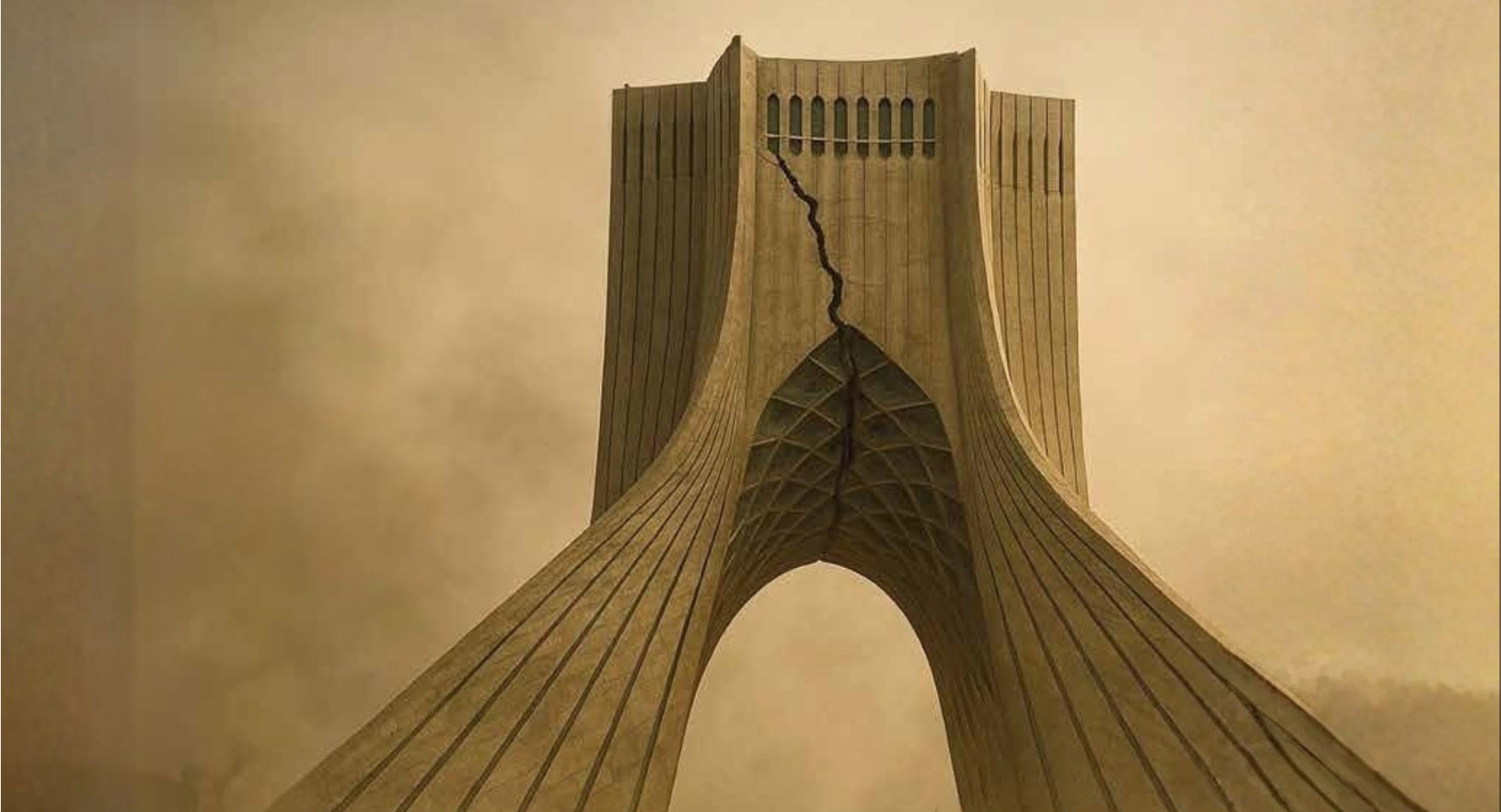
For many years, I have argued that a political system built on internal repression and external confrontation cannot sustain durable legitimacy or long-term strategic credibility. A state that governs through fear at home while exporting instability abroad ultimately confronts the accumulated costs of that contradiction. No system can indefinitely suppress its society while destabilizing its region without eroding its own foundations.
For more than four decades, the Islamic Republic has relied on a dual doctrine: coercion internally and confrontation externally. Domestically, repression has been institutionalized — imprisonment of journalists, systematic discrimination against women, suppression of civil protests, and repeated lethal crackdowns. Externally, the regime projected power through proxy militias, ideological expansion, and calibrated destabilization, even as its own economy deteriorated under sanctions, corruption, and structural mismanagement.
Recent coordinated military operations conducted by the United States and Israel represent more than a tactical development. As Commander in Chief of the United States Armed Forces, President Donald Trump framed the action as a restoration of credible deterrence and a reassertion of red lines long tested. His message to the regime was clear: destabilization will no longer be absorbed without consequence. His message to the Iranian people was equally deliberate — this confrontation is not with Iran as a nation, but with a governing structure whose policies have endangered both its citizens and regional stability.
This recalibration alters Tehran’s cost-benefit calculus. The strategic gray zones within which it operated for years are narrowing, and the margin for escalation without consequence is shrinking.
Tehran’s response reinforced the logic of deterrence restoration. Rather than de-escalating, the regime widened confrontation, directing attacks toward Bahrain, the United Arab Emirates, Qatar, and Riyadh. These actions are strategically revealing. A state that reacts to pressure by striking neighboring countries — many of which have prioritized economic modernization and regional integration — signals unpredictability rather than strategic confidence.
Iran’s regional posture is now more constrained than at any point in recent years. Its proxy networks face sustained pressure. Its economy remains structurally fragile. Its domestic legitimacy has been repeatedly challenged through nationwide protest movements, during which thousands of Iranians have been arrested and many killed. The regime’s reliance on force to silence dissent underscores its insecurity, not its strength.
At this critical juncture, clarity of distinction is essential: Iran is not synonymous with the regime. It is a nation with immense civilizational depth, significant human capital, and a young, educated population that has repeatedly demonstrated courage in demanding dignity and accountability.
Prime Minister Benjamin Netanyahu addressed the Iranian public directly: “You are not our enemies, and we are not your enemies. We have a common enemy: the murderous cult of the ayatollahs.” He urged members of Iran’s security forces to reconsider their alignment and described this moment as an opportunity to establish “a new and free Iran.”
Whatever one’s policy preferences, the strategic importance of this messaging is substantial. It reframes the confrontation as one between governance models — authoritarian expansionism versus accountable statehood — rather than between nations. It challenges the regime’s long-standing narrative that external pressure is an attack on Iranian identity itself.
Recent protest movements inside Iran, particularly those led by women and younger generations, reveal a society that is politically conscious and dynamic. Governments confident in their legitimacy do not rely systematically on lethal repression to preserve authority. Iran’s long-term stability — should responsible leadership emerge — will depend not on ideological rigidity, but on whether political structures align with the aspirations and capabilities of its people.
Whether change in Iran unfolds gradually or through accelerated transition, responsible policymakers must consider what a stable reintegration pathway would require under established regional security principles.
Any future framework must be conditional, sequenced, and compliance-based. Security normalization would require verifiable commitments: cessation of proxy warfare, disengagement from non-state armed actors, adherence to maritime security norms, and transparency in missile doctrine consistent with international obligations. Participation in regional security dialogue would follow measurable compliance — not precede it.
Economic reintegration would need to be phased and benchmark-driven. Sanctions relief or expanded market access would be tied to financial transparency, anti-corruption enforcement, compliance with global banking standards, and adherence to non-proliferation commitments. Regional partners and allies that have aligned themselves with prosperity, integration, and strategic transparency could provide structured channels for gradual reintegration into trade, technology, and investment networks.
The United States would anchor this process within a rules-based financial and legal framework, ensuring predictability, accountability, and adherence to international norms.
Institutional stabilization would be essential. Any responsible leadership in Tehran would need to strengthen governance structures, reinforce judicial independence, and ensure civilian oversight of security institutions. International engagement, if offered, would be technical and performance-based — focused on capacity building rather than political engineering.
Encouragingly, voices within the Iranian opposition have increasingly articulated a vision grounded in constitutional governance, economic modernization, and reintegration into the international system. Figures such as the Son of the former Shah , Reza Pahlavi, who has consistently emphasized secular statecraft, institutional reform, and peaceful transition, represent part of a broader movement seeking to align Iran with global norms of accountable governance. Whether or not any single individual ultimately leads that transformation, the emergence of structured, modernization-oriented leadership is essential if Iran is to move from confrontation to responsible statehood.
Iran now stands at a consequential moment in its modern history. The forces of deterrence, domestic aspiration, and regional recalibration are converging.
What follows will not be determined by rhetoric, but by decisions — in Tehran, by the Iranian people; in Washington; and across the region. This is not merely a period of tension; it is a structural test of governance, credibility, and strategic direction. The objective is the restoration of balance, sovereignty, and lawful order.
The choices made now will shape not only Iran’s future, but the strategic architecture of the Middle East for generations.