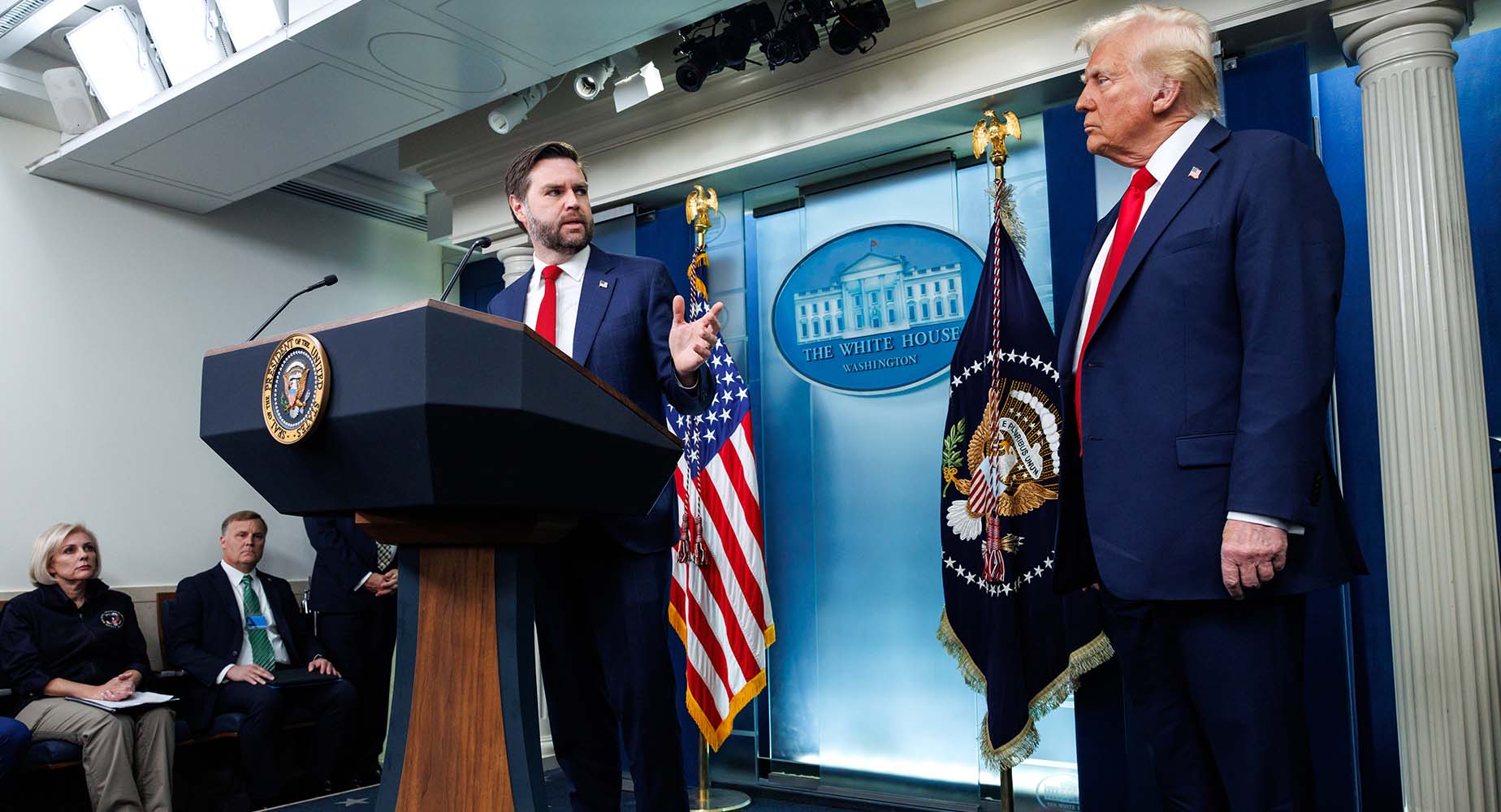
At a moment when the Middle East is once again compelling Washington to confront first principles—how to balance deterrence and diplomacy, force and restraint, leadership and prudence—Vice President JD Vance has emerged as one of the clearest interpreters of President Donald Trump’s foreign-policy vision. What Vance brings is not a break with Trump, but a sharper strategic vocabulary. He has helped frame America First not merely as political instinct or campaign rhetoric, but as a more coherent view of statecraft: alliances must be more reciprocal, diplomacy must be backed by leverage, and military power must remain tied to defined political ends.
What has taken shape through the partnership between Trump’s instinct and Vance’s framing is neither isolationism nor improvisation. It is, increasingly, a recognizable strategic philosophy. At its core lies a straightforward proposition: American power is most effective when exercised with discipline; alliances are strongest when they rest on reciprocity rather than dependency; and military force must serve specific political objectives rather than drift into permanence. In that sense, Vance has become less a policy innovator than a doctrinal interpreter—giving conceptual clarity to impulses Trump has long expressed in political form.
The first principle of this emerging framework is burden-sharing. For decades, the United States has upheld an international order in which many allies grew accustomed to strategic dependence while Washington absorbed a disproportionate share of the military, financial, and political costs of maintaining stability. Trump challenged that arrangement from the outset. Vance has helped explain why that challenge is not simply transactional, but structural.
From this perspective, alliances endure not because they are sentimental inheritances, but because they remain strategically sustainable. Reciprocity is therefore not a secondary matter; it is the foundation of credible partnership. The question is no longer whether the United States should preserve its alliances, but whether alliance systems designed for another era can remain viable if they continue to function on assumptions that no longer reflect strategic reality. The answer suggested by the Trump-Vance framework is that they cannot.
This logic applies most visibly to Europe, where greater responsibility for continental defense is increasingly treated not as an aspiration but as a necessity. But the principle is broader. Across regions, partners are expected to assume a greater share of responsibility for securing their own environments. The United States remains indispensable to the global balance of power. Yet indispensability does not require permanent overextension. Burden-sharing, in this sense, is not merely a negotiating tactic. It is an attempt to recalibrate the alliance system on more durable terms.
A second principle of the Trump-Vance approach might be described as restraint without weakness. Here, too, Vance has helped clarify what is often misunderstood. America First does not imply a rejection of force. It implies a rejection of force divorced from strategy. It rejects open-ended interventions whose original purposes have faded but whose costs continue to accumulate. It questions the habit of equating military activism with geopolitical seriousness.
The experience of the post-Cold War era looms heavily over this critique. Again and again, the United States entered conflicts with overwhelming military superiority but with insufficient political clarity about the end state it sought to achieve. The result was not always defeat in the conventional sense, but something perhaps more corrosive: strategic exhaustion, ambiguous outcomes, and a growing disconnect between American power and American purpose.
That history is central to Vance’s worldview. The distinction he emphasizes is not between strength and restraint, but between strength and drift. Strategic credibility is not measured by the duration of military presence, nor by the scale of deployment alone. It is measured by clarity of objective, proportionality of means, and the discipline to conclude an operation once its political aim has been achieved. In this respect, Vance has supplied a more developed intellectual architecture for Trump’s long-standing skepticism toward what he has often called “forever wars.”
This helps explain Vance’s growing relevance inside the administration’s strategic discourse. Trump’s instincts reflect a broader shift in American public sentiment: a fatigue with underwriting a global order in which commitments widen even as reciprocity narrows. Vance translates that sentiment into a more formal framework—one that seeks to reconcile American primacy with strategic selectivity. Within that framework, diplomacy is not weakness; selectivity is not retreat; and limited force, if clearly defined, may in some cases be more credible than indefinite intervention.
Nowhere is this framework more consequential than in the Middle East. Few regions expose more sharply the perils of both overreach and passivity. On one side lies the risk of strategic entanglement—of tactical responses gradually hardening into permanent commitments untethered from political definition. On the other lies the risk that hesitation invites escalation by hostile actors, emboldens proxy networks, weakens deterrence, and unsettles allies whose security still depends, in no small measure, on American credibility.
The Trump-Vance approach seeks to steer between those two failures. Its underlying premise is that the United States should remain engaged in the region, but on more disciplined terms. The objective is not to reorder the Middle East through sweeping ideological projects or open-ended nation-building. It is narrower and more strategic: to preserve the regional balance, protect core American interests and partners, deter hostile revisionist actors, and ensure that tactical necessity does not evolve into strategic drift.
It is in this context that Iran becomes the central test case. Tactical nuances within the administration may differ, but the underlying strategic proposition is clear and consistent: Iran must not acquire a nuclear weapon. That is the line around which the broader framework is organized.
Within that framework, diplomacy remains preferable—provided it can verifiably eliminate the nuclear threat. But diplomacy without leverage becomes something else entirely: a mechanism for delay, erosion, and strategic evasion. The Trump-Vance view therefore places diplomacy and pressure in deliberate combination. Negotiation is not discarded, but neither is it romanticized. Economic coercion, regional deterrence, political isolation, and, if necessary, the credible threat of force all serve the same limited objective: preventing nuclear breakout without reproducing the logic of indefinite war.
This is where Vance’s role has particular significance. He gives conceptual precision to an approach that rejects both maximalist interventionism and strategic complacency. He frames American power not as a synonym for constant military presence, but as the capacity to shape outcomes, impose consequences, and maintain escalation dominance while keeping sight of the political end state. In the Middle East, that distinction is not academic. It is the essence of strategy.
Seen in this light, America First appears less as a doctrine of withdrawal than as an attempt to restore hierarchy to American foreign policy. It seeks to distinguish vital interests from peripheral commitments, reciprocity from dependency, and achievable political outcomes from ideological overreach. It is not a renunciation of leadership. It is an argument for a different definition of leadership—one grounded less in permanent motion than in strategic discrimination.
On alliances, this means asking more of partners. On military power, it means avoiding both overextension and passivity. On the Middle East, it means combining credible deterrence, sustained pressure, and diplomacy backed by leverage, while preserving the option of limited but decisive action should core security lines be crossed.
In that sense, Vance’s contribution is not to invent a new foreign policy from whole cloth. It is to render an existing one more intelligible. He gives sharper definition to instincts that have long animated Trump’s worldview, and in doing so, he has helped transform America First from a political slogan into something closer to a governing doctrine.
Whether that doctrine will ultimately succeed remains uncertain, as all foreign-policy frameworks are tested not in theory but in events. But one point is already clear: what is taking shape is a deliberate effort to move American strategy away from the false choice between withdrawal and permanent intervention.
The ambition is not passivity, and it is not crusading activism. It is a more disciplined realism—one that seeks to align American power more closely with American purpose.