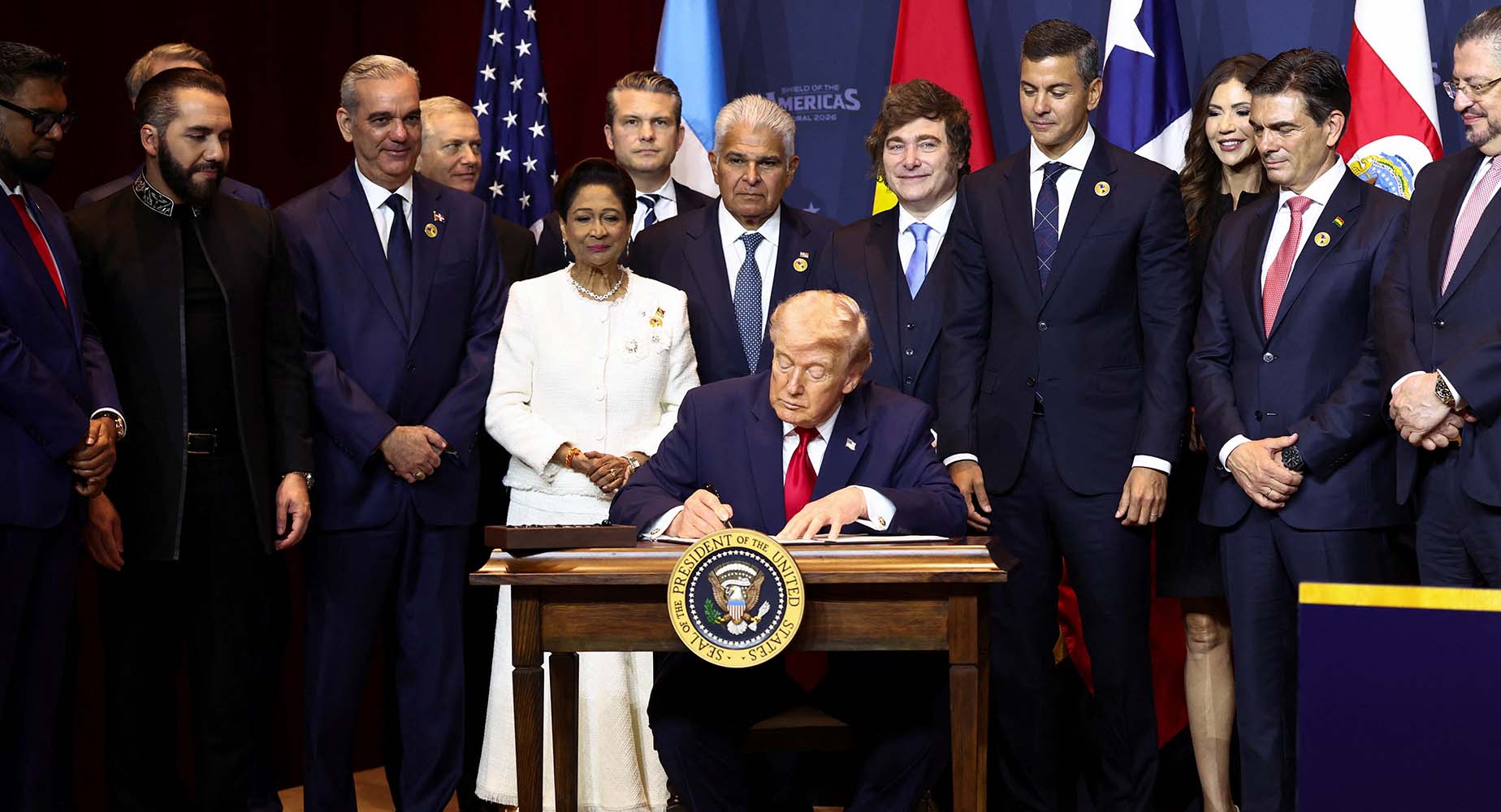
For his Latin American Leaders Summit, President Trump convened a group of like-minded hemispheric leaders in Doral, Florida. The meeting, driven by China’s influence in the Hemisphere, offered a rare opportunity: focused time among partners who understand that strategic competition in our own neighborhood is no longer theoretical.
What is needed is a proposal that aligns capital, supply chains, and institutions in a way that strengthens prosperity and security across the Americas. That proposal could take the form of a Liberty Pact for the Americas. American engagement in the Western Hemisphere has never been continuous or sentimental. It has historically been threat-driven and episodic. When outside powers asserted influence close to home, Washington focused intensely. When those pressures receded, attention drifted elsewhere.
Today that familiar pattern is visible again — but the competitive landscape looks different. China’s presence in the hemisphere is no longer marginal or purely commercial. It is structural and embedded. Chinese firms operate ports, logistics corridors, energy systems, telecommunications networks, and critical mineral supply chains throughout Latin America and the Caribbean. Russia plays a secondary role as a spoiler, but China is the long-term economic competitor.
At the same time, our definition of “hemisphere” must evolve. Greenland, the Arctic, Antarctica, and even Pacific island states far to our west should be part of a broader definition of our Western Hemisphere Homeland that directly affects American security and economic resilience. Shipping lanes, undersea cables, fisheries, energy corridors, and mineral access connect these regions to the North American homeland.
Greenland’s strategic minerals and Arctic shipping routes matter for supply chains. Antarctica’s scientific infrastructure and logistics footprint shape future governance norms. Pacific island states influence maritime access across the broader Pacific basin. Treating these regions as peripheral bureaucratic categories rather than integral components of hemispheric strategy is a mistake.
The competitive challenge is straightforward. Supply chains, energy reliability, digital infrastructure, and access to strategic commodities now define geopolitical power. Where governance is weak and infrastructure underdeveloped, external actors can acquire durable leverage through bundled finance and long-term commercial ties.
The United States must compete — but it must do so intelligently.
Too often Washington oscillates between benign neglect and rhetorical alarm. When engagement occurs, it sometimes defaults to conditional aid frameworks or warnings about what partners should avoid. That approach is insufficient in a world where competition is capital-intensive and infrastructure-driven.
China’s advantage is operational. Its financing is bundled, fast, and tied to delivery. Projects move quickly from announcement to groundbreaking. By contrast, U.S. tools are powerful but fragmented, and our processes are slow.
The Liberty Pact for the Americas would not be a treaty, a military alliance, or a new aid program. It would be a voluntary, investment-led framework designed to crowd in private capital, align incentives, and accelerate projects that strengthen growth and institutional resilience.
The Pact could rest on four practical principles.
First, investment over aid. Sustainable influence flows from productivity, jobs, and growth. Aid can support reform, but it cannot substitute for functioning markets and private sector expansion.
Second, markets anchored by institutions. Investors require regulatory predictability, contract enforcement, fiscal discipline, and transparency. Institutional quality is foundational.
Third, integration as strategy. Nearshoring and regional supply chain integration reduce systemic risk for the United States while creating opportunity for partner countries.
Fourth, performance-based participation. Countries would opt in and advance based on measurable reform and project milestones. The framework would reward results, not rhetoric.
Rather than discussing abstract concepts, leaders in Florida could identify a short list of flagship projects that demonstrate seriousness.
The tools already exist. The U.S. International Development Finance Corporation can provide political risk insurance and credit support. The Export–Import Bank can anchor export-oriented infrastructure. The Inter-American Development Bank brings scale and project discipline. The U.S. Trade and Development Agency can accelerate feasibility work. Enterprise funds can invest directly in growth-oriented sectors.
The issue is not capability. It is coherence and speed.
The Florida meeting should help provide a moment to align these instruments around clear priorities and timelines. Public capital should be used to de-risk projects and mobilize multiples of private investment. Capital deployed strategically can deepen alignment far more effectively than rhetoric.
History suggests that U.S. focus on the hemisphere will not last forever. Global crises will shift attention. This is why events like the Florida meeting matter. They allow leaders to convert episodic focus into durable economic architecture. Competing in the Western Hemisphere does not require matching every external loan dollar for dollar. It requires offering something more sustainable: transparent financing, high-quality standards, institutional strengthening, and integration into trusted supply chains.
The hemisphere does not need another speech about shared destiny. It needs a practical framework that delivers visible results.