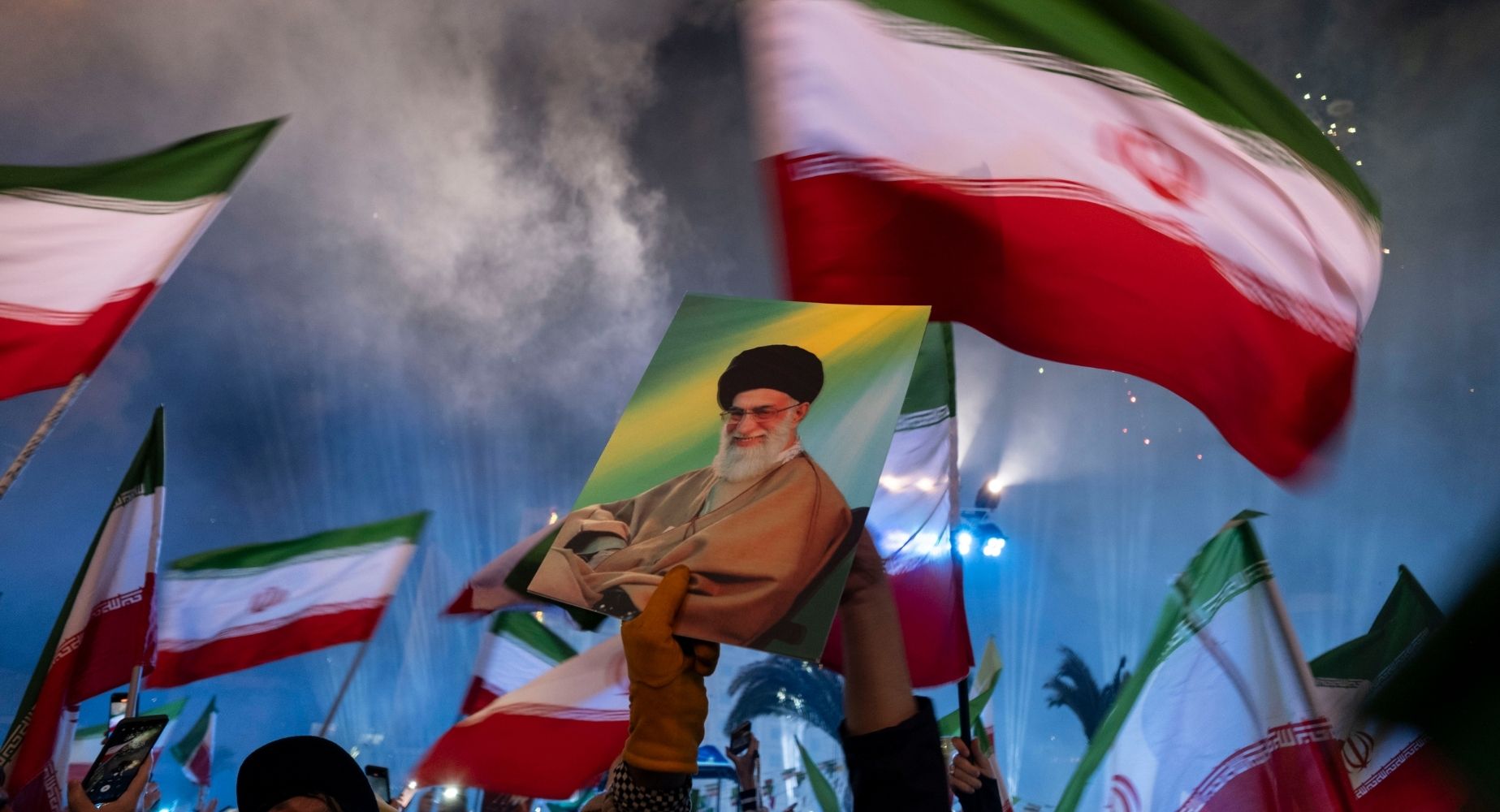
Why the Islamic Republic Survives Crisis, Resists Reform, and Defies Conventional State Analysis.
For decades, analysts have repeatedly misunderstood the Islamic Republic of Iran because they have tried to interpret it through models designed for conventional states. Some view Iran as a rigid centralized dictatorship in which all power flows vertically from a single supreme authority. Others assume that every major crisis — sanctions, protests, economic collapse, military confrontation, or leadership transition — should naturally produce rapid regime disintegration.
Yet Iran continues to defy both expectations.
The reason is structural.
The Islamic Republic is not merely a government in the classical sense. Over four decades, it has evolved into something more complex: a layered survival architecture — a political-security organism built not only to govern, but to endure pressure, absorb shocks, and preserve continuity under permanent confrontation.
The closest metaphor is not a pyramid, but an onion.
Power in the Islamic Republic functions through concentric layers: ideological, military, economic, bureaucratic, clerical, regional, and security-based. These layers are neither fully autonomous nor fully centralized. They overlap, reinforce one another, compete internally, and collectively protect the core of the system.
Every crisis peels one layer away. But beneath it, another layer remains operational.
This is one of the central reasons why repeated predictions of imminent collapse have consistently failed.
Most modern states rely on relatively clear institutional chains of command. Decision-making flows from recognized executive centers through bureaucratic hierarchies. Even authoritarian systems usually remain dependent on a coherent centralized apparatus.
Iran operates differently.
The Islamic Republic gradually transformed itself during decades of war, sanctions, assassinations, internal unrest, and regional conflict. Under constant pressure, the system adapted not by becoming simpler, but by distributing operational resilience across multiple overlapping centers of power. This was not democratization. It was survival decentralization.
The result is a structure in which formal government exists beside ideological authority, elected institutions coexist with security oversight, official economic structures function alongside sanctions-era shadow networks, and diplomacy itself operates beside regional military ecosystems that possess their own logic and momentum.
The Islamic Revolutionary Guard Corps did not simply become a military institution within this architecture. Over time, it evolved into something far broader: a security apparatus, an economic actor, a political network, an ideological institution, and a regional strategic infrastructure at the same time. The IRGC does not merely defend the regime. In many ways, it became woven into every layer of the regime itself.
The Islamic Republic learned early that excessive centralization creates fragility. A purely vertical system can become vulnerable if its command structure is broken. Especially after the Iran-Iraq War, and later under sanctions and international isolation, the regime increasingly developed mechanisms of redundancy and distributed control. Different institutions and networks were given enough operational autonomy to preserve continuity during crisis while still remaining tied to the ideological and security core of the state.
This helps explain why external pressure often produces outcomes very different from those expected in Western strategic circles. Sanctions may weaken one sector while simultaneously strengthening black-market financial systems connected to security structures. Military pressure may damage one command layer while reinforcing ideological cohesion in another. Internal unrest may fracture parts of the political elite while consolidating the security apparatus. The system absorbs shocks unevenly, but it absorbs them.
Each layer protects the others.
One revealing statement came from Iranian President Masoud Pezeshkian before the recent regional escalation, when he remarked that “every governor is a president.” In an ordinary administrative context, such a phrase might simply imply decentralization or local executive initiative. But within the Islamic Republic’s structure, the statement unintentionally revealed something deeper about how power now functions.
Over time, the system cultivated forms of semi-autonomous operational behavior inside the broader framework of regime preservation. Different ideological, security, economic, and regional actors no longer always wait for direct centralized instructions. Instead, many operate according to an internalized understanding of what constitutes “protecting the system.”
This creates a form of distributed “fire-at-will” governance.
Such decentralization increases resilience during crisis. But it also creates structural complications. In highly centralized systems, negotiations or policy shifts can theoretically be imposed from the top. In Iran’s layered architecture, however, even when parts of the state seek de-escalation, smaller but deeply embedded ideological or security actors may possess enough operational capacity to obstruct, delay, or undermine those efforts.
The issue is not merely political disagreement.
It is architectural.
Western diplomacy often approaches Iran as though it were negotiating with a conventional nation-state possessing a single coherent strategic center. But the Islamic Republic increasingly behaves like a layered ecosystem of overlapping power structures in which ideological legitimacy, regional deterrence, sanctions-era economic interests, and security influence have become deeply interconnected.
Concessions on missile programs, nuclear policy, or regional influence are therefore not perceived merely as tactical compromises. For many embedded actors within the system, they are perceived as existential threats to the architecture of survival itself.
This helps explain why moments of apparent diplomatic opening repeatedly produce contradictory signals, internal resistance, or sudden escalation. The structure contains multiple centers capable of influencing outcomes. The onion tightens as pressure increases.
The same misunderstanding appears in Western analysis of Iran’s regional networks. The common framework describes Hezbollah, Iraqi militias, the Houthis, and other aligned groups primarily as Iranian “proxies.” While this description contains elements of truth, it oversimplifies the nature of the relationship.
Many of these networks increasingly function not merely as external allies, but as partially integrated extensions of the Islamic Republic’s broader security architecture. The boundaries between state power, ideological influence, regional deterrence, covert financing, and transnational armed networks have intentionally become blurred.
This ambiguity is not accidental. It is part of the regime’s survival logic.
Financial flows often move through opaque or semi-official channels shaped by sanctions economies and gray-market structures. Regional networks simultaneously serve strategic, ideological, and defensive purposes. These structures are not simply foreign policy tools operating outside the state. In many ways, they have become outer layers of the onion itself.
The Islamic Republic’s greatest strength may also be its greatest weakness. The same distributed architecture that protects the system from rapid collapse also limits its ability to reform, adapt, or strategically recalibrate. A structure designed for survival under siege gradually becomes dependent on permanent crisis conditions.
This becomes especially significant in the context of eventual succession after Ali Khamenei. As leadership transition approaches, various institutional layers — security networks, clerical circles, economic actors, regional structures, and ideological factions — will all seek to preserve or expand their influence within the future order.
Under such conditions, even relatively small actors may possess enough leverage to disrupt negotiations, escalate tensions, or obstruct political restructuring in order to secure their position within the next configuration of power.
The result is a system capable of surviving extraordinary pressure while simultaneously becoming increasingly rigid. Not because it is too centralized, but because it has become too structurally layered to change coherently.
For years, much of the international debate surrounding Iran has oscillated between two simplistic expectations: collapse or normalization. Both frameworks misunderstand the nature of the system.
The Islamic Republic is neither a conventional centralized dictatorship nor a fragile state waiting for immediate disintegration. It is a distributed ideological-security architecture built for endurance.
Understanding this reality is essential not only for diplomacy, but also for any serious discussion of sanctions, regional conflict, succession, opposition strategy, or long-term political transition inside Iran.
Without understanding the structure, policy becomes reactive. Without understanding the layers, analysis remains superficial. And without understanding the architecture of survival itself, both external powers and internal opposition movements risk repeatedly misreading the dynamics of the Islamic Republic.
Before strategy comes structure.
Before solutions comes understanding.