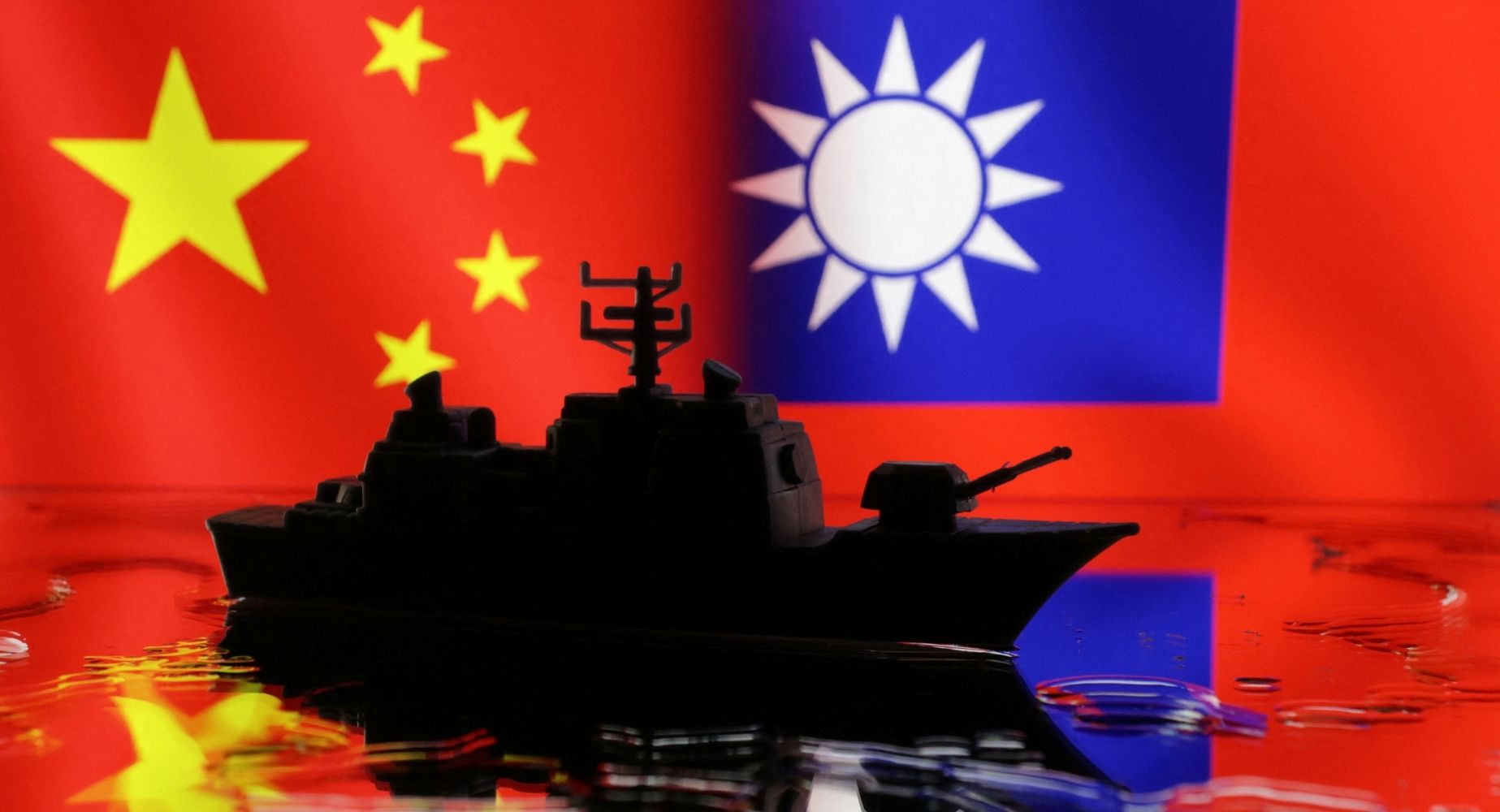
The most dangerous feature of international politics is the claim by China’s communist government, dating from its formation in 1949, that the island of Taiwan, 100 miles from its southern coast, is a rebellious province rather than a sovereign state. In its view, therefore, Beijing has the right to use force to bring the island under its control. A Chinese attack on Taiwan, for which the communist regime has been preparing for years, could bring a military response from the United States and its Asian allies. The ensuing armed conflict between the two strongest military forces on the planet might engulf the entire world and involve the use of nuclear weapons. China’s claim on Taiwan, in short, threatens to start World War III.
That claim is everywhere regarded as fixed and unshakeable, an immutable fact of international life from which the communist regime in Beijing will never retreat. Yet its status as the equivalent, for international politics, of the law of gravity in the natural world, is odd. It is neither well grounded historically nor, especially from the standpoint of China’s own interests, particularly sensible.
For most of mainland China’s long history its government did not control Taiwan, and the current, Beijing-based, Communist regime has never done so. A Chinese annexation of the island might seem to conform to the widely accepted principle of national self-determination, but the people of Taiwan, ethnically Chinese though most of them are, do not wish to be part of the People’s Republic of China and indeed are prepared to fight to avoid this fate. Moreover, not every national group dwells in a single sovereign state. Germans in Austria and Switzerland live contentedly outside the German Federal Republic. So it is with Chinese people themselves: not even China asserts that Singapore, with three-quarters of its inhabitants ethnically Chinese, must join the People’s Republic.
Yet another reason for the oddity of the seemingly iron-clad character of the Chinese claim to Taiwan is that Beijing has no assurance of ever being able to make good on it. True, it is much larger and more populous than Taiwan and commands far more military resources. As a recent article in the journal Foreign Affairs by Dennis Blair, the former Commander-in-Chief of the American Pacific fleet, plausibly argues, however, the Communist regime does not have the capacity to conquer the island at present and its prospects for achieving that capacity in the future are not necessarily bright. Of course, threatening to conquer it may bring some short-term benefits; but making a threat that is never carried out erodes the standing of the threatening party.
Finally, and perhaps most importantly, mainland China stands to gain a great deal by abandoning its claim and establishing formal diplomatic relations with Taiwan. This was not possible at the outset of the People’s Republic in 1949, because Taiwan was occupied by the Communist Party’s opponent in the Chinese Civil War, Chiang Kai-shek’s Kuomintang, which asserted that it alone had the right to govern the mainland. Chiang’s successors abandoned this claim in 1991, clearing the way, in theory, for normal state-to-state ties across the Taiwan Strait. Establishing such relations would remove the cause of a potentially ruinous war. In so doing, it would engender good will for China around the world. It would make the People’s Republic appear far less threatening to its neighbors than it now does. It might give China full access, which it now lacks, to the cutting-edge computer chips that Taiwan manufactures, which would bring it substantial economic benefit.
Chinese recognition of Taiwan thus qualifies, not least for the People’s Republic itself, as the international equivalent of low-hanging fruit. Yet there seems to be no chance whatever that China’s government will pluck it. Why is this so?
A decision to abandon the claim on Taiwan would have to come from the supreme Chinese leader, Xi Jinping, and he appears to have personal reasons for continuing it. This was not true of the two most powerful previous Chinese communist leaders. Neither Mao Zedong nor Deng Xiaoping regarded Taiwan as an urgent matter. Mao is reported to have said in the 1970s that the union of the island with the mainland could wait for 100 years. The two could adopt this attitude because they had political legitimacy that Xi does not possess: Mao from leading the communist takeover of China, Deng from presiding over its economic modernization. They could afford, politically, to defer the Taiwan question indefinitely. By contrast, Xi, who came to power after communist rule was firmly established in China and who inherited surging economic growth – which has slowed during his time in office – lacks their political armor. Moreover, like so many leaders who seek to leave behind them monuments of one kind or another, Xi seems to wish to be remembered in Chinese history as the man who recovered – as he would see it – Taiwan.
Xi will not hold supreme power in China forever, even if, like Mao, he holds it for life. In all probability, his successor will come from the Communist Party, and whatever changes in the policies and governance of the People’s Republic that person may make, with the position as leader will come incentives to maintain the claim on Taiwan. The new leader will be steeped in, and be the product of, communist political culture. Since the time of the first communist dictator, the Russian V.I. Lenin, that culture has eschewed political pluralism and emphasized domination, control, and the use of force to secure both.
The next Chinese leader will also be likely to share Xi’s goal of maintaining the Communist Party’s monopoly of power. The vast police-state apparatus that the Party has constructed over more than seven decades serves this purpose, of course; but to cultivate popular support, and in the absence of the promise of revolutionary transformation that Mao offered and the double-digit economic growth that Deng began, the post-Xi leader is likely to rely, as has Xi, on the nationalist appeal that inheres in the claim to Taiwan. Nationalism of an aggressive kind has become increasingly important to the Party as belief in the precepts of Marxism-Leninism-Maoism, the initial justification for its rule, has all but collapsed.
The Communist Party’s position on Taiwan serves the purpose of self-preservation in another way. Recognizing Taiwanese independence would lend legitimacy to Taiwan’s democratic political system. It would concede, if only tacitly, that Chinese people can govern themselves democratically; and if the people of the mainland were to take that point to heart, this would jeopardize Communist rule there.
From the forgoing analysis it might seem to follow that the end of communist rule in China, unlikely though that may be in the short term, would make possible the abandonment of the insistence that Taiwan is a breakaway province that must be returned to the control of the mainland. Even that development might not suffice, however. A post-communist government of China would have at least two reasons for continuing the Communist Party’s Taiwan policy. First, such a government would be likely to aspire to Chinese primacy in East Asia and beyond. Not only the communists, but also Chiang Kai-shek’s Kuomintang whom they displaced and the Qing dynasty that governed the country from the seventeenth century to the twentieth, both had that goal. Control of Taiwan would pave the way for Chinese maritime supremacy in the western Pacific, which a post-communist Chinese regime, if the past is any guide, might well pursue.
In addition, accepting Taiwanese independence could call into question the inclusion within the borders of the Chinese state of large parts of what is now the People’s Republic. The country’s dominant ethnic group, the Han Chinese, comprise 90 percent of its population, but the homelands of the Buddhist Tibetans and the Muslim Uighurs stretch over more than 40 percent of its territory; and these groups would surely secede from China if they could. Official acknowledgement of Taiwanese independence would only encourage them. The potential loss of that much of the country would probably not sit well with even the most liberal-minded Chinese citizens.
Thus, the Chinese claim to govern Taiwan, despite the dangers it poses and the costs, actual and potential, it imposes on China, has considerable staying power. Recognizing Taiwanese independence, for all the benefits it has the potential to bring, would appear to have no constituency in China. It is decidedly not acceptable to Xi Jinping. It is highly unlikely to be acceptable to his successor. And it may well be unacceptable, for the foreseeable future, to the Chinese people themselves.