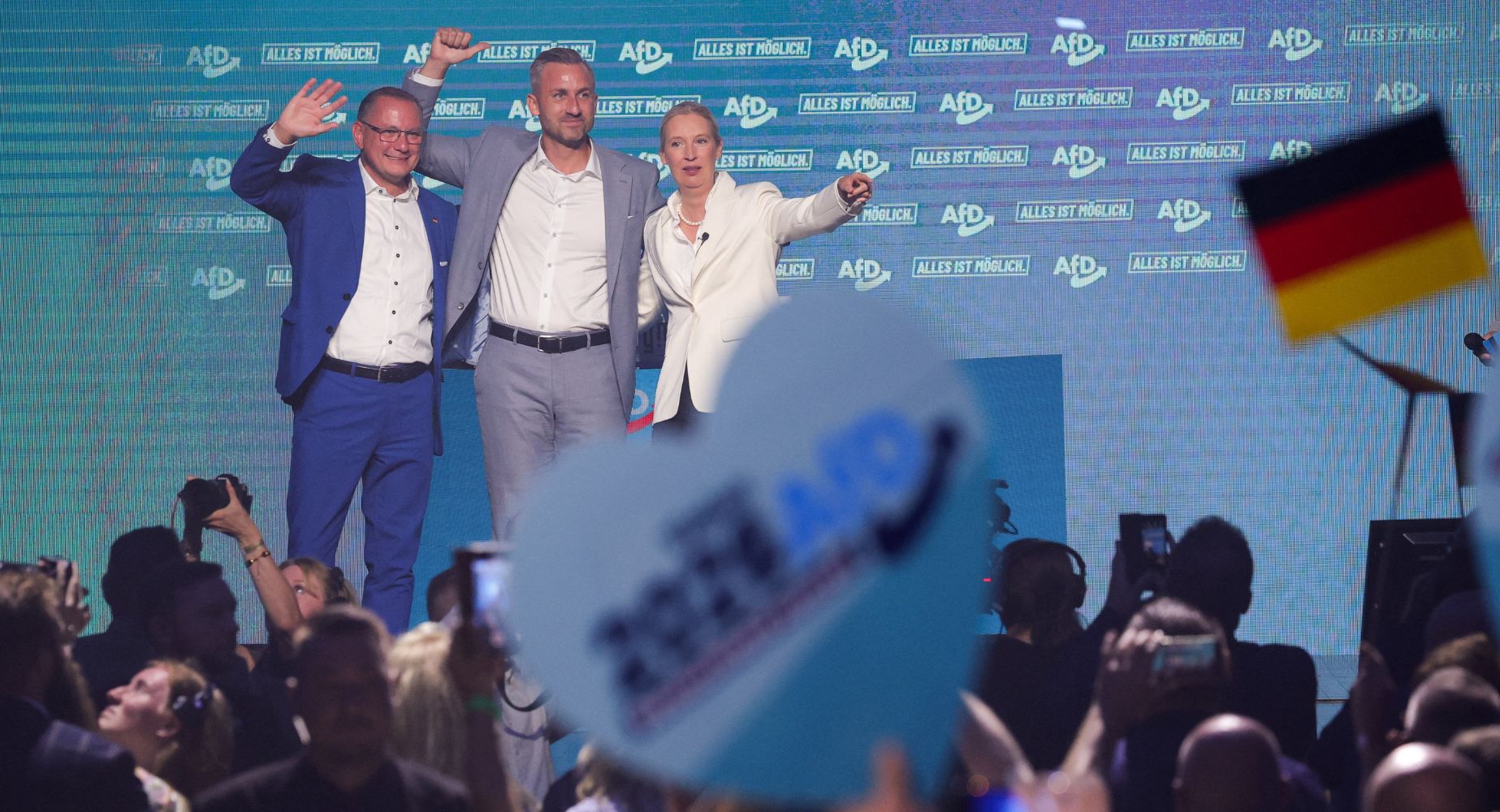
The German left-leaning weekly DER SPIEGEL recently carried a mugshot of Ulrich Siegmund on its cover page with the caption “The Most Dangerous Man in Germany”. Campaigning as the “happy warrior” for the hard-right populist AfD party (Alternative fuer Deutschland) in the state of Saxony-Anhalt, Siegmund cheerfully autographed the SPIEGEL cover, while thousands of his supporters lined up to get a copy. Predictably, the attempt to demonize backfired, almost every second voter cast the ballot for Sigmund. His decisive victory at the polls continues to shock the political establishment in Berlin. For months, the media had cast the state election in Sachsen-Anhalt as a “fateful election” with “Germany’s democracy at stake”. Comparisons to the dying days of the Weimar Republic fueled appeals to “save our democracy”. Even cool-headed political scientists asked aloud whether Germany’s “shipwreck of democracy” could still be averted.
Elections in Germany’s smaller states are usually of secondary consequence; Saxony-Anhalt proved the exception. It is a small, landlocked state of some 2.2 million people, sparsely populated, demographically aging, economically strained, and its infrastructure crumbling. Only after German unification in 1990, Saxony-Anhalt regained its status as one of Germany’s 16 states. Five centuries ago Saxony-Anhalt was the cradle of the Reformation – sparking monumental political turmoil – and bloodshed – in Germany and Europe. Martin Luther lived, preached, and was buried in Wittenberg, a sleepy university town in Saxony-Anhalt. Reportedly, in 1517 he posted his 95 “Reform Theses” at the door of the Castle Church in Wittenberg. This past Sunday its citizens turned out in extraordinary numbers—a record 77 %—to choose their next legislature. Will the AfD’s landslide victory in Saxony-Anhalt once again set off a fundamental realignment of German, and perhaps European, politics?
The AfD was founded in 2013, at first as a conservative, economically neoliberal protest against the Euro and the European Union’s financial-rescue packages, above all for Greece. Its name was no accident: “Alternative für Deutschland” was meant to rebuke Chancellor Angela Merkel’s habitual insistence that her policies were “alternativlos” (without alternative). From the outset the Berlin establishment mocked the party and branded it a danger to German democracy. In September 2013, the young AfD lost the federal elections, winning only 4.7% with no seats in the Bundestag (federal parliament). Then the refugee crisis of 2015 recast German politics entirely. The Merkel government’s decision to admit large numbers of asylum seekers and refugees boosted the AfD to rapid nationwide growth. The “open-border policy” – embraced by Merkel, her CDU, all center-left parties, and much of civil society as a “moral imperative” – became fertile ground for populist grievance. Slogans like “We are the people” and “We want our country back” resonated first across the formerly communist eastern region of Germany.
The breakthrough came in the federal election of February 2025. With Alice Weidel as its candidate for chancellor, the AfD took 20.8 % – almost exactly double its 2021 share – and 152 seats, making it the second-largest caucus in the Bundestag (federal parliament), only behind the governing CDU/CSU group. Today nationwide the AfD polls between 25-30%. The AfD drew heavily on working-class voters in the industrial Ruhr region in the west, at the SPD’s expense; this past Sunday in Saxony-Anhalt the CDU alone shed nearly 100,000 votes to it. The AfD party has, in short, matured into a genuine nationwide catch-all people’s party, with a substantial lower-middle-class and blue-collar base.
The AfD has been transformed in the process. Rivalry and infighting over its policy direction produced a party opposed to immigration, prevailing asylum practice, and multiculturalism – and, more broadly, to what it decries as the erosion of “German identity” (Ueberfremdung). Its program calls for resuming Russian energy imports and lifting sanctions, opposes open-ended military aid to Ukraine, rejects the central pillars of climate policy, and favors less integration within the European Union (EU). It has cultivated a markedly more Russia-friendly foreign policy, mixed with a distancing from NATO, than any establishment party. And there is certainly no denying that neo-Nazis, racists, and homophobes have found a home in its ranks. The party’s harder extremist edge came into full view in Thuringia in 2024, where – under Björn Höcke, whom a German court has ruled may lawfully be called a fascist, as a “value judgment grounded in fact” – it took 32.8 % and became, for the first time, the strongest party in a German state election. This past Sunday in Saxony-Anhalt it went further still, posting its best state result to date. The AfD candidate, Ulrich Siegmund, is likely to become the next Minister-President of Saxony-Anhalt.
So, what happened on Sunday? The AfD doubled its vote to some 44 %, while the CDU – the party of Chancellor Friedrich Merz – was roughly halved, to about 17 %. Far behind trailed the SPD and the Greens at around 9% apiece, the post-communist Left (Die Linke) at a similar level, and the BSW just above the 5% threshold. Forming a government in Magdeburg, the state capital, will take time: every other party has sworn never to cooperate with the AfD, an organization classified as “extremist right-wing” by the Office for the Protection of the Constitution, Germany’s domestic intelligence service.
Is German democracy at risk? To the other parties, the largely center-left civil society, and much of the media, the answer is an emphatic yes. Yet their prescription can be summed up to boycotting and isolating the AfD while expanding the welfare state still further. The leadership of the CDU is still enlisted in that front. The party that dominated West German politics for decades, starting with Konrad Adenauer, resolved formally in 2018 to reject “any coalition or comparable cooperation with the AfD.” Die Linke, heir to East Germany’s communist party, was later added to the list of “untouchables”. Upholding the Brandmauer (firewall) has become official doctrine for the CDU/CSU and every party of the center-left. The refrain “We must not repeat the mistakes of Weimar; we must confront fascists early; defending democracy is a civic duty” now serves as the rationale for shunning the AfD.
And a boycott it has been. Despite its 152 seats, the AfD has been denied every position of consequence in the Bundestag – no vice-president, no committee chairs – and, on a personal level, its members are shut out of most social occasions, down to the parliamentary soccer teams. For any establishment figure, merely being seen “having a coffee and chatting with an AfD member” invites, at the very least, a social-media firestorm. Germans call it a shitstorm.
No issue has polarized the German public quite like the debate about the wisdom and utility of the Brandmauer. That it has already been breached in practice, time and again, is a reality its defenders often prefer to ignore. In numerous small communities and counties, elected AfD office holders have participated in setting local policies, by and large accepted by the traditional parties. Moreover, in the neighboring states of Thuringia (Erfurt, Weimar) and Saxony (Dresden) both CDU Minister Presidents could only form minority governments. Short of forming a coalition, the AfD has been invited to participate in a “consultative mechanism” to develop policies.
Now the overriding urgent question is how to deal with the smashing success of the AfD in Saxony-Anhalt, and the drastic decline of the traditional parties. True, Saxony-Anhalt, with its 1.7 million voters, is not the center of the world, but what chancellor and party leader Merz labeled “the worst defeat in the party’s history” is an unmistakably shrill alarm signal. Moreover, as the election analysis illustrated, the CDU has lost its “competence advantage” to the AfD in every policy field, including economics and national security.
Fortunately, the chorus of voices within the CDU camp rejecting the strict adherence to the “Brandmauer doctrine” is growing. Treating a sizable political opponent like a leper only reinforces a siege mentality. The calls for bans instead of political argument, the refusal to observe the parliamentary rules of the game, the exclusion of candidates for municipal offices — all these moves were mistakes that contributed to the AfD’s radicalization, and also success. “Behind the Brandmauer you can promise anything”, says Christian Stecker, a political scientist at the Technical University in Darmstadt. “It protects them (the AfD) from the disappointment that accountability in a democracy implies”. And “anyone still talking about firewalls has not recognized the signs of the times,” added Michael Kretschmer, CDU Minister President of Saxony, recently.
A leading voice among several intellectuals is Andreas Roedder, professor of contemporary history at Mainz University. He is a CDU member who has helped draft the CDU’s platform and one of the prominent skeptics of the “Brandmauer” framing. Roedder also heads R21, a centrist think tank platform, advocating political reform proposals across the board.
He outright rejects the term “Brandmauer” as emotionally overwrought, implying an “all or nothing” firestorm is imminent. Instead, he prefers cool headed language dealing with right-wing populists and most importantly, addressing of real political problems voiced by roughly one third of the German electorate. Roedder is not arguing for cooperation with the AfD. He insists the CDU must clearly distinguish itself from right-wing populists — but he thinks the “firewall” rhetoric is politically clumsy and indiscriminately lumping together the 25% plus of German voters leaning AfD as quasi- or real Nazis. His call for a change in strategy is convincing: the Brandmauer has pushed increasing numbers of voters away – rather than winning them back.
His alternative can be called “red lines instead of firewalls”. Rather than a Brandmauer, Roedder suggests substantive red lines drawn between what is legitimate and what is not a legitimate policy proposal. Roedder defines those red lines among others: human dignity, protection of democratic institutions, and the rule of law. These principles must never be up for negotiation, nor issues like Antisemitism, Holocaust denial or debates about history initiated only to break taboos for propaganda purposes. All other policy issues, he argues, the CDU should engage in with its own answers on migration, climate, gender policy — instead of ceding those topics to the AfD by refusing to touch them. Underlying Roeder’s proposals is his broader thesis that Germany’s polarization stems in part from a “green-red cultural hegemony” that has stigmatized legitimate conservative positions as far-right, and often as racist. The mature and civil response should be to democratically reintegrate that space as a perfectly legitimate “right-of-center” – rather than demeaning and abandoning it to radicals.
At the core of the German democracy’s dilemma lies the fact that for more than a decade two thirds of the German electorate have been voting center-right. Yet, in response the voters have experienced only governments on the center-left. That’s why large numbers of Germans found their way to the AfD – from all strands of society, in east and west. The Brandmauer doctrine so far has trapped the CDU into compromising its own genuine policy positions, made the CDU the prisoner of forming coalitions only with the left whose own support has become smaller and smaller. Yes, the ECONOMIST correctly observed: “The AfD is among the more extreme of Europe’s populist outfits, many of which shun its company. It flirts with racism and Nazi imagery, has sympathy for Vladimir Putin and harbors former neo-Nazis in its ranks. Its boorish behavior demeans parliaments”. But those who believe that Germany finds herself again in the year 1932, and perceive the AfD as some reemergence of the NAZI party, know very little about 1932. Andreas Roedder: “To this day the AfD lacks key characteristics of the Nazis: the Führer principle, paramilitary violence, belief in a totalitarian state. Whether the party is substantially unconstitutional and anti-democratic – claimed time and again by opponents – remains an open question, untested by the Federal Constitutional Court.”
In any event, the Brandmauer has failed to arrest the AfD’s rise. Within the next few months two more state elections in Mecklenburg-Vorpommern and Berlin are likely to produce comparable results: the AfD will again grow. Chancellor Merz’ popularity has hit bottom. More than 80% of Germans are dissatisfied with his performance governing with his CDU/SPD coalition. Replacing him would serve no purpose, nobody will be able to reign in the AfD. Only a substantial tangible political course correction can do the job. Minority governments with changing majorities may well be the least bad option.