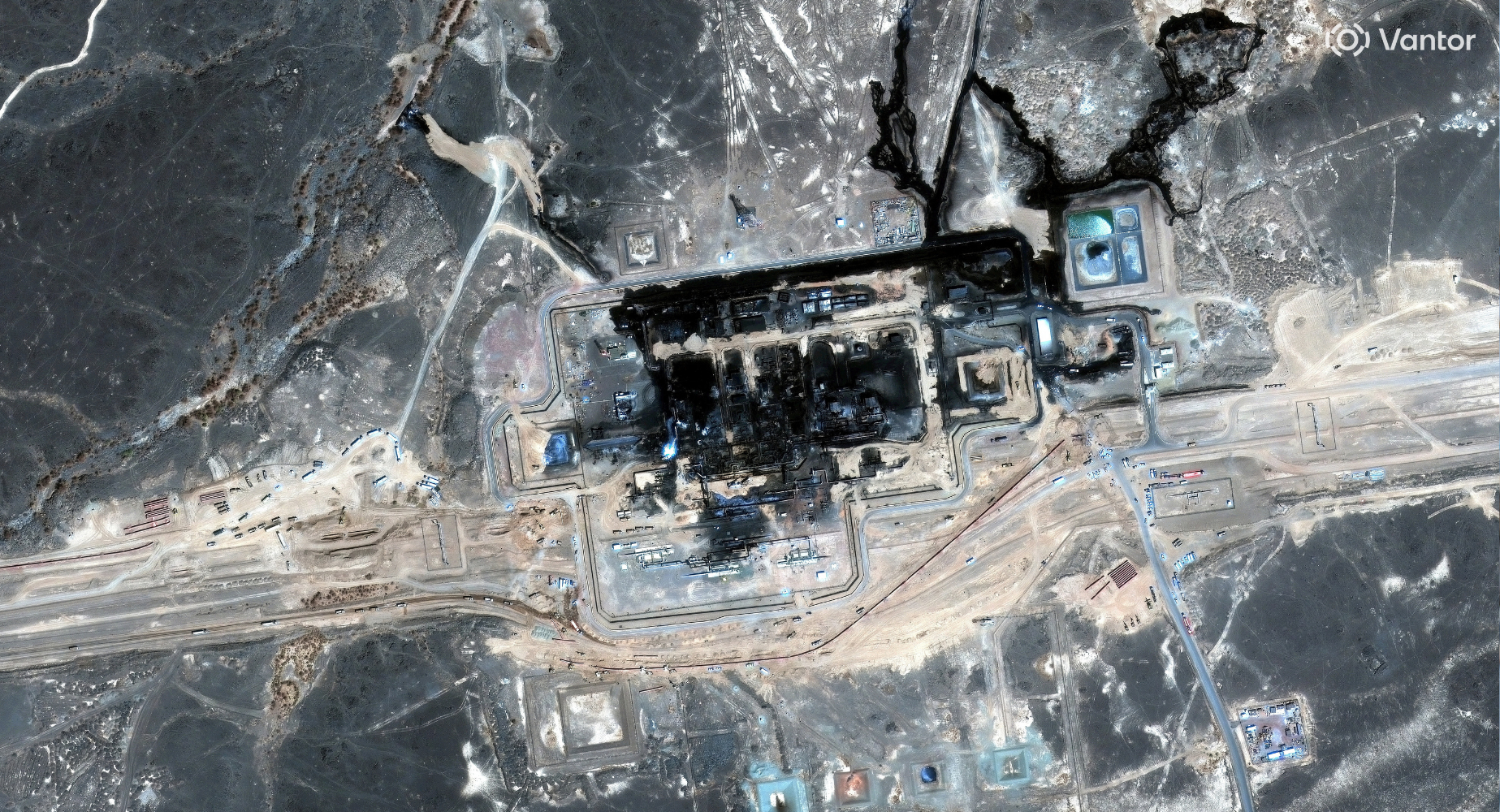
The strike on Saudi Arabia’s East-West oil pipeline represents a major strategic escalation by the mortally wounded Islamic Republic of Iran, carried out through its proxies in Iraq. On Friday, September 11, the Saudi Energy Ministry said the line had been attacked on Thursday morning in the Riyadh and Medina regions and shut “as a precautionary measure.”
The Saudi Foreign Ministry added that several drones coming from Iraq had carried out the attacks, causing injuries and damage that are still being assessed. Publicly available imagery and subsequent satellite analysis showed scorched ground and extensive fire damage at a pumping station near Al Mesba’ah and smoke at another near Al Dhekra, along a stretch southeast of Medina.
Riyadh has not announced a firm restart date. U.S. Energy Secretary Chris Wright said this week that flows could resume in a matter of days and described the shutdown as a brief interruption; other assessments still put a partial restart measured in days and full capacity restoration in weeks — some estimates as long as five to eight weeks — while Aramco has already cancelled or delayed late-September cargoes to European buyers. Until Thursday the pipeline had been transporting roughly four to five million barrels a day—about four to five percent of global supply—on a system designed for six to seven million barrels. Oil, already elevated by the wider war, climbed back above $100. As of Wednesday, September 16, Brent was trading near $107 a barrel after having tested the 108–109 range, with WTI in the low $100s, as the outage continued and Yanbu loadings came under strain.
Who launched these drones is now a matter of official record in Baghdad. Early accounts tied the fires to the Houthis because that group was simultaneously hitting southern Saudi sites and advancing on the Red Sea coast of Yemen. The drones, however, were launched from southern Iraq. The office of Iraqi Prime Minister Ali Falih al-Zaidi said an investigation had traced the origin of the attack to Maysan Province, near the Iranian border; the commander of the Maysan Operations Command was quickly dismissed, and Iraqi forces later said they had seized a launch platform in the al-Tayeb border district. Baghdad also closed several crossings with Iran. Predictably, established pro-Iranian militias in Iraq have denied responsibility; Iraqi sources have instead placed responsibility on small breakaway cells. The episode has exposed how little control Baghdad still has over many armed factions even as the U.S.-led coalition’s remaining presence in Iraq winds down. President Trump, asked in Dublin on Saturday, said Iran was “probably” responsible. That reading fits a clear strategic pattern: militias and cells in Maysan, on the Iranian border, are within long-range drone range of the east-west pipeline, and Tehran has every incentive to hit the one Saudi route that still bypasses the Strait of Hormuz while its Yemeni allies attempt to close the strategic Bab el-Mandeb at the southern end of the Red Sea. Riyadh has said it will not retaliate immediately, instead giving the Baghdad government time to respond.
Hormuz itself is not a sealed door. Before the war it carried about twenty million barrels a day of crude and refined products, roughly a fifth of world oil consumption. Iran’s campaign and the American blockade of Iranian ports slashed maritime traffic far below the old rhythm. What still moves through Hormuz now does so largely because of U.S. naval operations.
Central Command has, since the spring and summer escort effort, assisted well over 1,500 commercial ships and hundreds of millions of barrels along the southern lane hugging Oman, opposite the Iranian shore. Non-Iranian Gulf exports have recovered into the high single digits to low double digits of millions of barrels a day when alternative routes and dark cargoes are counted. Kuwait and the UAE continue to move crude through a mix of Hormuz loadings, discounts, ship-to-ship transfers, and the Fujairah pipeline. Saudi Arabia had been the exception that proved the rule: it cut Ras Tanura loadings through Hormuz for long stretches and shifted the bulk of its exports to Yanbu. The kingdom’s insurance policy was the East-West line, designed for six to seven million barrels a day across the peninsula, with a large share reserved for west-coast refineries and the rest for export. That workaround is viable only if the pipeline itself and Bab el-Mandeb are secure. As of this week, the pipeline is still closed because drones launched from Iraq reached its pumping stations, while the “Gate of Lamentation” is within range of Houthi missiles, drones, and artillery.
The Houthis’ coastal offensive has become a complicated battle on the ground. After taking the port city of Al-Mokha on Thursday, Houthi forces pushed to Dhubab and, on Friday, onto the islands that sit in and beside the strait. Local officials and government sources said the group holds Mayun (Perim) in the middle of Bab el-Mandeb, Zuqar, and—by midweek—Greater and Lesser Hanish islands after government-allied forces withdrew from the archipelago. A military official from the internationally recognized Yemeni government stated that everything previously held on the western coast had fallen. The Houthis announced that maritime navigation would be safe for companies except Saudi vessels.
That exception is the point. Houthi control of the approaches to the Bab threatens Riyadh’s current main oil export route even once the pipeline is repaired. Tankers leaving Yanbu cannot reach Asia or the Mediterranean without passing a narrow strait now flanked by Houthi forces. Ship crossings through the strait dropped sharply after the island seizures.
Displacement figures have risen well beyond the early IOM estimate of about 46,000; later tallies put newly displaced people in the range of roughly 75,000 to 85,000 or more, with more than 500 killed in the recent fighting according to hospital and situation-report counts.
The strategic consequences of the recent fighting go beyond even the issue of Saudi oil exports. The Bab el-Mandeb is the southern end of the Suez Canal trade corridor. Ships from Asia to Europe must enter the Red Sea there before they can reach Suez. About 12 percent of global trade, worth roughly $1 trillion a year, normally moves through the corridor. That volume makes the Bab as important, in systemic terms, as the Strait of Hormuz.
Hormuz remains the world’s oil tap, even in its reduced state. The Bab is the hinge between the Indian Ocean and the Mediterranean. Constrain one and energy prices spike. Threaten both at once, as Iran is now trying to do through its proxies, and container rates, insurance, food shipments, and industrial supply chains are all impacted on a global scale.
These developments are best understood as a desperate attempt by the mortally wounded Islamic Republic to lash out at a key American ally even as it is being strangled in economic terms by the Trump Administration’s naval blockade. The Maysan drone launches and the Houthi coastal advances are two arms of a coordinated strategy. The same American fleet that guides Saudi, Emirati, and Kuwaiti tankers past Iranian guns and missiles has spent months interdicting traffic to and from Iranian ports and, in recent days, hitting the ships that still try to move Tehran’s oil. U.S. forces disabled multiple shadow-fleet and IRGC-linked tankers after Iranian missiles targeted American warships. Iranian crude loadings have collapsed; inventories are piling up because barrels cannot leave. The rial has crashed to record lows near or beyond two million to the dollar on the free market—street quotes this week have been in the range of about 2.3 million rials per dollar. Massive inflation of food and household goods prices has followed. The Islamic Republic is not striking Saudi Arabia merely to demonstrate its strength. It is trying to overturn the regional strategic chessboard out of desperation.
That is why the pipeline strikes and the island seizures should be understood together. The drones were launched from Maysan, not Saada, but the strategic logic is identical. Tehran’s proxies still have missiles, drones, and local manpower. What they no longer have in the same measure is a sponsor flush with oil cash. The best way to remove the danger that the Houthis in Yemen and the Iranian-backed militias in Iraq pose to Saudi Arabia and U.S. regional interests is by achieving the unconditional surrender of the Islamic Republic. Cut off the head of the snake and its proxies will wither. Already Iran’s economic distress has diminished the support it can give the Houthis and its other regional clients. Baghdad’s haste to identify the drone launch site, seize equipment, close border crossings, and fire the local militia commander is important in this regard. Iraq does not want to be held responsible for a war that Iran is trying to conduct via its territory.
The battle raging in Yemen is not one-directional. The forces of the internationally recognized Yemeni government have announced strikes on Houthi vehicles and fighters in Mokha and on the Mokha-Dhubab road, after Saudi aircraft hit Mokha’s airport on Friday.
Yemeni government spokesmen described a “kill box” over the newly contested coast. By midweek they claimed to have retaken ground, even as Houthis launched further missiles and drones at Saudi cities. Inland, government-aligned units have been advancing or maintaining pressure on Houthi forces in al-Jawf, al-Bayda, Taiz, Marib, and parts of Hodeidah and have publicly framed the campaign as a drive on Sanaa. Those columns have been reported as closing distance on inland axes even as the government gave ground on the coast. Government spokesmen now call the fight a “battle for survival.” The bottom line is that Houthi control of the Yemeni highlands is no longer cost-free, and the failing Islamic Republic cannot indefinitely support a militia fighting on several fronts.
The strategic conclusion is clear. Trying to protect the east-west pipeline, Yanbu, and the Bab el-Mandeb by chasing every drone in Yemen or every launcher in Maysan is an unworkable strategy. Naval facilitation through Hormuz has already shown what American power can do when it is applied to the source of the threat. The Houthis and the Iraqi militias are symptoms of a much greater danger: a desperate revolutionary regime in Tehran that uses its proxies to threaten global trade chokepoints and key U.S. regional interests and allies. Increasing military and economic pressure on Iran to the point of the unconditional capitulation of the Islamic Republic is the best way to defend U.S. allies and interests in the Gulf and the Red Sea. Echoing Cato the Elder’s stance on Carthage, one might say today, “Regimen Iranicum delendum est.”