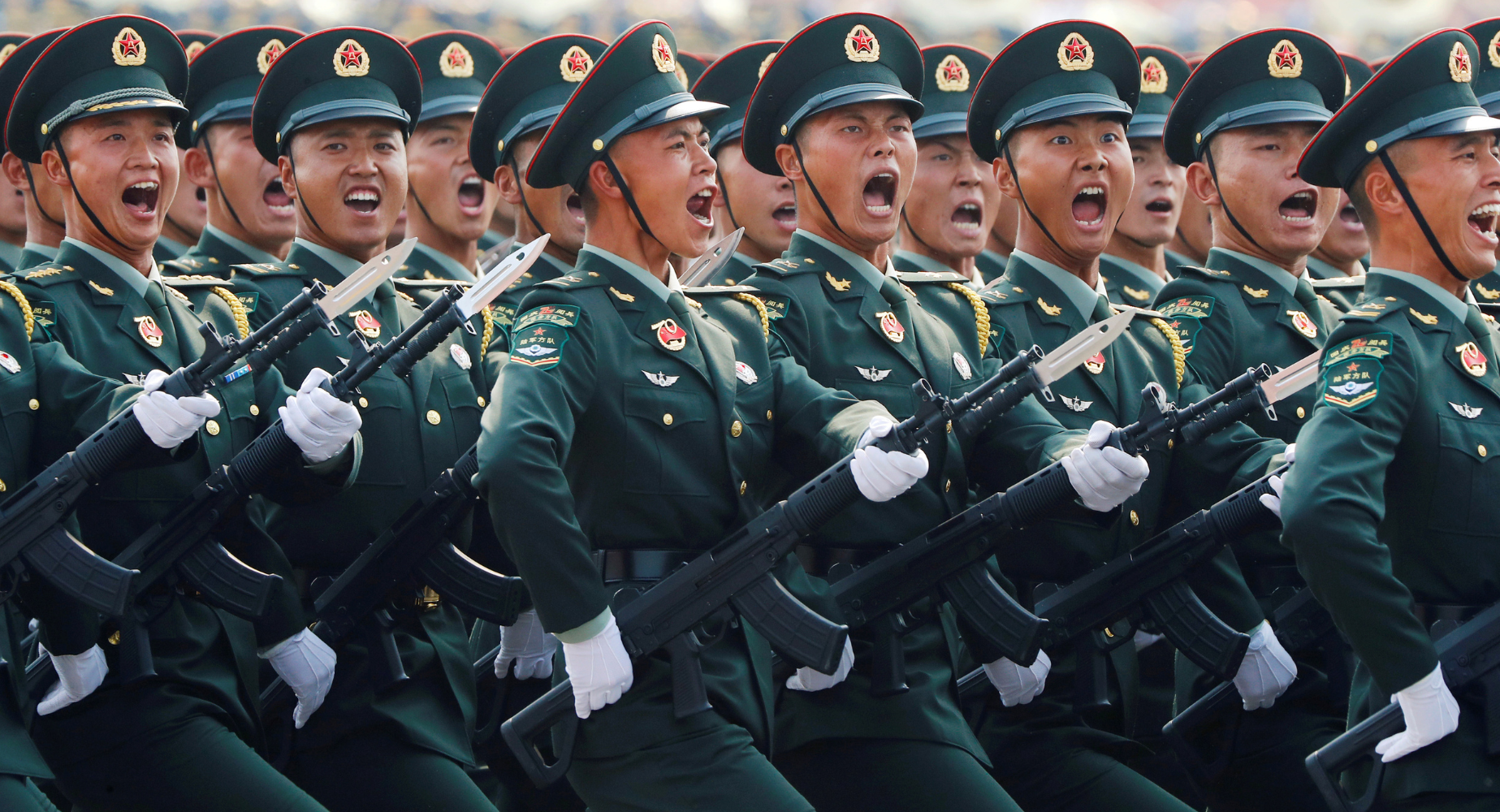
How loyalty over truth hollowed China’s military and turned equality into a system of control.
The survival of a totalitarian system hinges on a simple inversion: loyalty replaces truth. Once that shift locks in, institutions no longer chase reality—they chase alignment. Whether in the barracks of the People’s Liberation Army or the corporate and bureaucratic hierarchies of China’s cities, competence is filtered out, autonomy is constrained, and performance is sacrificed to obedience.
This isn’t a passing glitch. It is the governing logic. Over time, it produces a system that looks formidable on paper but is structurally prone to miscalculation—militarily and socially.
The Loyalty Trap
Xi Jinping’s purges in the PLA—senior officers removed—are framed primarily through anti-corruption and disciplinary campaigns, but they serve a deeper function: alignment. In centralized systems, “corruption” can overlap with something more politically dangerous—independent judgment. When a senior general is removed, the institutional message becomes clear: survival depends on agreement, not accuracy.
Officers internalize it quickly. Reports are shaped before they move upward. Risks are softened; failures are contained. The report that confirms expectations survives; the one that challenges them does not. A command culture takes shape where readiness is declared rather than tested, and problems arrive at the top pre-filtered. Risk assessments reflect what is acceptable, not what is real.
Corruption persists because it does not necessarily threaten power. Truth does. The result is a leadership increasingly insulated from reality, operating with high confidence but limited verification.
China’s military modernization is real—more ships, more missiles, more integrated systems, and a shifting balance across the Taiwan Strait. But modern war is not decided by inventory. It depends on coordination, logistics, adaptability, and honest internal feedback. A system that filters truth struggles to sustain these under pressure, and the symptoms are already visible: procurement corruption, disruptions in senior command, and open questions about readiness. U.S. intelligence assessments reported by Bloomberg found that some Rocket Force missiles had reportedly been fueled with water rather than propellant, and that silo lids in parts of the force failed to function properly—details cited among the factors behind the 2023 purge of the defense minister and Rocket Force leadership. These are not merely personnel problems. They point to the structural danger of a system that rewards alignment over accuracy.
Russia demonstrated the danger of this pattern in Ukraine. The comparison is not one of military equivalence; China is not Russia, and the PLA is not the Russian armed forces. The relevance lies in the institutional mechanism. Russia entered the invasion with assumptions that depended on a rapid operation and the seizure of Kyiv, while subsequent analysis identified a military culture that incentivized dishonest reporting. The result was not immediate military collapse, but strategic miscalculation at scale. Capability existed. What failed first was the system’s ability to assess reality accurately.
That distinction matters for China. Its risk is not simply weakness, but misperception. A leadership insulated by its own reporting may overestimate its readiness and underestimate the complexity of war. The greater the military capability, the more consequential such misperception can become. Systems do not just lose this way—they misjudge before the conflict fully begins.
Equality Without Autonomy
The same logic extends into society. China presents gender equality as a success: high participation, strong representation in education, and formal legal protections. But this equality is conditional. It operates within limits defined by the state.
Women are integrated into the system, but not fully autonomous within it. In practice, participation is high, yet gender pay gap persists; representation exists, yet leadership remains male-dominated; legal protections exist, yet enforcement is uneven.
This is not a contradiction. It is design. The system does not grant autonomy; it grants participation within boundaries.
In rigid hierarchies where accountability is selective, power extends beyond formal roles. A bureaucracy of consent emerges in many workplaces, where authority shapes access—promotions, contracts, and opportunities. Under these conditions, refusal carries consequences. Consent becomes conditional, shaped by imbalance rather than free choice. The outcomes are consistent: underreporting of harassment, reputational risks for those who speak, and informal systems that override formal protections. The law exists, but using it can be costly. Silence becomes rational.
The same structure that discourages officers from reporting failure discourages individuals from challenging authority. In both cases, the cost of truth exceeds the cost of compliance. Military distortion and social control do not produce identical consequences, but they emerge from the same institutional mechanism: the suppression of truth when truth threatens hierarchy. In the military, it distorts information moving upward; in society, it constrains agency moving against power. Suppression at the top reproduces itself across levels—from command structures to bureaucracies to workplaces—not because every institution functions identically, but because the same hierarchy of incentives teaches people what can safely be said, challenged, or refused.
The result is a widening gap between perception and reality. Military capability is overstated. Equality is overstated. Leadership confidence rests on filtered information. This gap does not collapse immediately. It can persist precisely because the system remains functional enough to sustain it. It stabilizes—until reality intervenes.
Taiwan’s Strategic Resilience
Taiwan operates under a fundamentally different structure. Its institutions are not designed for the silence of alignment, but for the noise of correction. This does not mean Taiwan is free from bureaucratic failure, political pressure, military weakness, workplace inequality, or institutional error—democracy does not eliminate distortion. Its advantage lies elsewhere: it creates competing channels through which distortion can be exposed and challenged.
In Taipei, military assessments are not just reported; they can be publicly contested. Policies are not merely issued; they are stress-tested by a free press, political opposition, and an independent legislature. Social issues—from labor conditions to harassment—can move through legal mechanisms, public debate, and grassroots activism rather than being absorbed into a single state narrative. Taiwan’s #MeToo movement is a concrete example: after the movement exposed deficiencies in existing protections, the legislature passed amendments in 2023, including stronger provisions addressing abuses of power.
This is the strategic power of a liberal order. It produces feedback, one of the most critical assets in a volatile world. Feedback is not a moral ornament; it is a tactical weapon. The significance of openness is not that democratic systems always reach the correct answer—they do not. It is that error can encounter opposition before it becomes orthodoxy.
Systems that allow uncomfortable truths to circulate possess mechanisms for adaptation that systems built around political alignment progressively weaken. Correction may be noisy, slow, embarrassing, and politically costly. But the noise itself carries information. While the CCP uses authoritarianism to control the economy and society, that control can create a form of brittle strength: powerful in mobilization, but vulnerable when assumptions prove wrong. Taiwan’s democracy, by contrast, depends on a more flexible strength—the capacity to absorb criticism, expose failure, and alter course without treating correction itself as disloyalty.
The difference is functional before it is ideological. One system filters reality to protect the hierarchy; the other permits competing institutions to contest reality in order to correct it. Neither is immune to failure. But only one makes disagreement a legitimate part of the system.
How Systems Learn to Lose
The art of losing is not formed on the battlefield. It is built earlier—in promotion systems that reward conformity, institutions that penalize dissent, and cultures where loyalty crowns all. China’s system remains a formidable machine of mobilization, but it is a machine without a check-engine light.
That is precisely why its strength should not be underestimated—and why its vulnerabilities should not be measured only in ships, missiles, economic output, or personnel. A system can accumulate power while simultaneously degrading its ability to understand how effectively that power can be used.
The CCP’s model assumes that truth can be managed. But truth that is managed eventually becomes information that is distorted. As the gap between state perception and ground reality widens—militarily, economically, and socially—the system moves from a state of equilibrium to a state of risk. Liberalism’s greatest advantage is not that it avoids mistakes. It is its capacity for self-correction. Authoritarianism’s greatest flaw is not that it is always weak. It is that its concentration of authority progressively raises the cost of admitting error, until the system begins to require something no political order can sustain: perfection.
Loyalty over truth does not immediately weaken a system; it distorts it. For a time, power can conceal that distortion. Institutions continue to function, armies continue to modernize, economies continue to produce, and official measures continue to signal confidence. But reality is not required to respect the narrative.
And when accumulated distortion finally meets reality—whether in war or in society—the system that has trained itself not to hear correction discovers the cost of loyalty too late. It does not adjust. It reacts.