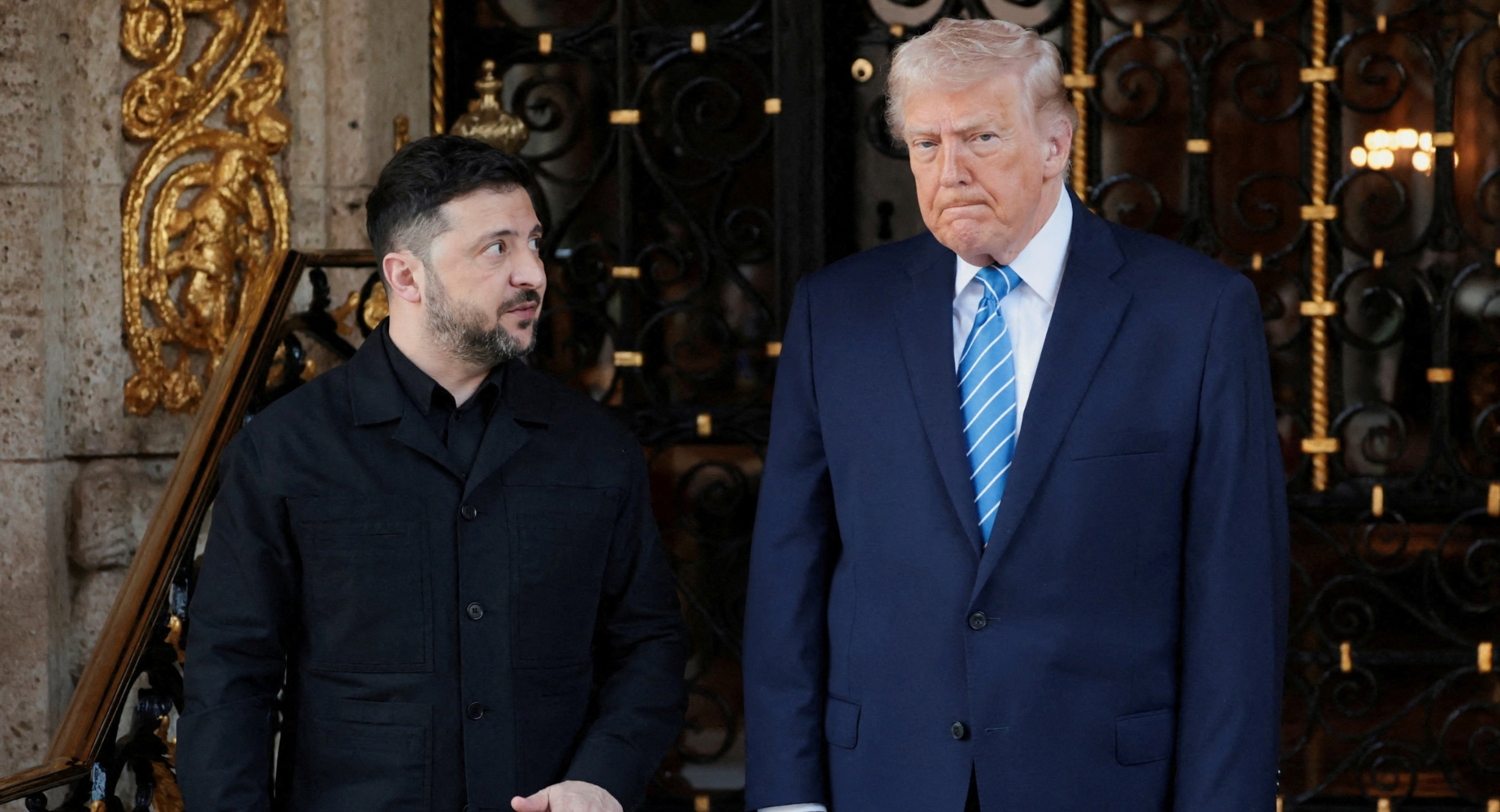
Steve Witkoff and Jared Kushner, President Trump’s go-to negotiators, recently returned from another round of discussions that aim to bring an end to the Russo-Ukrainian War.
It was Witkoff’s eleventh meeting with Vladimir Putin and his first with Ukrainian President Volodymir Zelensky. It likewise was Kushner’s first trip to Kyiv.
Both Putin and Zelensky characterized their respective meetings with the American duo in polite terms. Putin called the talks “highly useful” while Yuri Ushakov, his exceedingly shrewd senior national security advisor and former ambassador to Washington, stated that Witkoff and Kushner “outlined a number of ideas regarding possible avenues for a settlement” without detailing what those ideas might be. For his part, Zelensky claimed that he and the two American envoys discussed “all possibilities” including several genuinely new ideas.
Nevertheless, all that both leaders agreed to was nothing more than to resume the talks that had stalled six months ago, with the United States serving once again as a go-between. When that resumption might take place, and under what conditions, however, has yet to be determined.
In any event, whenever the talks finally do commence, they may prove to be of no great significance. That at least is the view of the current and former top Finnish officials and experts whom I met during a trip to Helsinki shortly after Witkoff and Kushner returned home from their talks.
Finland’s leaders have long been especially sensitive to developments in Moscow. Once a Russian grand duchy, after achieving its independence in 1917 the country fought twowars in the twentieth century against the Soviet Union. Because Finland was allied to Nazi Germany in World War II, Joseph Stalin considered, but then decided against, seizing the country as he had the Baltic states in 1940.
Instead, he forced Helsinki to accept an uneasy and nearly subservient neutrality in the war’s aftermath that lasted for decades. Finland only truly gained unfettered freedom of action when the Soviet Union collapsed.
As a result of its having joined NATO in April 2023, Finland’s roughly eight-hundred-mile border with Russia is now the alliance’s longest. It has been the victim of Russian hybrid warfare.
Not surprisingly, Helsinki brings a special perspective when analyzing developments in the
Kremlin.
It is the unanimous opinion of all with whom I met that Putin will not compromise with Ukraine. They are convinced that he will continue to fight because he believes that he will win the war. Several added a second reason: he will continue to fight because he believes that Washington ultimately will force Zelensky to give up at least Luhansk and Donetsk, the two eastern Ukrainian oblasts much —though not all—of which Russia has occupied since 2014.
As one of Finland’s former leaders pointed out to me, after consistently denying that Russian forces had invaded the two oblasts, on one occasion he inadvertently blurted out to that person that “his” troops took them. And, as Putin has made clear regarding Crimea, which Moscow has illegally annexed, he will not give back what he has taken.
Moreover, Putin remains unmoved by the staggering losses his forces are suffering, now amounting to about 40,000 killed or wounded monthly. Nor does he appear especially responsive to Russia’s increasingly dire economic situation.
Like many European officials who have dealt with Putin, the Finns who know him personally note that he combines an idealistic obsession with restoring the Great Russia of the Czars with the ruthless methods of the KGB, his former employers. One former senior leader told me that Putin pores over old Russian maps to determine where the Empire gained territory and where it lost it. Another former official who had served as Finland’s ambassador to Moscow recalled that in order to have personal access to the maps as well as Czarist treaties, Putin moved the national archives from their home in the Ministry of Culture to the presidential office.
A top former official who also has met Putin several times noted that Putin, like many Russians, has a strong sense of grievance against the West in general and the United States in particular. Since he is incapable of finding fault with his own policies, he truly believes that despite assurances that it would not interfere in Ukrainian politics, it was the West, led by Washington, that prompted the February 2014 Maidan Square upheavals. Putin likewise resents America’s disrespect of Russia in the aftermath of the Cold War, especially Barack Obama’s dismissive remark that Russia merely was merely “a regional power that is threatening some of its immediate neighbors not out of strength but out of weakness.”
Because they are convinced that Putin will not yield at all, the Finns with whom I met are uncertain how he might respond if Ukraine not only continues to fight against what Kyiv rightly considers to be an existential threat, but further expands its attacks on Russian infrastructure and military targets. All agree that Russia will retaliate at least in kind and will ramp up the nature of its attacks on Ukrainian targets. They are deeply concerned, however, about the possibility that if he sees himself cornered, Putin will resort to a tactical nuclear attack on Ukraine. Several of my interlocutors asked if, and equally important how, Washington would respond if Putin were to unleash such an attack on Ukrainian territory. It is a question that weighs heavily in Helsinki.
Putin’s obstinacy should not prevent Trump’s negotiators from working to bring the war to an end. It is always a mistake to postulate that a given situation can never change. After all, no one predicted the imminent fall of the Berlin Wall; the dissolution of the Warsaw Pact; and the collapse of the Soviet Union. But in the meantime, at least according to the Finns, the five-year war could on for quite some time, certainly into a sixth year and perhaps even a seventh.