As an international megaproject, AI is achieving what decades of diplomacy could not.
In the United States and many other countries today, AI is developing a bad rap. Propagandists are using the technology to flood the information commons, while autocrats supercharge state surveillance. A mounting obsession with digital sovereignty risks further fragmenting the internet into algorithmically curated tribes. The pessimists are not wrong to point out AI’s significant risks. But they have mistaken a hazard for destiny—and in doing so, they have missed the most consequential diplomatic story of the modern age.
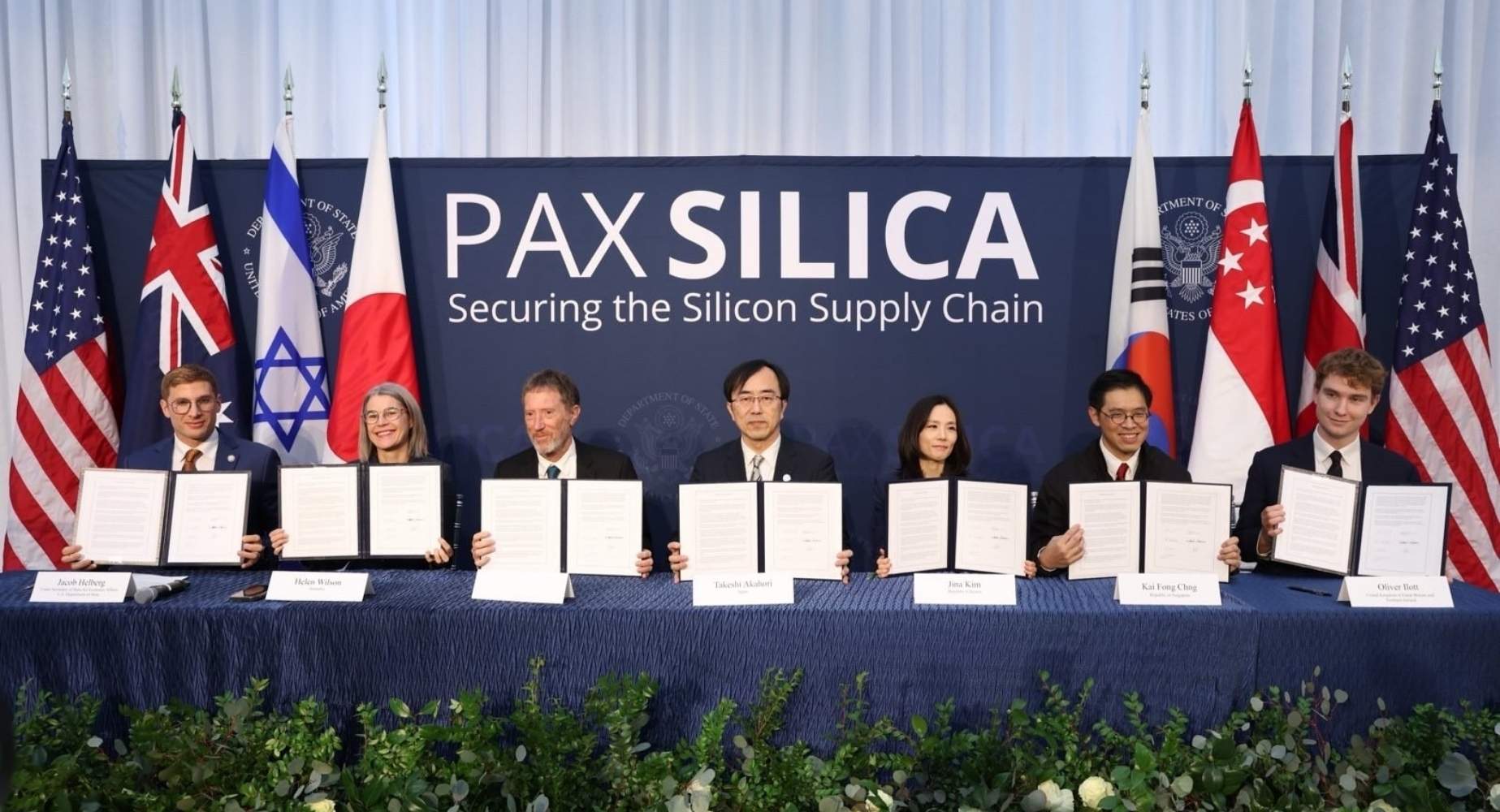
Within a single 48-hour period in January, Israel and Qatar acceded to the same American-led diplomatic framework: Pax Silica, a coalition organized by Under Secretary of State Jacob Helberg to secure the supply chains that underpin AI’s development. It was a remarkable feat. After decades of shuttle diplomacy struggled to put Jerusalem and Doha at the same table, the economics of AI had managed to effectively fast-track a sort of diplomatic normalization, by granting both governments equity in a project larger than the Levant.
International collaboration is an indelible feature of the physical AI supply chain. No country commands the full stack of technical inputs required to unlock superintelligence, or even serve today’s AI models to billions of monthly active users. The United States may design the world’s most advanced chips and produce its frontier AI models, but U.S. labs depend on Taiwan to manufacture them, on South Korea for high-bandwidth memory, on the Netherlands for lithography, and on Japan for specialty chemicals used to print circuit boards. The Gulf states bring energy and capital; Australia and Nordic states bring rare minerals; and Israel brings a robust chip design ecosystem that will sustain global innovation.
Fifteen countries have signed the Pax Silica declaration since December, with Taiwan formally endorsing its principles through a creative diplomatic arrangement of its own. It is billed as a “coalition of capabilities,” designed to give countries with little else in common a shared project—and a stake in one another’s success. Qatari capital, Israeli engineering, Filipino assembly, and Norwegian sovereign wealth are today all contributing to a shared technology stack. Fort Foundry One, the flagship semiconductor facility now planned in Israel under a 99-year lease, is a prime example of a project spanning the efforts of a dozen nations.
Skeptics will note that commercial interdependence has failed to live up to its promise as an international peacemaker. The difference is that AI is not merely an industry, but a discrete megaproject—one whose fate is shared, and steered, by each hand contributing to its production. The trillions of dollars already committed to global data center buildouts are sure to transfigure entire economies. Yet this investment is fully interdependent with the billions spent scaling up the production of switchgear manufactured in Germany, fiber optic cables made in Japan, and dozens of other supply chains spanning the industrial world.
There is a second reason to believe AI’s ties will bind: A decades-long engineering project is more resilient to disruption, and harder to dial back, than standard commodities trade. A country that builds its digital infrastructure on American chips, American cloud platforms, and American models is not merely trading with the United States, but embedding itself in an ecosystem with switching costs that persist for decades, alongside every other country that made the same choice. Once built, silicon bridges are hard to burn.
But infrastructure is only half of the assignment. The pessimists’ nightmare—AI as an engine of autocratic repression or social division—will come true by default in societies that import the technology without an adequate civic immune system. And so, at the same time they collaborate to engineer physical infrastructure, free and open societies will likewise embed shared values as an enduring source of geopolitical power. Some, though not all, of the partners collaborating to build AI will share an interest in establishing content provenance standards that let citizens verify what is real, or boost AI literacy for students and educators. Still others will see value in designing products that reject censorship—giving rise to AI models that will argue fluently and honestly in Arabic, Hebrew, Hindi, and Tagalog.
The divisive uses of AI are not evenly distributed across political systems. Whereas AI models developed independently in autocracies are sure to help governments filter speech and harden instruments of state repression, there exists a vast, global market for tools that put capabilities in the hands of individuals—as tutors for underserved students, encrypted communication channels for dissidents. In the age of AI, the task before likeminded democracies is to ensure that market remains well-served—by pooling resources to build technology that liberates power instead of concentrating it.
None of this is guaranteed. If Pax Silica’s signature projects do not convert into steel and silicon, the coalition could deflate optimism in American leadership instead of making the case for collaboration. Rising energy costs and the impulse to own every facet of AI’s development could derail promising leads. And a Washington that treats partners as vassals rather than stakeholders will generate exactly the backlash a multilateral megaproject cannot afford.
The choice before the United States and its partners is coming into focus. AI will sow division wherever its diffusion is left to adversaries and accident. It will build bridges wherever America organizes the building—deliberately, generously, and with the confidence that a technology born of free societies, deployed through coalitions of free societies, will carry their values with it.