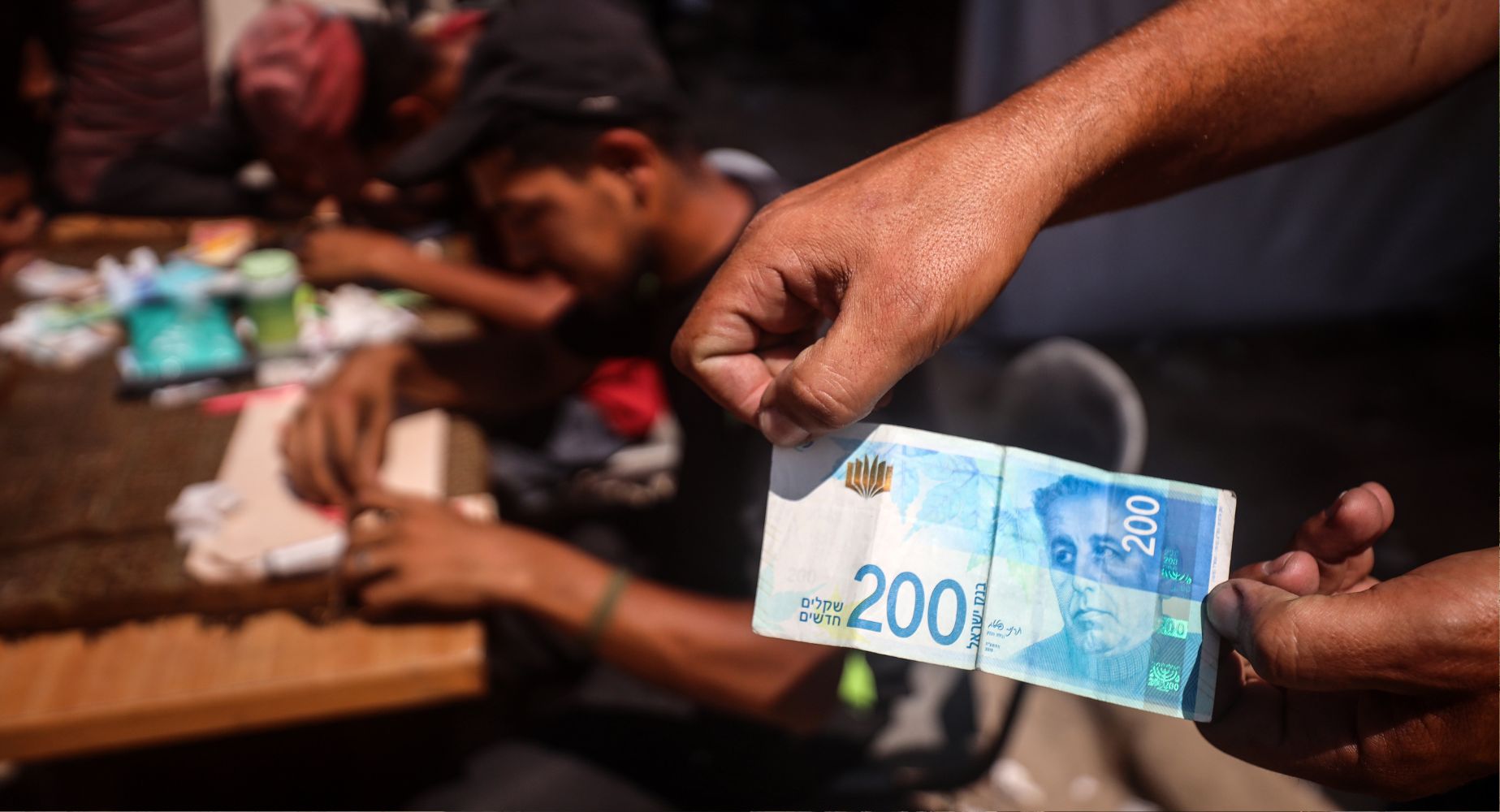
The September 2026 elimination by the IDF of two Gaza-based money changers, Jabr Moqbel, head of the Moqbel currency-exchange network, and, days later, Shadi Abu Hasira, a central money changer in Hamas’s military wing who ran the Geneva exchange network, highlights an important reality: Hamas’s financial system is under sustained pressure, but it remains functional, adaptive, and internationally connected.
The Israeli campaign against Hamas’s finances has degraded senior personnel, disrupted exchange networks, frozen assets, sanctioned front organizations, and reduced the terror organization’s ability to move money openly. Yet Hamas has retained access to a mix of overseas support, including major financial backing from external state sponsors like Iran, commercial cover, informal banking, domestic taxation, coercion, charity-linked fundraising, and limited cryptocurrency channels.
Hamas does not depend on a single treasury, bank, donor, or route into Gaza. Instead, it operates a distributed financial architecture: money is raised abroad; concealed through businesses, charities, trading companies, and investment structures; moved through informal value-transfer systems and currency-exchange houses; converted into cash, goods, salaries, weapons inputs, and political patronage; and replenished locally through coercive control of Gaza’s economy. The recent Israeli campaign has struck one of the most operationally relevant layers of that system, the local mechanisms that convert foreign funding into usable cash inside Gaza. But the wider architecture has not been eliminated.
The latest strikes
On September 25, the IDF and Shin Bet announced the targeted killing of Jabr Moqbel in Deir al-Balah, in the central Gaza Strip. According to the IDF, Moqbel headed the “Moqbel” currency-exchange network, which transferred millions of shekels in foreign currency to Hamas. The military said the funds supported payments to operatives, restoration of military infrastructure, and terrorist activity against Israeli forces and civilians.
On September 27, Israel eliminated Shadi Abu Hasira in Gaza City. The IDF described Abu Hasira as a central money changer in Hamas’s military wing who ran the “Geneva” exchange network, which moved tens of millions of shekels in foreign currency to Hamas. Abu Hasira also ran Gardena Professional, a Gaza commercial company that Israel said facilitated his transfer activities.
These strikes formed part of a wider campaign. On September 25, the IDF and Shin Bet said that 16 Hamas operatives involved in money exchange and the transfer of funds had been killed over the course of the war. Israel assessed that the network they managed moved more than $1 billion for Hamas’s military activities through dozens of money changers in Turkey and Gaza.
Among the figures named by Israel were Ibrahim Abu Shamala, described as the financial chief of Hamas’s military wing; Mohammed Abu Alwan, identified as responsible for funding Hamas’s political wing; and Khader Jamasi, Ihab Khraizem, and Hussein Qadra, who allegedly managed the receipt, offsetting, and onward transfer of funds.
The practical significance is substantial. A money-exchange network does more than hold funds: it connects external donors and facilitators with cash inside Gaza, bypassing the banking system and creating liquidity that can be used for salaries, procurement, bribes, smuggling, weapons restoration, and payments to operatives. Eliminating personnel at this level raises Hamas’s transaction costs, slows the movement of funds, exposes commercial cover entities, and forces Hamas to rebuild trust-based financial relationships. It does not, however, automatically confiscate the money already held in cash, stored underground, dispersed among traders, or embedded in overseas networks.
External funding and Iran
Iran remains Hamas’s most important state-backed military patron. U.S. government estimates have long assessed that Iran provides up to $100 million annually in combined support to Palestinian terrorist groups, including Hamas and Palestinian Islamic Jihad. That support is not only cash: it includes training, weapons expertise, technical assistance, and assistance in moving funds through shell companies, shipping transactions, precious metals, money-exchange networks, and cryptocurrency channels.
The $100 million figure is an estimate for Iranian support to Palestinian terror groups, but likely fluctuates with Iranian liquidity, sanctions enforcement, wartime losses, regional escalation, and Tehran’s prioritization of Hezbollah, Iraqi militias, the Houthis, and its own military recovery.
Iranian support also overlaps with charitable and welfare channels. In 2023, the U.S. Treasury said Iran’s Bonyad Shahid, or Martyrs Foundation, provided millions of dollars through the Gaza-based Al-Ansar Charity Association to families affiliated with Hamas and Palestinian Islamic Jihad. Such support can serve a military purpose indirectly by sustaining recruitment, compensating families, preserving loyalty, and embedding armed organizations within civilian welfare systems.
Turkey as a financial hub
Turkey remains an important node in the organization’s external financial ecosystem. Turkish territory, companies, charities, traders, and exchange mechanisms have repeatedly appeared in U.S. sanctions actions and Israeli assessments concerning Hamas finance.
On July 23, 2026, the U.S. Treasury sanctioned El-Kahira for General Trading, a Turkey-based company that it said had transferred hundreds of thousands of dollars for Hamas. Treasury stated that the company also provided underground banking services involving both fiat currency and cryptocurrency. Its owner, Khuldun Khamis Zakaria Alden, and shareholders Zaid Issam Ahmed Al-Jebouri and Abdullah Issam Ahmad Al-Jebouri, were designated as well.
That action followed a March 12 Treasury designation of Turkey-based non profit organizations Ghazi Destek Dernegi, Hayat Yolu, and Palestinian White Hands Assistance and Solidarity Association. Treasury said internal Hamas records showed that these organizations were involved in directing external funds to Gaza-based charities controlled by Hamas and in materially supporting Hamas members and projects benefiting the military wing.
The repeated appearance of Turkish entities in sanctions cases demonstrates that Turkey remains a major node in Hamas’s external financial infrastructure.
Qatar’s role: Prewar funding and post-war involvement
Qatar has long served as a primary political and financial underwriter for Hamas. Prior to October 7, 2023, Doha provided hundreds of millions of dollars in annual aid to Gaza, transferring an estimated $1.8 billion to $3 billion over the years. Although ostensibly intended to support civil servant salaries, humanitarian projects, and infrastructure, intelligence assessments indicate that these inflows effectively enabled Hamas to divert resources toward its military buildup and terror infrastructure.
In the post-war context, Qatar is attempting to return to its role, as a major role in Gaza’s reconstruction. Qatar continues to host Hamas’s political leadership and maintain crucial diplomatic ties.
Charities and commercial cover
The charitable sector remains one of Hamas’s most resilient fundraising tools because it exploits genuine humanitarian need, donor sympathy, weak cross-border oversight, and the difficulty of distinguishing aid delivery from political and military patronage in a territory governed by Hamas.
Treasury’s March 2026 action stated that Hamas uses nonprofit organizations abroad to channel resources to Gaza charities it controls. The July 2026 action expanded this picture: Indonesia-based Tujah Bulah Global, operating under the alias Seven Spikes Global, was described as a Hamas-created fundraising body for the military wing, while Gaza-based Madad Palestine Charitable Society allegedly collected money ostensibly for civilians but knowingly diverted funds to military purposes.
Domestic revenues, taxes, and aid
Before the war, Hamas derived major revenue from its governing role in Gaza: taxes and fees on imports, commerce, fuel, cigarettes, licensing, border activity, construction, and business operations, particularly regarding goods entering from Egypt.
A Congressional Research Service summary, citing 2023 estimates, noted that Hamas’s annual revenue was assessed at more than $1 billion, including roughly $360 million in taxation on goods entering Gaza and about $750 million from foreign sources.
War has badly degraded the taxable commercial economy that Hamas previously governed. Border controls, Israeli military operations, destruction of commercial infrastructure, shrinking consumer purchasing power, disrupted banking, and competition from armed clans and alternative local actors have all reduced Hamas’s ability to tax Gaza in the conventional sense. Yet economic destruction also creates black markets, scarcity premiums, extortion opportunities, control over remaining distribution channels, and demand for cash-exchange services, conditions Hamas can exploit where it retains coercive leverage. This includes levying fees on private commercial trucks, extorting importers, controlling distribution channels, and profiting from black-market sales of fuel and diverted aid.
Hamas has both the incentive and documented history of exploiting civilian and charitable institutions.
Crypto and residual reserves
Cryptocurrency has become a useful but secondary channel. It offers Hamas flexibility, rapid cross-border fundraising, pseudonymous transfers, and access to donors outside formal banks. It does not replace the need to cash out, move value through brokers, and obtain physical currency or goods inside Gaza.
In March 2025, the U.S. Justice Department seized approximately $201,400 in USDT (pegged digital currency) intended for Hamas. The department said the seized funds came from addresses that had laundered more than $1.5 million in virtual currency since October 2024, using at least 17 rotating cryptocurrency addresses disseminated to supporters through an encrypted group chat. Some relevant accounts were registered to Palestinian individuals living in Turkey and elsewhere.
Conclusion
Hamas’s finances are substantially degraded relative to its pre-October 7 position. Its investment portfolio, estimated at its peak to have managed more than $500 million in assets, has been exposed and systemtically targeted; its domestic taxable economy has been devastated; and Israel has killed a growing list of financial officials, exchange operators, and fund-transfer managers.
But the organization is not financially defeated. Its remaining strength lies in decentralization: external Iranian backing; foreign charities and business fronts; Turkish-linked exchange and underground-banking nodes; commercial activity inside Gaza; extortion and taxation of surviving commerce; cash reserves; and low-cost digital fundraising.
The financial campaign requires persistent targeting of money changers and commercial fronts in Gaza; sanctions and enforcement against overseas charities and trading companies; financial intelligence sharing and cryptocurrency platforms; and aid-delivery mechanisms that reduce opportunities for coercion or diversion without obstructing civilian relief.