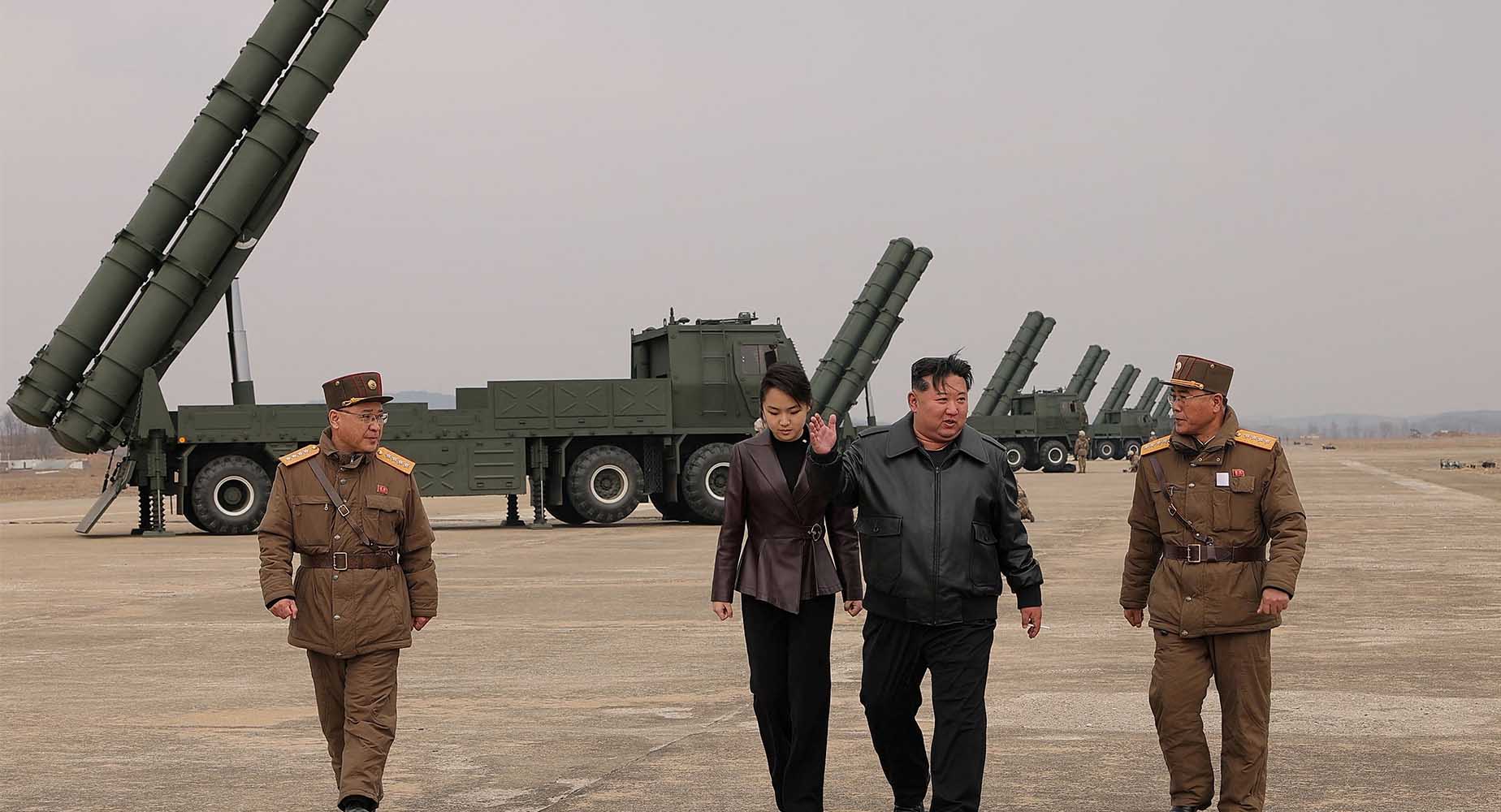
What Kim Jong Un says at the current Ninth Party Congress meeting will reveal whether there is an opening for nuclear negotiations with the Trump administration. Despite President Trump’s repeated offers to meet with North Korea’s leader Chairman Kim Jong Un during his recent trip to Asia, there was no response. Kim’s appearance with Xi Jingpin and Vladimir Putin at China’s recent military parade commemorating the end of World War II shows he is firmly aligned with two other great powers and may not feel the need to meet with the United States president. Kim is in a much stronger political position now than he was during President Trump’s first term. To re-start talks between the United States and North Korea, new approaches are needed.
Kim declared that North Korea “will never give up nuclear [weapons],” which he described as being “tantamount to demanding we surrender our sovereignty.” For Kim, possession of nuclear weapons is “irreversible.” Given that North Korea has conducted six nuclear weapons tests since 2006 and may have a nuclear arsenal equal to France and Britain, his claim to be a nuclear state is, regrettably, credible. Four American presidents have failed to curb North Korea’s drive to a obtain a nuclear weapons capability. It is time to consider something other than just demanding he give up a nuclear arsenal he believes is essential to his survival.
During his confirmation hearings, Secretary of State Marco Rubio suggested that the United States needs to consider a new approach to reducing the risk of inadvertent nuclear war as path to the ultimate goal of denuclearization of the Korean Peninsula. Exploring measures to reduce inadvertent war may help to change security and political facts on the ground.
South Korean President Lee Jae Myung announced a new policy to further relations between the two Korean states during his speech at the annual UN General Assembly meeting last year. The policy has a catchy anachronym END, which stands for Exchange, Normalization, and Denuclearization. President Lee stressed “we must end the era of hostility and confrontation on the Korean Peninsula and usher in a new era of peaceful coexistence and shared growth.” While President Lee’s new initiative may advance Secretary Rubio’s call to reducing the risk of nuclear war, Chairman Kim rejected it in part because of its call for denuclearization.
Former U.S. Director of National Intelligence in his memoir “Facts and Fears” suggested several political measures might change the political dynamics in constructive ways. He argued that a “reasonable first step might be to meet [North Korea’s] for a peace treaty,” since “all we have now is a ceasefire.” Clapper argued that “Only the bigger partner can change the narrative.”
In Joel Wit’s recently released and exhaustively researched account of U.S.-North Korean nuclear negotiations over the course of the last 30 years, he makes similar suggestions and also offers some creative economic options that might further President Lee’s call for exchange, and normalization in the short-run and leave open the possibility of denuclearization in the long-run. Wit notes that Australian mining companies believe North Korea has considerable deposits of rare earth minerals that are critical to the digital economy. Following the model of the U.S.-Ukraine agreement on a reconstruction investment fund to facilitate mining rare earth minerals, the U.S. and North Korea could fashion a similar agreement that spurs rare earth mineral mining. To advance this initiative some sanctions would need to be repealed, which is something Chairman Kim has long sought.
Another policy course change Wit suggests is to call for a freeze on further North Korean nuclear tests and a halt of missiles tests by both Koreas could start the process. Since North Korea has a nuclear capability, shifting discussions to measures that reduce inadvertent nuclear is a pragmatic approach. These limited but highly visible security steps could complement more dramatic political and economic measures.
Given Kim’s stated position that North Korea is a nuclear weapons state, he will not readily engage in discussions designed to take away nuclear capabilities that he believes ensure his country’s survival. Shifting the focus of nuclear diplomacy to political and economic measures as well as steps to reduce the risk of inadvertent nuclear war is valuable in itself and might bring Kim back to the negotiating table. Measures reducing the risk of nuclear conflict can serve as pathway to denuclearization rather than insisting North Korea give up its nuclear arsenal right now and have a better chance of restarting suspended negotiations.