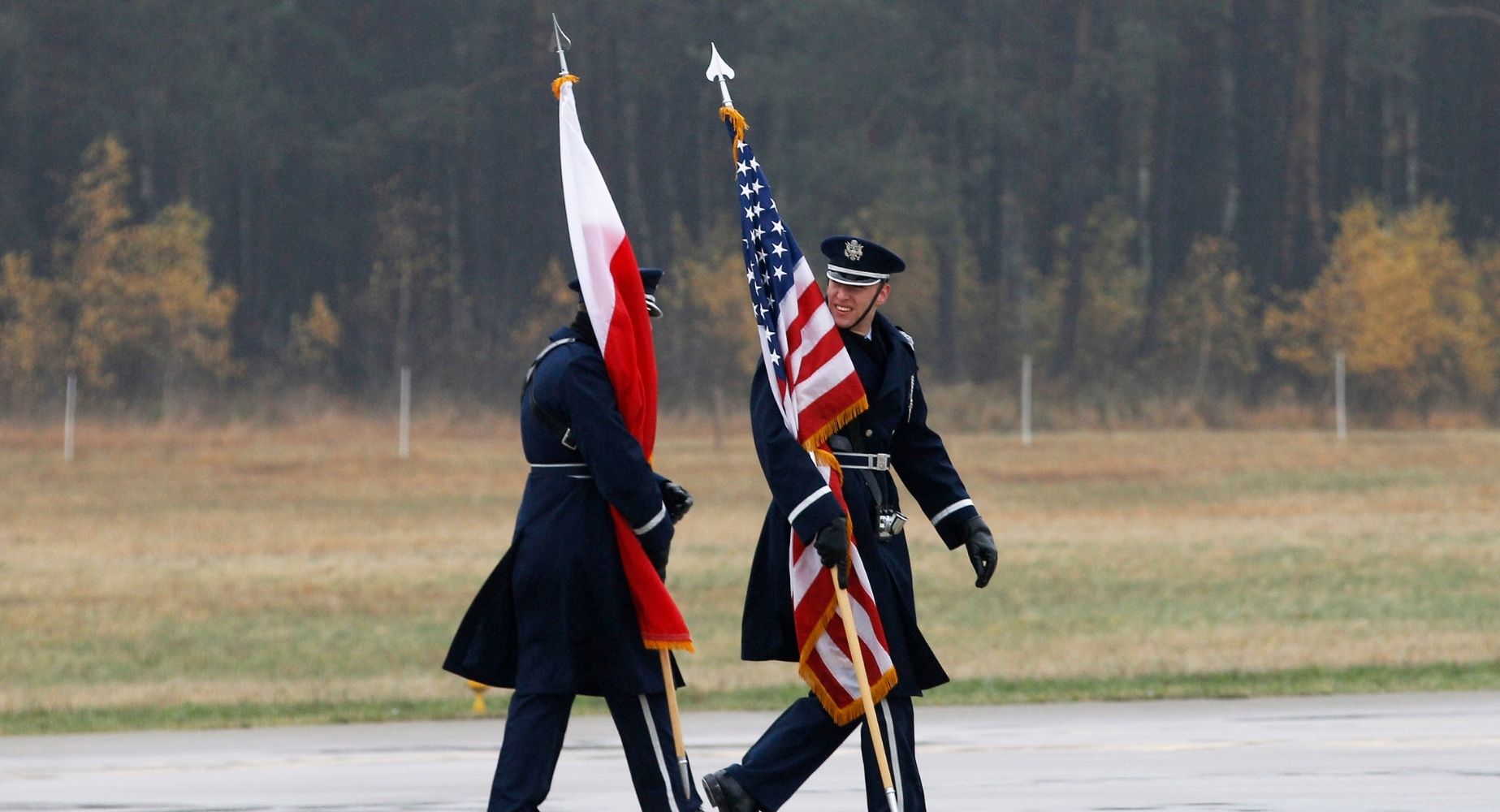
For decades, Poland has been one of the most pro-American countries in Europe, and often the most pro-American of all. That is now beginning to change, and Washington should treat this trend as a strategic warning. In 2024, 86 percent of Poles viewed the United States favorably, the highest figure among all countries surveyed by Pew Research Center. One year later, that number fell to 55 percent, while unfavorable views rose from 10 percent to 37 percent. This does not mean Poland has joined America’s loudest critics. It does mean that a remarkable reservoir of public goodwill is eroding and doing so faster than many in Washington may realize.
The U.S.-Polish partnership is far more than symbolic. Poland is not simply a grateful security consumer on NATO’s eastern flank. In fact, many officials in Washington already view Poland as one of America’s most serious security partners in Europe: a reliable frontline ally, often described as a model ally. At a time when anti-American sentiment is growing in parts of Poland, there is little evidence of any comparable anti-Polish sentiment in the United States. Poland is also one of the alliance’s most serious burden-sharers. According to NATO estimates, Poland spent 4.48 percent of GDP on defense in 2025, the highest share in the alliance and above the United States. Warsaw now plans to increase its defense spending to 4.8 percent in 2026. A substantial share of those expenditures flows into the United States, where Poland procures a wide range of equipment, including 96 Apache helicopters, 32 F-35A fighters, 350 Abrams tanks, Patriot/IBCS air defense systems, and HIMARS rocket systems. Washington has also backed this trajectory financially, including through an additional $4 billion Foreign Military Financing loan guarantee announced in June 2025, which brought total loan support to Poland to $11 billion over the last two years. At the same time, Poland invests heavily in the infrastructure that supports the U.S. military presence on its territory, including the Army Prepositioned Stocks-2 complex in Powidz, the Aegis Ashore missile defense site in Redzikowo, itself a sign of deep strategic trust, and the continued expansion of facilities in Drawsko Pomorskie. Since Russia’s full-scale invasion of Ukraine, the United States has also played a central role in reinforcing the broader security architecture on which Poland depends.
While defense cooperation often makes the headlines, the relationship is also far deeper economically than many in Washington assume. Overall U.S. trade in goods with Poland reached a record-high $28.3 billion in 2025, more than doubling over the last five years since 2020. This puts Poland among the top 30 U.S. trading partners, ahead of Saudi Arabia in 2025. While this may come as a surprise to many, two areas are worth mentioning. Poland is importing a growing amount of LNG from the United States, not only for its own use but also to supply the broader region, serving as an increasingly relevant node in regional energy connectivity. Poland is also deeply embedded in the American aerospace ecosystem, with major manufacturers such as Sikorsky, Pratt & Whitney, Goodrich, Raytheon, and Lockheed Martin maintaining a strong presence across Poland’s Aviation Valley in southeastern Poland, centered on Rzeszów and its surrounding area. At the same time, Poland remains less exposed to Chinese capital than most European economies. Cumulative Chinese FDI in Poland in 2000–2024 stood at roughly $5 billion, compared with about $40 billion in Germany, $27 billion in France, $18 billion in Italy, and nearly $9 billion in Hungary, according to data from Rhodium Group and MERICS. From a U.S. strategic perspective, this is another factor confirming that Poland is not only a model NATO ally, but also a more reliable economic partner than many others in Europe. There are already promising signs of deeper industrial cooperation, but they remain too limited in scale to match the strategic importance of the relationship.
The facts are increasingly overshadowed by signals coming from Washington that affect the perception of the U.S.-Polish relationship. The recently published strategic documents – the National Security Strategy, the National Defense Strategy, and the Annual Threat Assessment – were widely discussed in Poland in light of one central question: where does this model ally fit into the new U.S. strategic paradigm? While it is understandable that, in the face of emerging threats and the need to put America and American citizens first, U.S. priorities must change and its global posture must be adjusted accordingly, concerns about Poland’s security, still largely dependent on the transatlantic bond, are real. Although Europe is mentioned as a key military and economic partner, expectations in Poland and across NATO’s eastern flank, especially considering the war in Ukraine, are greater. Those expectations are only partially reflected in the current strategic framework and, more importantly, have not yet been matched by sufficiently ambitious policy instruments. Another issue is the rhetoric sometimes used by President Trump. And while his comments about Poland itself are invariably positive, some of his broader remarks about allied military contributions have been received negatively in Poland, particularly because Polish forces shared risk shoulder to shoulder with American troops in Afghanistan and paid a real price for that commitment.
The growing security vacuum, even if only perceived as such, is increasingly being filled by Europe, and most notably by the European Union. For decades, the Polish view was clear: NATO and the transatlantic partnership formed the core of national security, while the European Union underpinned economic growth and social development. That balance is now beginning to shift. Many in Poland have started to see the European Union as a potential guarantor of security as well, pushing for much closer and deeper cooperation and, in some cases, for a move from a union of sovereign states toward a quasi-federal system. A key example was the recent debate in Poland over SAFE (Security Action for Europe), a €150 billion EU defense loan instrument whose key goals were not only to support member states financially, but also to tie them more closely into European defense supply chains and strengthen the European defense sector. While President Nawrocki vetoed the proposed bill, arguing that it implied an intrusive encroachment on Polish sovereignty and would create generational debt, it is notable that the United States did not put a comparably ambitious offer on the table. Such a move would not only have helped shift perceptions in Poland about a possible U.S. disengagement from Europe, a narrative increasingly present in parts of the Western European press but would also have sent a meaningful signal that Poland is treated as a truly strategic partner. At a time when U.S. Ambassador Tom Rose has publicly said more than once that “Poland is family,” the absence of a comparably ambitious American offer is even more striking.
This tension between hard economic and military realities, on the one hand, and perceptions shaped by interpretations of the U.S. strategic shift and public statements, on the other, will inevitably grow. If the United States ignores this trajectory, it could end up making a serious strategic mistake by assuming that Poland will remain permanently in the U.S. sphere of influence regardless of circumstances. The change will not happen overnight. It is nevertheless real, and it is raising concerns among pro-Atlantic voices on both sides of the Atlantic. This shift is not driven by American signaling alone. It is also shaped by domestic developments in Poland. Polish public opinion is far more nuanced today than it was before. This is partly the result of deepening political polarization in Poland, but also of a broader media environment in which President Trump is often perceived more as a source of risk than as a strategic asset, with wider consequences for the transatlantic partnership.
Another factor is that the European Union, after decades of ignoring the views and warnings coming from Central and Eastern Europe, is slowly coming to its senses and beginning to recognize that, for example vis-à-vis the Russian threat, the assessment from Poland and other countries in the region was correct. Third and finally, transactionalism in international relations plays an essential role. In this context, many people in Poland are beginning to view the United States as a power that too often relies on rhetorical reassurance and transactional pressure to increase sales, rather than making an equally serious effort to integrate Poland and its economy more deeply into U.S. strategic supply chains and long-term strategic planning. The core of the U.S.-Polish relationship should not rest on increased trade alone, but also on the assurance that, in a moment of need, the United States would step up for Poland just as Poland has repeatedly stepped up for America, from the American War of Independence to the missions in Iraq and Afghanistan.
While the situation is alarming, it is not too late to reverse the trend and restore the transatlantic partnership to the level it maintained over the last decades. Poland is already a serious and committed ally, a model ally, and a strong economic partner of the United States. It is embedded in several strategic supply chains and is investing heavily not only in its own security, but also in broader regional security. It also serves as a hub and gateway to the region, while at the same time keeping China at bay. Nevertheless, the current perception is that, despite important areas of real cooperation, what Poland still receives above all are warm declarations of an everlasting bond, compliments about being a model ally, and too many off-the-shelf solutions. Considering developments within the European Union and growing pressure for federalization, this is simply not enough to sustain the partnership at its current level.
What Poland truly needs, and what Washington should consider providing, are real ways and means to embrace Poland as the core regional partner it already is and to support its emergence as a key U.S. ally in Europe. That should include not only broader industrial integration but also privileged regulatory and export-control treatment closer to what America offers its most trusted defense partners. In practical terms, this means tying Poland more deeply into American supply chains, not only in aerospace, where this already works, but most importantly in the defense sector. This would require not only expanding existing co-production efforts and locating additional strategic manufacturing plants in Poland but also offering genuine technology transfer and a serious offset package to strengthen the Polish defense sector. It also means more American investment, especially in logistics, which would not only increase the mobility of allied forces, but also help develop underinvested areas of Poland. It means supporting Poland as a key regional hub on NATO’s eastern flank and helping it emerge as a leading regional player, capable of diffusing security across the broader region. Finally, it means viewing Poland as a partner in shaping regional, and potentially even global, security rather than merely as an executor of strategy designed elsewhere.
Poland remains one of the most pro-American and strategically aligned countries in Europe. But this will not last forever. If Washington does not step up its game, it may lose Poland.