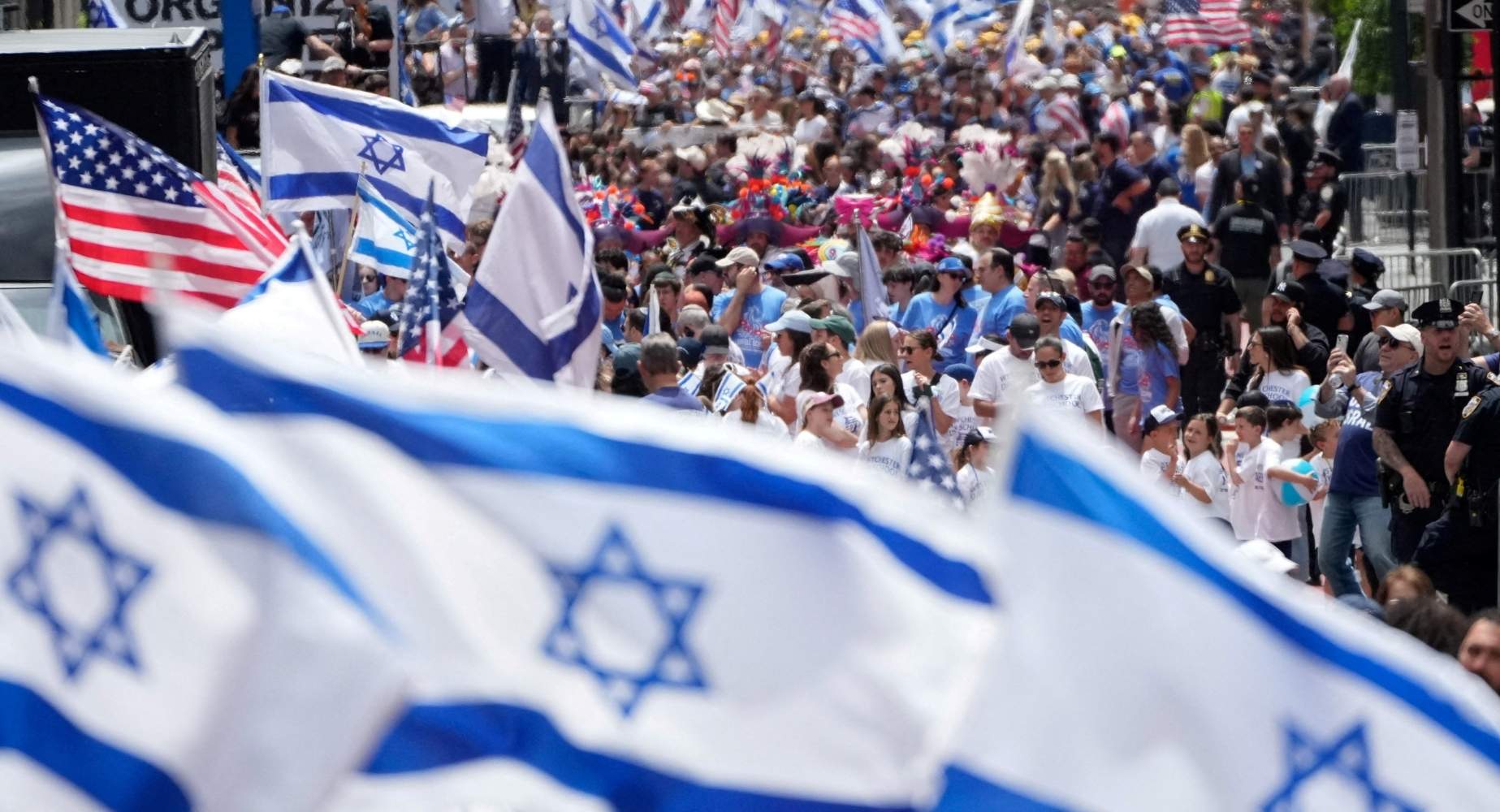
By fighting shoulder-to-shoulder with the United States in two major military operations, Israel is benefiting from the closest relationship it has ever had with Washington. Yet in an ironic twist of political fate, at the very same time both political and more ominously, public support for the Jewish state is the lowest in decades.
The wars in both Gaza and Lebanon have been the subject of hysterical anti-Israeli reports, many of which have subsequently proved inaccurate. As a result, the media, especially social media, has provided a new and powerful platform for the anti-Israeli, and anti-Semitic Democratic Left and Republican far-Right. Both cast Israel as a purveyor of “Genocide” and often question Israel’s very existence.
On the Right, influencers like Tucker Carlson and politicians like Representative Thomas Massie (R-KY) have argued that support for Israel is not in America’s interests. On the Left, numerous academics and the Democratic Socialists of America (DSA) have branded as a “Zionist” any Jew that supports the notion of a Jewish State, and called for that person’s exclusion from all public discourse and activities.
Moreover, Democrats have nominated an increasing number of openly anti-Israel candidates, some of whom are Jewish and many of whom are members of DSA or identify with its platform. And leading Democrats have met with Hasan Piker, whose anti-Israel and anti-Semitic diatribes are followed by millions.
It is perhaps no surprise therefore that in an increasingly hostile American environment, the Anti-Defamation League reported that despite a decline in total anti-Semitic incidents in 2025, they were still five times more frequent than a decade ago.
Unceasing polemical attacks by those on both the Right and the Left clearly are influencing public perceptions of Israel. A Pew poll taken in March found that 60% of U.S. adults have an unfavorable or somewhat unfavorable view of Israel and only 37% view Israel favorably. Four years ago, those numbers came close to being the reverse: 55 per cent of Americans viewed Israel favorably, 42 % viewed the country unfavorably. Moreover, for the first time ever, a February Gallup Poll found that Americans are more sympathetic to Palestinians (46%) than to Israel (33%).
An even more recent Pew poll in June found that 83% of those identifying themselves as politically Left hold unfavorable views of Israel, while 67% of centrists do the same as do 37% of those politically Right.
Even more troubling is the fact that poll results are not confined to any one group. The March Pew poll found that 57% per cent of Republicans aged 18-49 view Israel somewhat or very unfavorably. An even higher percentage of Democrats in the same age group, 84%, have a negative view of the Jewish state.
Israel commands little support in several important religious communities. These include only 39% of White non-evangelical Protestants, 35% of Catholics and a 33% of Black Protestants. Perhaps not surprisingly, only 4% of Muslim American view Israel positively. But Muslims are among the fastest growing American faith communities. Their political power and influence is certain to grow over time.
Israel still commands significant support from the Jewish and Evangelical communities— respectively 64 and 65 per cent—but the fact that roughly a third of each community does not view Israel favorably is a troubling sign.
Israel commands the strongest support among Modern Orthodox Jews, many of whom have family living on the West Bank and/or serve in the Army. Haredi Jews generally also support Israel, with the notable exception of Satmar and its related communities that are openly anti-Israel. In any event, the Orthodox constitute only about 15 per cent of all American Jews, and the largest and most liberal Jewish stream, the Reform Movement, is far more critical of Israel. Indeed, the thirty per cent of New York Jews who voted for Zohar Mamdani, a longtime BDS supporter who refuses to concede Israel’s right to exist, reflects the split that is roiling the American Jewish community.
Part of the American public’s seeming disillusion with Israel certainly stems from the Gaza war. Part is a result of disgust with the statements and actions of the far-right ministers Bezalel Smotrich and Itamar Ben Gvir. But part is a direct result of its highly negative view of Benjamin Netanyahu.
When President Donald Trump angrily told Netanyahu in a June phone call that “everyone hates you,” he was exaggerating, but nevertheless was reflecting a view held by a majority of the American public. The March Pew poll reported that nearly 60% of respondents “have little or no confidence in Netanyahu to do the right thing regarding world affairs” up from 52% last year. That figure is almost identical with the Pew findings regarding public approval of Israel and points to a positive correlation between the two sets of polling results.
Negative views of Netanyahu are highest among young Americans. The June Pew poll indicated that toughly two-thirds of those aged 18-49 have little confidence that he would “do the right thing regarding world affairs.” In fact, that view is shared by 54% of those aged fifty and above.
Public opinion and growing pressure from the party’s left-wing has led many Democratic politicians to question aid to Israel. In April a record 40 Democratic senators voted to cut off some American arms to Israel. Congressional hopefuls have been increasingly distancing themselves from pro-Israel policies and especially from AIPAC.
Some presidential candidates have gone even further. Most notably, Maryland Senator Chris van Hollen, who is also a potential candidate for Secretary of State if Democrats take the White House in 2028, penned an op-ed in the New York Times that echoed long-standing Palestinian demands for the West Bank, Gaza and East Jerusalem, the last of which Israel officially designated as part of its united capital forty-six years ago.
Recognizing the danger to Israel if it loses American support, especially if the Democrats take the House of Representatives in the upcoming November elections, and if a Democrat is elected president in 2028, Netanyahu has announced that upon the 2028 expiry of the current American- Israel Memorandum of Understanding, Jerusalem no longer will request any financial assurance from Washington.
That approach may quell some of the criticism of Israel, but in politics 2028 is an eon away; until then Israel will continue to be the subject of vitriolic criticism on the extreme Right and the Left both in Washington and in the public at large.
Ending American financial assistance to Israel also will not bring an end to public dislike of Netanyahu, who has been the face of Israel for so long that many Americans under the age of thirty hardly recall any other Israeli prime minister. Should Netanyahu form a new right-wing government after the upcoming Israeli elections, he may find that terminating American aid may not change American public opinion. And he may yet come to regret his decision to plump so openly for one of America’s two great political parties while essentially writing off the other.