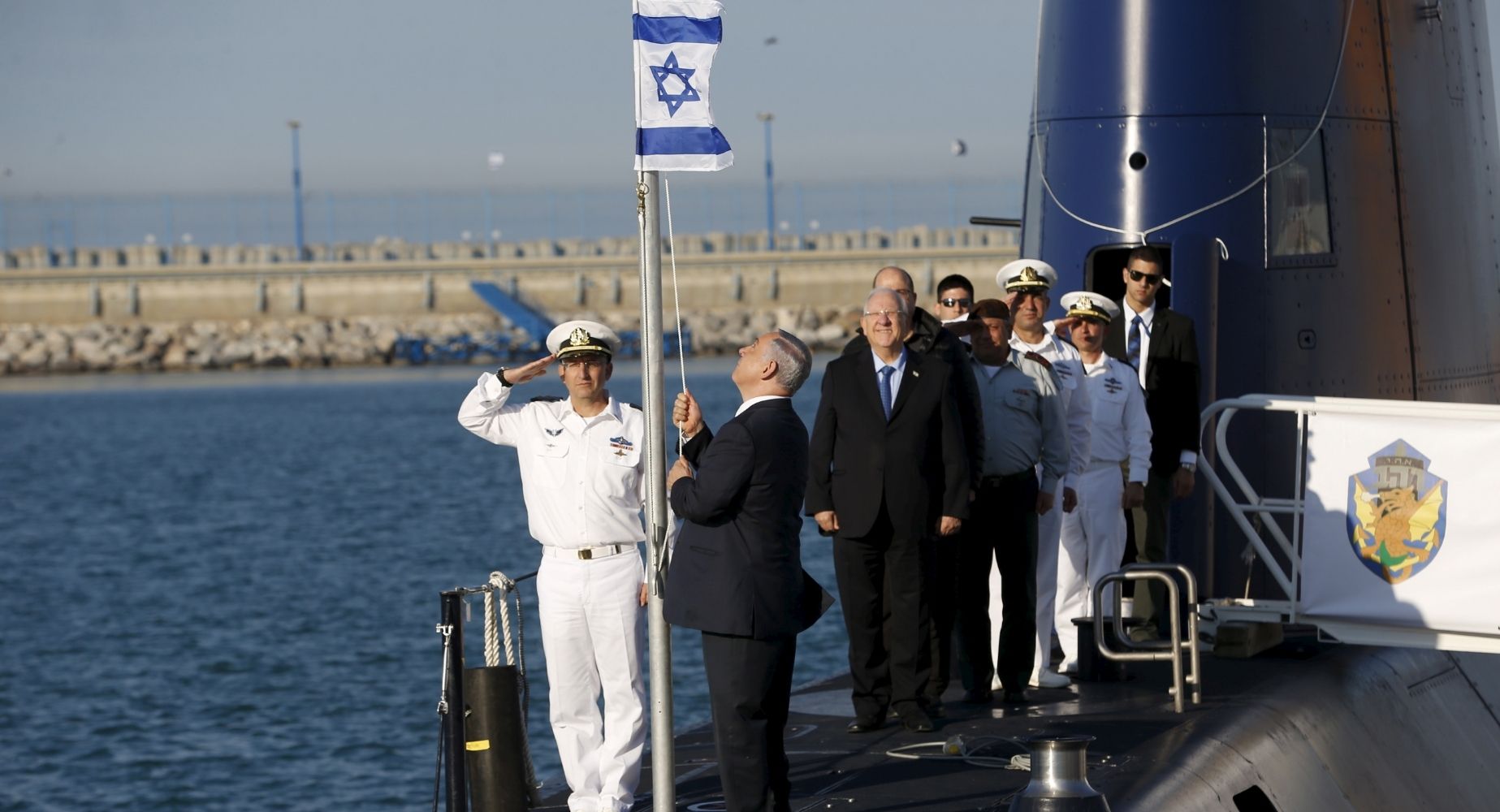
Even after “Operation Roaring Lion” and America’s “Operation Epic Fury,” Israel’s presumptive nuclear weapons remain essential for deterrence of nuclear threats. There are also foreseeable circumstances in which these weapons could deter certain non-nuclear threats. Most plausible, in this connection, would be circumstances in which the enemy threats referenced large-scale conventional attacks (whether first-strike attacks or retaliatory attacks) and/or chemical/biological harms.
Issues and Correlates
What do such complex circumstances signify in tactical or operational terms? To begin, Israel’s deterrence posture identifies two seemingly distinct modes of strategic dissuasion: conventional and nuclear. Further to the intentionally opaque nature of this traditional posture (i.e., “deliberate nuclear ambiguity”), Israel’s nuclear deterrence would not come into play until all forms of conventional deterrence had been exhausted.
But to fully understand all this, background will be important. Before suffering setbacks from the coinciding American and Israeli operations in 2026, Iran had regarded Israel as a “one bomb state,” as a despised adversary subject to “removal” by a single nuclear bomb. Though annihilationist ipso facto, this strategic view was not entirely propagandistic. It was easily confirmable, as Alfred North Whitehead once observed, by the “laws of physics.”
Such “laws” ought never to be disregarded in matters of military deterrence. Still, Israel’s national survival is never just about a designated enemy’s military capabilities. Rather, it remains closely connected to this enemy’s presumed willingness to risk existential harms.
Specifics are important. There will be many underlying details. Assuming enemy rationality, enemy willingness will depend in large part on the credibility of Israel’s deterrence posture. As for non-rational state enemies, attention and assets should both be allocated to variously graduated preemption options. Regarding Israel’s survival as a state, these allocations are always of primary importance. In essence, therefore, what is needed in Jerusalem is a comprehensive framework for competitive risk-taking that offers “seamless” retaliatory options.
When a country smaller than America’s Lake Michigan faces interpenetrating threats from state and sub-state adversaries, it requires a secure and flexible deterrent, one that could escalate in variously prefigured increments from non-nuclear weapons (chemical, biological, hypersonic and/or electromagnetic pulse ordnance) to theatre and/or strategic nuclear warfare. Supporting such an informed warning would entail a four-part intellectual understanding:
(1) science-based judgments of probability must be based on the determinable frequency of relevant past events;
(2) there has never been a relevant past event; i.e., a nuclear war;
(3) maintaining visibly compelling conventional deterrence could make it less necessary for Israel to escalate to nuclear threats/nuclear conflict; and
(4) aptly measured nuclear threats could enhance the persuasiveness of Israel’s conventional threats.
There are also several antecedent questions:
How might Israel actually find itself involved in a nuclear war?
Under what specific circumstances could Israel discover itself involved (whether wittingly or unwittingly) with belligerent nuclear weapons use?
To answer these questions, Israeli analysts will need to integrate critical military aspects of their investigations with authoritative legal standards.
What are the Relevant Threats to Israel?
For the moment, such integrative concerns could seem extraneous, gratuitous and without suitable empirical foundation. Israel, after all, remains the only nuclear weapons state in the region. Nonetheless, malleable order-of-battle considerations could change unexpectedly, perhaps even from moment to moment. This prospective “fluidity” appears most obvious in regard to diminishing threats from Iran and to potentially expanding threats from Egypt, Turkey, Pakistan or North Korea.
Sometimes, in strategic matters, truth must emerge through paradox. Even without an already-nuclear adversary in the region, Israel could find itself having to rely on calibrated nuclear deterrence against biological and/or conventional threats.
In late September 2024, Russian foreign minister Sergei Lavrov openly proclaimed Russia’s right to introduce nuclear weapons into any future conflict with Ukraine-supporting NATO states. Though not a Middle Eastern theatre of warfare, the idea of threatening escalation to nuclear weapons in response to “unacceptable” sub-nuclear belligerence is still concerning. Conceptually, the dynamics of calculated threat would be similar or identical. These dynamics would be universal.
In all foreseeable cases, Israel’s nuclear doctrine and strategy should remain oriented to deterrence,\ not nuclear war-fighting. Plausibly, with such an understanding in mind, Jerusalem has already taken steps to reject tactical or “battlefield” nuclear weapons and to disavow any correlative plans for nuclear counter-force targeting.
For Israel, nuclear weapons can make sense only for deterrence ex ante; not revenge ex post. In “eleventh-hour” circumstances, taking this sensible position could mean crossing the nuclear threshold against a dangerous and determined non-nuclear adversary. As rational strategy, any such intent will need to be made known before Jerusalem would need to actualize any such nuclear threat.
There are associated legal issues. Contrary to conventional wisdom, nuclear deterrence and associated forms of nuclear strategy that include preemption could support expectations of international law. But the adequacy of international law in preventing nuclear war in the Middle East will depend on more than formal treaties, customs or “the general principles of law recognized by civilized nations.” It will also depend on the success or failure of particular country strategies in the region and on the “will” of adversarial states to maintain certain shared intellectual understandings. If Israel’s nuclear strategy could successfully reduce the threat of a regional nuclear war, whether because of compelling nuclear deterrence or by defensive first-strikes strikes, it deserves to be considered a legitimate component of international law enforcement.
Pertinent Scenarios
Realistic threat scenarios should remind Israel of its always-overriding need for comprehensive nuclear theory, an inductive-deductive explanatory framework based on systematic and systemic thought. Among other things, this reminder would postulate a counter-value targeted nuclear retaliatory force that is recognizably secure from enemy first-strikes and recognizably capable of penetrating that state’s active defenses. To best meet such imperative security expectations, the IDF would be well-advised to continue with evident sea-basing (submarines) of nuclear deterrent force. Optimally, such steps would become part of a broader policy shift from “deliberate nuclear ambiguity” to “selective nuclear disclosure.”
To satisfy equally important requirements of “penetration-capability,” Jerusalem will have to stay visibly ahead of enemy air-defense refinements. If duly followed, such positioning could enhance not “only” Israel’s national security, but also more general prospects for nuclear war avoidance. “Everything is very simple in war,” says Clausewitz, in his classical discussion of “friction” (On War), “but the simplest thing is still difficult.”
How might Israel become actively involved in a nuclear war? In response, four basic scenarios present themselves: Nuclear Retaliation; Nuclear Counter-Retaliation; Nuclear Preemption; and Nuclear Warfighting. All these scenarios could be impacted by ongoing and potentially intersecting conflict situations in North Korea/South Korea; Russia/China/Ukraine or India/Pakistan.
Strategically and jurisprudentially, the world security regime represents a system. Accordingly, what happens in any one place could have notable and palpable effects in other places. Moreover, the investigation of pertinent scenarios should always be considered an intellectual task, hence, not one amenable to resolution by politicians or pundits.
(1) Nuclear Retaliation
If in the future an enemy state should launch a nuclear first-strike against Israel, Jerusalem would respond legally and to whatever extent possible with a nuclear retaliatory strike. If enemy first-strikes were to involve other forms of unconventional weapons, including high-lethality biological mass-destruction weapons, Israel might still launch a permissible nuclear reprisal. Such an unprecedented response would depend in large measure on Israel’s calculated expectations of follow-on aggression and its assessments of comparative damage-limitation.
If Israel were to absorb “only” a massive conventional attack, a nuclear retaliation could still not be ruled out, especially if: (a) Israel’s adversary were perceived to hold nuclear, and/or other unconventional weapons in reserve; and/or (b) Israel’s leaders were to believe that exclusively non-nuclear retaliations could not prevent destruction/annihilation of the Jewish State. A nuclear retaliation by Israel could be ruled out only in seemingly evident circumstances where enemy aggressions were conventional, “typical” (sub-existential or consistent with previous instances of enemy attack in magnitude/intent) and hard-target oriented (that is, directed only toward Israeli weapons and military infrastructures, not to “soft” civilian populations).
(2) Nuclear Counter-Retaliation
Should Israel ever feel compelled to preempt enemy nuclear aggression with conventional weapons, the target state’s response (assuming rationality) would likely determine Jerusalem’s next moves. If this response were in any way nuclear, Israel could expectedly turn to nuclear counter-retaliation. If this retaliation were to involve other weapons of mass destruction, Israel might feel pressed to take an appropriate escalatory initiative. Any such initiative would reflect the presumed need for what is formally described in strategic parlance as “escalation dominance.”
All authoritative decisions would depend on Jerusalem’s early judgments of adversarial intent and its accompanying calculations of essential damage-limitation. Should the enemy state response to Israel’s preemption be limited to hard-target conventional strikes, it is unlikely that the Jewish State would move on to consider nuclear counter-retaliations. If, however, the enemy’s conventional retaliation was plainly “all-out” and directed toward Israeli civilian populations – not just to Israeli military targets – an Israeli nuclear counter-retaliation could not be excluded ipso facto. It could also be permissible under international law.
Such a unique counter retaliation could be ruled out only if the enemy’s conventional retaliation were proportionate to Israel’s preemption; confined exclusively to Israeli military targets; circumscribed by legal limits of “military necessity” (a limit routinely codified in the law of armed conflict) and accompanied by explicit and verifiable assurances of non-escalatory intent.
(3) Nuclear Preemption
It is implausible that Israel would ever decide to launch a preemptive nuclear strike. Though circumstances could arise in which such a strike would be technically rational and ascertainably legal, it is still unlikely that Israel would ever allow itself to reach such “all or nothing” vulnerabilities. Moreover, unless nuclear weapons were employed in a fashion still consistent with the laws of war – aka the law of armed conflict – this form of preemption would represent a flagrant violation of binding international rules.
Even if such consistency were possible, the psychological/political impact of nuclear weapons use on the world community would be negative and far-reaching. This means, among other things, that an Israeli nuclear preemption could be expected only where (a) a state enemy had acquired nuclear and/or other weapons of mass destruction presumed capable of annihilating the Jewish State; (b) this adversarial state had made clear that its military intentions paralleled its capabilities; (c) this enemy was believed ready to begin an operational “countdown to launch;” and (d) Jerusalem believed that Israeli non-nuclear preemptions could not possibly achieve the needed minimum levels of damage-limitation – that is, levels consistent with physical preservation of state and nation.
(4) Nuclear War fighting
Should nuclear weapons be introduced into actual conflict between Israel and an enemy state, nuclear war fighting at one level or another would ensue. This would be true so long as: (a) enemy first-strikes against Israel would not destroy Jerusalem’s second-strike nuclear capability; (b) enemy retaliations for an Israeli conventional preemption would not destroy Jerusalem’s nuclear counter retaliatory capability; (c) Israeli preemptive strikes involving nuclear weapons would not destroy adversarial second-strike nuclear capabilities; and (d) Israeli retaliation for enemy conventional first-strikes would not destroy enemy nuclear counter-retaliatory capabilities.
It follows that in order to satisfy its most essential survival requirements, Israel should take immediate steps to ensure the likelihood of (a) and (b) above, and the unlikelihood of (c) and (d).
An Historical Pride of Place
Though it is most important for Israel to stay-focused on measurable and scientific assessments of nuclear war fighting, it is clear that less tangible consequences should also be noted. At the onset of their once-unimaginable sufferings, the survivors of Hiroshima and Nagasaki found themselves, in psychologist Bruno Bettelheim’s words, an “anonymous mass,” or in the Japanese term, muga-muchu, “without self, without a center.” For the future of war and peace in the Middle East, such total disruptions of individual and social order produced unforeseeable outcomes, ones that extended far beyond any immediate physical or emotional losses.
There is more. The exterminatory effects of the two atomic bombs dropped on Japan were not confined to immediate or long-term experiences of those who bore direct witness, but were extended to their rescuers and the progeny of these rescuers. It would not be unreasonable to expand the survivor category of hibakusha to include children of Japanese mothers who did not experience the atomic explosions themselves.
Soon, Jerusalem will need to consider a prompt end to “deliberate nuclear ambiguity.” By selectively removing the “bomb” from its metaphoric “basement,” Israel’s strategic planners would be better positioned to enhance the credibility of the country’s nuclear deterrence posture. Ironically, any enhancements of Israel’s nuclear deterrent could effectively support wider objectives of applicable international law.
In Israel’s strategic nuclear planning, would-be state aggressors, whether nuclear or non-nuclear, should be encouraged to believe that Jerusalem maintains the willingness to launch measured nuclear forces in retaliation and that these forces are sufficiently invulnerable to first-strike attacks. Additionally, these enemies should be encouraged to expect that Israel’s designated nuclear forces could reliably penetrate their ballistic-missile and air defenses.
Though counter-intuitive, Israel and parts of the wider region would benefit from Jerusalem’s release of selectively broad outlines of the country’s continuously evolving strategic orientations. Without a prior and well-fashioned strategic doctrine, no such release could make persuasive deterrent sense. At the same time, a too-firm release could be interpreted as an explicit rejection of NPT (Nonproliferation Treaty) objectives. Though this is an agreement to which Israel is not a party, it is generally regarded as a stabilizing nuclear “benchmark.”
Selectively-released Israeli nuclear information could support the perceived utility and security of Israel’s nuclear retaliatory forces. Once suitably disclosed, national nuclear strategy should center on the targeting, hardening, dispersion, multiplication, basing, and yield of all operational ordnance. Under certain easily-imagined conditions, the credibility of Israeli strategic deterrence could vary inversely with the perceived destructiveness of its nuclear weapons.
During the spring of 2026, the importance of this counter-intuitive notion was lost on US President Donald J. Trump. To wit, vis-à-vis war with Iran, Israel’s most important ally threatened “obliteration” and the “destruction of an entire civilization.” These crude threats were not just less purposeful than plausibly-calibrated options, they also represented flagrant violations of authoritative international law.
There is more. Unsurprisingly, there will be many interrelated policy concerns, all with some measure or other of legal significance. One such concern underscores that Israel will need to prepare differently (yet subtly) for military engagements with an expectedly-rational nuclear adversary than with an irrational foe. In such nuanced circumstances, national decision-makers in Jerusalem would need to distinguish meaningfully between genuine enemy irrationality and feigned enemy irrationality.
This could be a “tough call.” How should Israeli decision-makers be expected to make such inherently imprecise distinctions? Is this even a reasonable strategic expectation?
In all refined studies of world politics, rationality and irrationality have taken on specific meanings. An actor (state or sub-state) is determinedly rational to the extent that its leadership always values collective survival more highly than any other preference or combination of preferences. Conversely, an irrational actor would not always display such an ascertainable preference ordering. Apropos of scientific limitations discussed above, determining whether such an adversary was rational or irrational would prove a bewilderingly inexact “science.”
In actual practice, operationalizing these potentially indecipherable distinctions would present complex intellectual challenges. Inter alia, the task would need to take account of whether scrutinized adversaries were (1) fully or partially sovereign states; (2) sub-national terrorist groups; or (3) “hybrid” enemies comprised of state and sub-state foes. A subsidiary but still-daunting task would be to figure out the ratio of decision-making responsibilities among hybridized foes. To successfully avoid a nuclear war in the Middle East, Jerusalem will need to confront variously subtle points of deterrence and fully clarify Israel’s formal position on Palestinian statehood.
The Primacy of “Mind”
Whatever calculable nuances would be encountered in Jerusalem, the only rational way for Israel to successfully meet these growing and overlapping challenges will be to stay ahead of its adversaries through superior powers of strategic erudition. In classical Greece and Macedonia, linked arts of war and deterrence were described by military planners as challenges of “mind over mind,” not just narrow contests of “mind over matter.” At conceptual levels, such ancient descriptions remain valid for Israel.
One further observation concerns Israel’s nuclear strategy and American national security. Though analysts generally examine the foreseeable impact of US nuclear guidance upon Israel, it is equally important to consider the impact of Israel’s nuclear strategy on US national security. Though largely unrecognized, there exists an ongoing and reciprocal connection between these two factors, a sort of continuous policy feedback-loop. Going forward, this “loop” should be examined more as a dynamic relationship than as a static or one-directional connection.
A starting point should be as follows: The suitability and durability of Israel’s nuclear strategy will impact not only the Middle East, legally and strategically, but also American national security. To the extent that Israel’s nuclear policies could have “spillover” effects for the United States, America could become the unintentional beneficiary of Israel’s strategic scholarship and planning. It also follows that if Israel’s nuclear posture should somehow fail to meet that country’s most urgent or existential security expectations, the derivative effect on the United States would be correspondingly negative.
Virtually any Israeli scholarship focused on nuclear war avoidance will be offered in at least partial response to world security configurations shaped by the United States. In this connection, Jerusalem will need to pay special attention to the changing face of US-Russian adversity. In this connection, it is no longer preposterous to foresee an American president standing shoulder-to-shoulder with his Russian counterpart against NATO.
If, nonetheless, geopolitical competition between the superpowers should become more tangibly war-oriented in Asia – most notably in regard to ongoing North Korean nuclear enhancements or Chinese military actions against Taiwan – it could have determinative effects on Israel’s nuclear posture and on a Middle Eastern nuclear war. On such effects, it ought not to be disregarded that (1) a nuclear war is logically possible with only one nuclear belligerent (i.e., an “asymmetrical nuclear war”) as well as with two or more nuclear adversaries (a “symmetrical nuclear war”); and (2) a nuclear war could be “symmetrical” even if one belligerent were seemingly “more powerful” than the other(s).
In all such matters, history will deserve increasingly disciplined attention. Earlier, North Korea helped Syria build a nuclear reactor, the same facility that was subsequently destroyed by Israel in Operation Orchard on September 6, 2007. Unlike Israel’s earlier Operation Opera, this preemptive attack, in the Deir ez-Zor region of Syria, was a second expression of the “Begin Doctrine.” It also portended, because of its North Korea connection, a much wider global threat to Israel.
Deleterious effects would likely be most dramatic if there were ever to be any direct nuclear exchange between the United States and North Korea. Similar connections could obtain in the aftermath of an India-Pakistan nuclear exchange, and would depend largely on specific and still-ascertainable Russian/American/Chinese alignments with Delhi or Islamabad. In both prospective conflict dyads – US-North Korea and India-Pakistan – any tangible expressions of nuclear belligerence could immediately impact Israel’s nuclear strategy and Middle East regional security.
For Israel, greater familiarity with jurisprudential principles could advance the nation’s legal as well as strategic obligations, most plainly those that jurist William Blackstone famously expressed in his Commentaries on the Law of England (Book 4 “Of Public Wrongs”): “Each state is expected, perpetually,” noted Blackstone, “to aid and enforce the law of nations, as part of the common law, by inflicting an adequate punishment upon the offenses against that universal law.”
Such ideas don’t just “pop up” ex nihilo. Blackstone is ultimately indebted to Cicero’s description of natural law in The Republic: “True law is right reason, harmonious with nature, diffused among all, constant, eternal; a law which calls to duty by its commands and restrains from evil by its prohibitions….”
Nuclear War and Justice
“Just wars,” wrote Hugo Grotius “arise from our love of the innocent.” Now, however, it is plain even by definition that a nuclear war could never be truly “just,” and that certain earlier legal distinctions (e.g., “just war” vs. “unjust war”) should be conformed to the changing technologies of military destruction. The only sensible adaptation in this regard should be to acknowledge timeless connections between international law and natural law and to oppose retrograde movements by powerful states to undermine such acknowledgments.
In the final analysis, to successfully prevent a nuclear war in the Middle East, it will be necessary to resist any world-system legitimations of belligerent nationalism. Nuclear deterrence and conventional deterrence are never best contemplated as separate security postures. Always, these seemingly discrete protective strategies are strongly interpenetrating and mutually reinforcing. Even while Israel remains the only regional nuclear power, its nuclear weapons and doctrine could be used to deter certain massive conventional aggressions from formidable state enemies.
A nuclear attack or nuclear war in the Middle East is not out of the question. It is never a casually dismissible prospect, even if Israel should remain the only nuclear weapons state in the region. How is this possible? The correct answer lies in the irremediably complex and deeply-nuanced structure of nuclear warfare possibilities, in the Middle East especially, but also anywhere else that a nuclear conflict is logically possible.
There is more. An atomic war could arrive in Israel not only as a “bolt-from-the-blue” enemy nuclear missile attack, but also by intended or unintended escalations. If, for example, an enemy state was to begin hostilities by launching “only” conventional attacks on Israel, Jerusalem could decide to respond, sooner or later, foolishly or wisely, with precisely calculated and correspondingly graduated nuclear reprisals. Alternatively, if these enemy states were to commence conflict by releasing certain larger-scale conventional or biological attacks upon Israel, Jerusalem’s conventional reprisals could be met, at least in the future, with enemy nuclear counterstrikes.
In the past, Israeli conventional preemptions have figured importantly as presumptive remedies for nuclear threat. Reasonably, if it hadn’t been for Israel’s earlier defensive first-strike operations against Iraq and Syria (Operation Opera and Operation Orchard, respectively), the Middle East would already have suffered destabilizing impacts of Arab/Islamist nuclear forces. Looking back on these critical examples of anticipatory self-defense, Israel had effectively ensured that jihadist terror groups would not become nuclear. The impact of these complex military operations benefited not only Israel, but also the United States and assorted allies.
Still, for the Middle East, the regional future is apt to become substantially less secure. With a still-aspirational nuclear Iran, derivative risks of nuclear terrorism could become intolerable. Some of these expected risks might not be confined to the Middle East. In one form or other, they could “carry over” to American and/or European homelands.
By maintaining a credible conventional deterrent, Israel could most reasonably reduce its potential exposure to nuclear warfighting. A fully persuasive Israeli non-nuclear deterrent, at least to the extent it would prevent large-scale conventional enemy attacks, could lower the country’s overall risk of exposure to unmanageable variants of nuclear escalation. In the specific lexicon of nuclear strategy, Israel could reap multiple security gains by staying in conspicuous control of “escalation dominance.” Taken together, these gains could prove indispensable.
Foreseeable Deterrence Connections
Certain noteworthy strategic possibilities will warrant special mention. Any rational state enemy considering attacks against Israel using chemical and/or biological weapons would take more seriously Israel’s nuclear deterrent. Inter alia, this argument suggests that a strong conventional capability will always be needed to deter or preempt certain large conventional attacks.
Inevitably, in seeking to continually reassess their own military power positions, Israel’s enemies will strive to determine how Jerusalem views its own conventional weapon opportunities and limitations. If these enemies did not perceive any Israeli sense of expanding conventional force weakness and were driven by expectations of Israeli unwillingness to escalate to nonconventional weapons, they could decide rationally to attack first. The net result could include: (1) defeat of Israel in a conventional war; (2) defeat of Israel in an unconventional (chemical/biological/nuclear) war; (3) defeat of Israel in a combined conventional/unconventional war; or (4) defeat of enemy state(s) by Israel in an unconventional war.
Ironically for Israel, even the “successful” fourth possibility could prove net-negative. This counter-intuitive conclusion should once again bring to mind Israel’s increasingly outdated “bomb in the basement.” Always, the credibility of Israel’s nuclear deterrent will depend in part on the perceived “usability” of its nuclear arsenal. Should Israel’s still-ambiguous nuclear weapons be regarded by prospective attackers as high-yield, indiscriminate, “city-busting” (counter-value) weapons, rather than as minimal-yield, “war fighting” (counterforce) ordnance, they might not deter.
Conceivably, and contrary to virtually all conventional wisdom on the subject, successful Israeli nuclear deterrence could vary inversely with perceived destructiveness. Going forward, this means that Israel’s necessary nuclear deterrent will require not only recognizably secure second-strike forces, but also weapons that could be used in “real war.” It further suggests that continued Israeli policies of “deliberate nuclear ambiguity” would encourage erroneous and aggressive calculations by prospective attackers.
On one occasion or another, this out-of-date security policy could fatally undermine Israel’s nuclear deterrent. The supposedly valid counter-argument that an Israeli end to “deliberate nuclear ambiguity” would encourage new enemy state nuclearization is based neither on historical evidence nor valid logical inference. From time immemorial, states have almost always done what would presumably maximize their survival interests. Rarely, if at all, have states been animated by more general interests of an improved world order.
There is more. In matters of Israeli nuclear deterrence, it ought never to be minimized that adversarial perceptions will be determinative. Unintentionally, to be sure, by keeping its nuclear doctrine and tangible capacity in the “basement,” Israel could contribute to an impression among pertinent enemies that its nuclear weapons are not operationally usable. In such circumstances, recalcitrant state enemies, unconvinced of Israel’s willingness to actually employ its nuclear weapons, might calculate the cost-effectiveness of striking first themselves. Depending on the particular circumstances, such adversarial acceptance could be either reluctant or enthusiastic, but still yield the same or similarly negative outcome for Israel. In Jerusalem, prima facie, any such adversarial presumptions would be unacceptable.
Consequences of Failed Military Deterrence
A nuclear war would not respect political or geographic boundaries. Because of the particular manner in which nuclear explosions behave in the atmosphere, the altitude reached by a distinctive mushroom-shaped cloud would depend primarily upon forces of the explosion. For yields in the low-kiloton range, this cloud would stay situated in the lower atmosphere. Its effects would be almost entirely “local.” For yields exceeding thirty kilotons, however, parts of the cloud of radioactive debris could “punch” into the stratosphere, thereby afflicting the launching state and particular noncombatant states together.
To prevent a regional nuclear war, Israel will need to field a fully-dependable nuclear deterrent. At the same time, it cannot rely on this necessary basis of national security doctrine any more than it can depend solely on conventional deterrence. Instead, it must depend on complementary nuclear/conventional forces/doctrine, variously interpenetrating systems of air defense and on the predictable availability of eleventh-hour preemption options.
In the volatile Middle East, military deterrence is a “game” that sane national leaders will have to play. For Israel, this ought always to be judged a game of strategy, not one of chance. This means, among other things, a continuing willingness to respect the full range of doctrinal complexity and to forge ahead with appropriate and presumptively advantageous security policies. To successfully influence the choices that fearsome state adversaries could make vis-à-vis Israel, Jerusalem will need to clarify that its conventional and nuclear deterrence postures are seamlessly interpenetrating and that the nation stands ready to counter enemy attacks at absolutely every level of possible confrontation.
There remain just two final points:
First, whether Israel’s overlapping deterrent processes are geared primarily toward conventional or nuclear threats, their ultimate success will depend on the expected rationality of relevant enemies. In residual cases where enemy rationality appears implausible, Jerusalem could find itself under continuous pressure to strike preemptively. If Jerusalem’s expected responses were to be judged both rational and law-enforcing, they would need to include a wide-ranging option for “anticipatory self-defense.” Always, for Israel, regional conflict prospects should be curtailed at the lowest possible levels of controlled engagement. Under no circumstances should Israel feel compelled to preempt against an already-nuclear adversary. To avoid such circumstances should represent Jerusalem’s overriding security obligation.
Second, even the most meticulous plans for preventing a deliberately-inflicted nuclear conflict would not remove the always-attendant dangers of an inadvertent or accidental nuclear war. While an accidental nuclear war would necessarily be inadvertent, there are forms of inadvertent nuclear war that would not be caused by mechanical, electrical or computer error. Moreover, such consequential forms of unintentional nuclear conflict could represent the unexpected result of misjudgment or miscalculation, whether by (1) singular error committed by one or both sides to a two-party nuclear crisis escalation, or (2) unforeseen “synergies” between these misjudgments/miscalculations.
The only predictable element of a nuclear crisis involving Israel and an enemy state would lie in its unpredictability. More than anything else, this implies an insistent obligation by Jerusalem not only to remain vigilant about enemy capabilities and intentions (both singular and cumulative), but to stay relentlessly cautious about Israel’s variable capacities to control adversarial nuclear events.
In the End, It’s an Intellectual Contest
Even after its 2026 military successes against Iran, Israel is entering into a period of protracted uncertainty. Before it can fulfill its primary legal and security obligations during this period, the Jewish state’s most capable scholars should accept increasing responsibility for meeting the strategic challenges of “mind.” In this regard, a core challenge will be deciphering the best course of action on nuclear matters whenever gainful action requires all relevant parties to cooperate. Florentine political philosopher Niccolo Machiavelli had something potentially helpful to offer in his essay On Fortune:
The world is a stupendous machine, composed of innumerable parts, each of which being a free agent, has a volition and action of its own: and on this ground arises the difficulty of assuring success in any enterprise depending on the volition of numerous agents. We may set the machine in motion, and dispose every wheel to one certain end; but when it depends on the volition of any one wheel, and the correspondent action of every wheel, the result is uncertain.
Going forward, the only way for Israeli strategists and decision-makers to make operational sense of bewildering uncertainties will be to approach their task as one requiring continuously refined “nets.” Under no circumstances should this task be allowed to become the province of political or commercial elites, the sort of transformation now underway at America’s portentously redefined “Department of War.” If such fearful anti-intellectualism were also to become a fait accompli in Israel, that country’s theory-based security policies could be torn into irremediable tatters.
To ward off existential military harms, including certain unprecedented forms of surprise attack, Jerusalem will need a continuously coherent strategic deterrent, one that incorporates all conceivable threats within a structured system of calibrated reactions. In diverse situations, making measured nuclear threats could serve Israel’s deterrence objectives before pertinent enemy states “go nuclear,” and not “merely” because Israel’s conventional deterrent would have failed. Reciprocally, Israel’s conventional deterrence, if suitably fashioned, could lower the threshold for Jerusalem to make rational belligerent use of nuclear ordnance.
It’s time for policy-relevant conclusions. The principal “lesson” of the foregoing assessment can be summarized as follows: Under no circumstances should Israel’s military planners embrace a concept of national security that regards conventional and nuclear deterrence as inherently sequential or mutually-exclusive. Always, in Jerusalem, conventional and nuclear deterrence should be conceptualized as complementary, force-multiplying and theory-based objectives.
“Theory is a net,” reminds Karl Popper. “Only those who cast, can catch.”