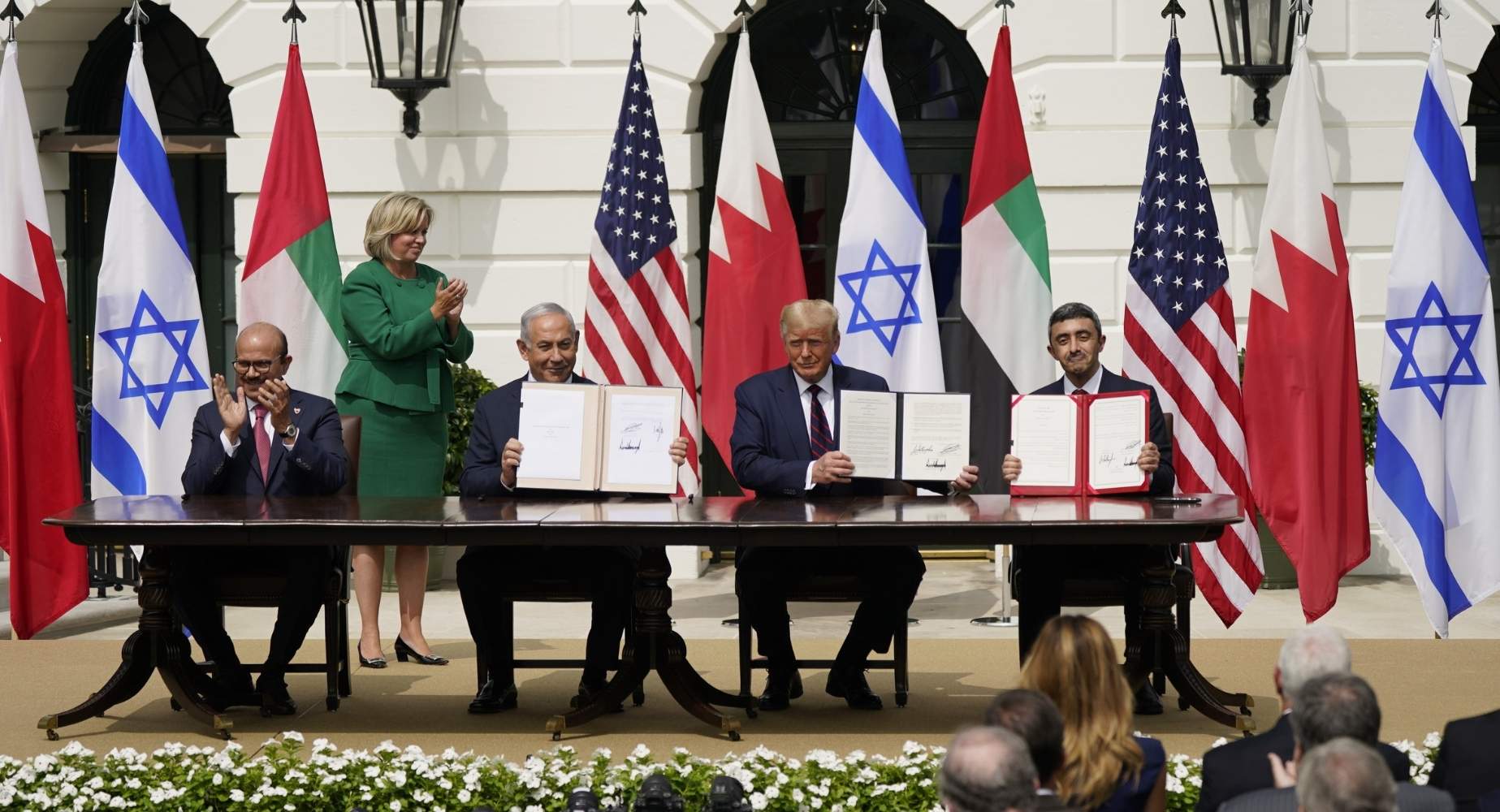
Suddenly, it seems, the Abraham Accords are back on the agenda.
Three years ago, hopes for a further expansion of the Middle Eastern political normalization wave unleashed by the Trump administration during its first term in office were still running high. Back then, numerous states – most conspicuously Saudi Arabia – seemed to be mere weeks away from some sort of diplomatic rapprochement with Israel.
Then came October 7, 2023. The horrific events of that day, which saw Hamas slaughter more than 1,200 Israelis, did more than fundamentally upend Israeli perceptions of the feasibility of making peace with the Palestinians. They (and the military offensive that inevitably came after) also drove a stake through the heart of what was then a promising regional drift toward integration.
Or so it seemed. Today, the Accords are in play once again – and the catalyst is Iran.
As part of its efforts to strike some sort of compromise with the Iranian regime, the Trump administration is currently in the process of strong-arming regional states into a more accommodating posture toward Israel. On May 25th , the President messaged on social media that he was “mandatorily requesting” countries like Saudi Arabia, Qatar, Turkey, Egypt, Jordan and Pakistan to sign on to the Accords as part of a prospective U.S. deal with Iran that is now in the works.
The idea, moreover, doesn’t seem to be an idle one. At a cabinet meeting a couple of days later, Trump again raised the issue, telling reporters that he believes these countries “owe it” to the United States to come on board.
For Washington, the calculus is clear. At home, President Trump is fighting a rear-guard action against Republican critics and political opponents alike, who for the moment seem united by the idea that the emerging agreement with Iran is beginning to look an awful lot like the Joint Comprehensive Plan of Action (JCPOA) negotiated by President Obama back in 2015.
That’s a real problem for the White House, because Trump made his disdain for that particular deal a big part of his rhetoric while still on the presidential campaign trail – and ended up abrogating it midway through his first term in office. It stands to reason, therefore, that any new arrangement with Iran that looks remotely like the 2015 JCPOA opens the president up to legitimate criticism, with potentially catastrophic consequences at the ballot box this Fall. That seems to be why the White House has hit upon the idea of changing the conversation, making its talks with Iran not simply about reopening the Strait of Hormuz and the status of Iran’s nuclear program but a broader regional realignment as well.
The problem here is that the adversary gets a vote. And so does the region.
In Iran, opposition to the Abraham Accords has run deep for years. There is credible evidence that derailing an incipient Israeli-Saudi normalization was a core objective for Hamas in carrying out its October 7th massacre – and that doing so was shaped, at least in part, by signals from Iran, a major financier and sponsor of the group.
Fast forward nearly three years, and the same logic persists. Iran’s remaining regime is deeply antagonistic to a regional dynamic that, by its nature, would serve to sideline it in the Middle East. Moreover, since Iranian officials believe they currently hold the upper hand in their stand-off with Washington, Tehran has more incentive than ever to oppose and undermine it.
Then there is the region itself. Most Middle Eastern states were vocal backers of the joint American-Israeli military campaign against Iran when it started this Spring, because they understood very well the threat that Iran posed to their own regimes. But the conflict hasn’t gone nearly as well as regional capitals initially hoped it would, and the uneasy stalemate that exists now has the potential to be locked in by an emerging U.S.–Iranian arrangement. Meanwhile, the United States has done precious little, at least so far, to bolster the security of Iran’s nervous neighbors, even as it is becoming increasingly clear that the regime in Tehran isn’t going anywhere for the moment. Against this backdrop, regional capitals are going to be understandably loath to initiate a political process that might put them even more squarely in the Iranian crosshairs.
That brings us back to Washington. The Abraham Accords were unquestionably the signal foreign policy achievement of President Trump‘s first term. And the arrangements among Israel, Bahrain, Morocco and the UAE still persist, despite the political tumult of the region after October 7th. They do because the strategic logic underpinning them – built around greater geoeconomic opportunity and beefed-up collective security – remains sound. Those factors remain the most durable basis for expanding the Accords. By tying the Accords to the current Iran conflict, the Trump administration risks turning what was previously seen by regional states as a strategic opportunity into something approaching an unwelcome obligation. Doing so would end up serving neither the Accords nor U.S. regional policy well.