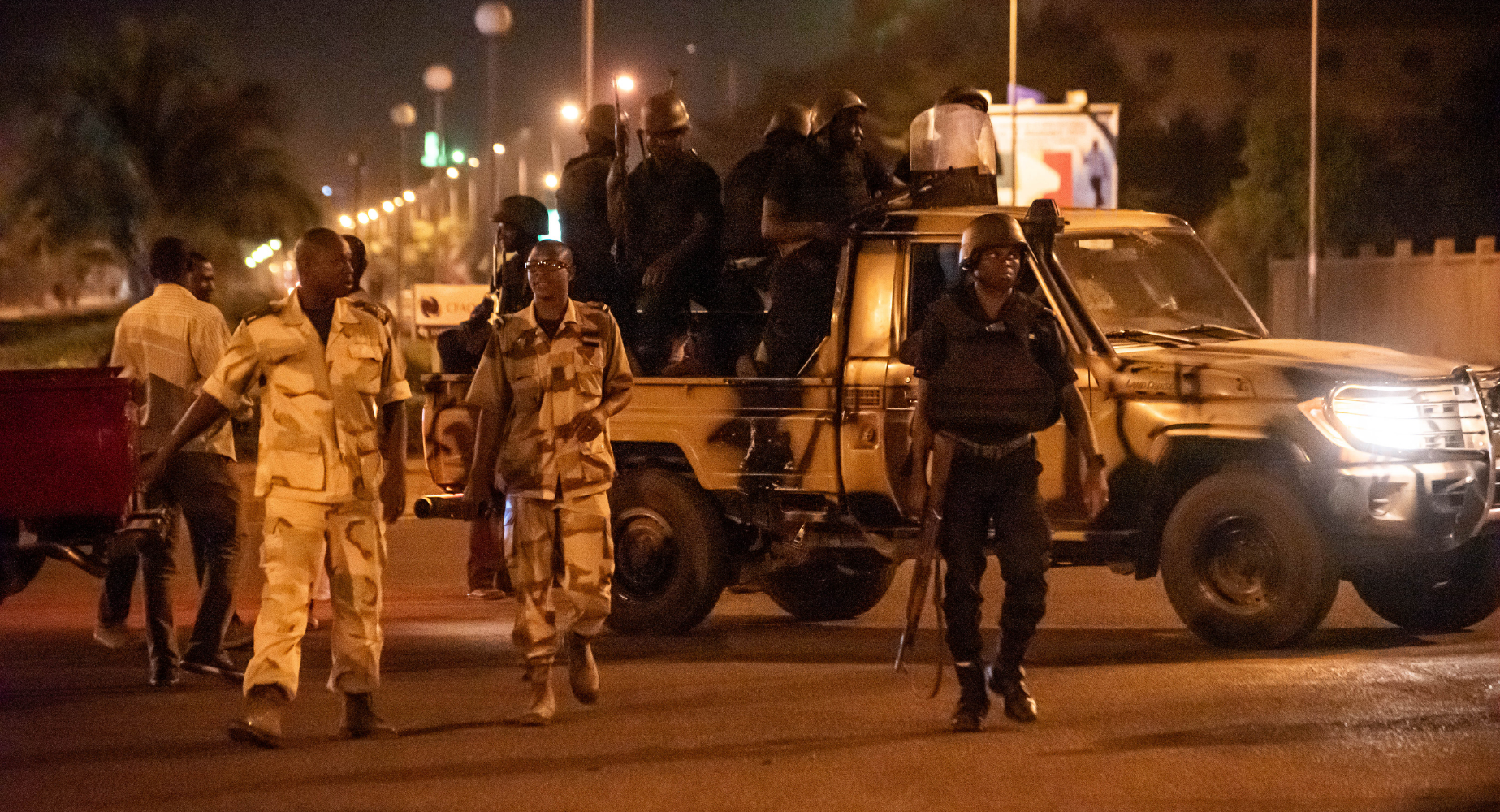
Over the past year, Jihadist terrorism in the Sahel region of Africa, especially in Mali, has reached a new level of audacity. Global Jihadist organizations are carrying out bolder attacks, determined to tighten their encirclement around the state and undermine its stability.
In April 2026, this escalating violence was marked most notably by a large-scale attack in Mali that claimed the life of the country’s Minister of Defense. The Al-Qaeda affiliated terrorist organization JNIM, together with local separatist elements from the Tuareg tribe identifying themselves as the “Front for the Liberation of Azawad” (FLA), carried out a multi-front offensive. The attack focused on Bamako, Mali’s capital, as well as on military bases and additional targets in the north of the country, including territorial gains in cities such as Kidal, Gao, and Mopti. This offensive followed approximately six months of siege operations by JNIM against fuel convoys en route to Bamako, aimed at subduing this strategically and symbolically vital stronghold of roughly four million residents.
In June 2026, JNIM continued to pressure Mali’s ruling junta, using psychological tactics against the local population. The group announced a two-million-euro reward for anyone providing intelligence on the location of the junta’s leader, Assimi Goïta, and one million euros for the location of two top military commanders. This announcement came after the Malian government issued a similar bounty on the head of JNIM’s leader.
On July 4, JNIM and the FLA launched a massive offensive in the north of the country, attacking three military bases. The heaviest fighting took place in the town of Anéfis, where the militants besieged the local base. The Malian army claimed it killed over 300 insurgents through airstrikes in the city. A few days later, the government managed to regain some control over the area, while the militants withdrew partially but remained nearby, continuing their shelling and blocking reinforcements from arriving. At the same time, JNIM carried out several additional attacks in central Mali against army positions and bases of pro-junta militias, with dozens of casualties reported on both sides during the battles.
By August 2026, the Islamist terrorist group’s determination to defeat the state seemed to grow, backed by stronger cooperation with the local separatists of the FLA. This intensifying alliance continues to challenge the military junta’s grip on power, leaving Mali’s future deeply uncertain as the conflict spreads across the region.
Mali: A Chronicle of Instability and Rising Terrorism
Mali is a landlocked country in West Africa, situated along the Sahel belt separating the Sahara Desert from Sub-Saharan Africa. Its status as a “terror-afflicted” state is largely the product of developments over the past two decades, during which Tuareg separatist elements aligned themselves with Jihadist terrorist organizations operating in the region, primarily JNIM.
Until 2012, Mali experienced relative stability following its independence from French colonial rule in 1960. However, a military coup in 2012 triggered a civil war, which was exploited by Tuareg separatists and global Jihadist actors to seize control of large territories in the north and impose strict Sharia law. In 2013, France – then still maintaining a significant presence in Africa and supporting counterterrorism efforts alongside local partners – launched a targeted military operation against terrorist elements. This intervention led to a peace agreement between the Malian government and Tuareg rebels of the National Movement for the Liberation of Azawad.
The improved security situation granted Mali several years of relative calm, until renewed internal tensions erupted in 2021, culminating in another military coup and the establishment of a new regime. This time, however, French support came under sharp criticism from the ruling authorities, who ultimately expelled France, citing its perceived ineffectiveness in combating terrorism. The regime’s new anti-French stance included suspending security cooperation agreements and was soon followed by the replacement of French forces with Russian personnel affiliated with the Wagner Group, later rebranded as the “Africa Corps”. The Russian presence was accompanied by propaganda efforts that intensified public resentment toward France and reinforced anti-colonial nationalist sentiment in Mali and neighboring states.
The Formation of a Regional Tripartite Confederation
Mali’s pivot away from France and the West, coupled with its pro-Russian orientation, encouraged similar shifts in neighboring Burkina Faso and Niger. Successive coups in these countries (Burkina Faso in 2022 and Niger in 2023) sharpened their shared interests in forming a trilateral alliance to address security needs and establish a pan-African political front aimed at expelling Western influence while strengthening ties with Russia to combat rising terrorism. For comparison, prior to the coup, approximately 20,000 French, UN, and African Union troops were stationed in Mali; afterward, reliance shifted to a much smaller number of Russian Wagner personnel.
Amid the French withdrawal, this tripartite confederation – known as the Alliance of Sahel States (AES) also withdrew from ECOWAS, the regional organization of West African states, and accelerated its security cooperation with Russia and the Africa Corps. Their objective has been to combat Jihadist terrorism led by JNIM and its rival, ISSP, the Islamic State’s Sahel branch.
The Intensification of JNIM and ISSP Activity in the Sahel
Terrorism is not the sole driver of instability in the Sahel. Extremist organizations exploit existing vulnerabilities, including ethnic conflicts, poverty, weak governance, and severe climate challenges – to expand their influence, impose extremist Sharia governance, and establish territorial continuity that could enable broader geographic and logistical expansion.
In recent years, the Sahel has emerged as the epicenter of global terrorism, accounting for approximately 50% of all terrorist attacks worldwide. This trend has accelerated across Mali, Burkina Faso, Niger, and beyond, driven by the growing boldness of Jihadist groups affiliated with Al-Qaeda and ISIS, including JNIM (Jama’at Nusrat al-Islam wal-Muslimin) and ISSP (Islamic State Sahel Province).
Founded in 2017 as Al-Qaeda’s official affiliate in West Africa, JNIM represents a coalition of several Jihadist factions and continues to pose a significant threat to regional stability. Its influence extends beyond Mali into countries such as Benin, Côte d’Ivoire, and Togo. This is in addition to the longstanding activity of Boko Haram and its offshoots in Nigeria, as well as emerging links between criminal gangs in northwestern Nigeria and Salafi-Jihadist networks across the Sahel.
Parallel to JNIM’s activities, ISIS-affiliated groups including ISSP and ISWAP (Islamic State West Africa Province), active in the Lake Chad Basin and Nigeria, have also intensified their operations. Throughout 2025 and into 2026, both JNIM and ISSP (despite internal rivalries) have escalated their campaigns by capturing military bases and expanding territorial control, particularly in Mali and Burkina Faso. JNIM’s encirclement of Bamako over the past year exemplifies this growing threat.
Regional Responses and Emerging Opportunities
In response, Sahel alliance states have increased military operations, including large-scale ground offensives, including raids and coordination with local actors. They have also announced plans to establish a joint force comprising thousands of troops to operate in the tri-border region of Mali, Burkina Faso, and Niger. However, their inability to effectively counter terrorist groups independently has deepened their reliance on Russian support.
Russia has supplied armored vehicles, weaponry, technical guidance, and political backing. Yet Russian and pro-Russian forces have also suffered significant losses and operational setbacks, leading to a reduction in their presence on the ground. As of 2026, following the expulsion of French assistance, the Russian backing has likewise failed to deliver the desired results in curbing terrorism, which continues to tighten its grip – bringing Mali close to a loss of effective security control.
The successful cooperation between global Jihadist organizations and local insurgents in Mali could rapidly replicate in neighboring Burkina Faso and Niger. Given the demonstrated limitations of Russian support, this serves as a warning sign for these states regarding the need to diversify their security partnerships.
Against this backdrop, it is notable that Sahel states have begun cautiously re-engaging with the United States. In March 2026, reports indicated that the U.S. was nearing an agreement with Mali to resume aerial operations, including the use of drones for intelligence gathering against Al-Qaeda linked groups. This followed U.S. willingness to lift sanctions on Mali’s defense minister and other officials previously suspected of ties to Russian mercenaries.
The Trump administration, while adopting a transactional “Trade, not Aid” approach toward Africa during its second term, appears to recognize the strategic importance of maintaining stability and combating Jihadist terrorism in the Sahel and West Africa. This is likely tied in part to American economic interests, particularly given the region’s mineral wealth (Mali, for example, is a leading lithium producer in Africa). Notably, in the past year, the U.S. also conducted military operations alongside Nigeria to protect civilian populations targeted by Boko Haram.
Morocco has likewise expressed concern over the escalating terror in the Sahel, which it views as part of its strategic “backyard”. Rabat strongly condemned the attacks in Mali and expressed solidarity with the country. Moroccan Foreign Minister Nasser Bourita warned of a clear connivance between separatist movements and terrorist organizations undermining regional stability.
Morocco plays an active and influential role in the fight against Jihadist terrorism. It does so through hard security measures, including countering terrorist cells within its territory, alongside military cooperation with the United States and regional partners – recently demonstrated in the “African Lion” exercise. This, as well as through softer approaches, such as the “Atlantic Initiative”, which promotes to establish logistical and strategic connectivity between Sahel states (Mali, Chad, and Niger) and the Atlantic Ocean, and training programs for Muslim clerics from the Sahel aimed at preventing religious radicalization.
More broadly, Morocco’s engagement in the Sahel also reflects its ongoing rivalry with Algeria for regional influence. In April 2026, Mali officially declared its support for Moroccan sovereignty over Western Sahara, amid Mali’s rising tensions with Algeria. In July 2026, during a cooperation conference held in Bamako, the Foreign Ministers of Morocco and Mali signed a joint statement committing to further strengthen bilateral cooperation, including in the fields of economy and trade.
Conclusion
The potential growing alignment between Mali, Morocco, and the United States, alongside the waning effectiveness of Russian support, may present an opportunity for developing multilateral cooperation frameworks. Such frameworks could position Morocco as a valuable moderate regional partner for the United States, particularly in countering the spread of global Jihadist extremism.
This dynamic could also serve as a practical extension of the moderate regional vision embodied in the Abraham Accords, potentially opening the door for Israeli involvement. Israel could contribute its extensive expertise in counterterrorism, alongside humanitarian assistance and cooperation in fields such as climate, agriculture, water, and healthcare.
The long-term risks posed by the continued expansion of Jihadist terrorism extend far beyond the Sahel. The potential spillover effects on Europe and the Middle East underscore the urgency of coordinated international intervention to stabilize the region.