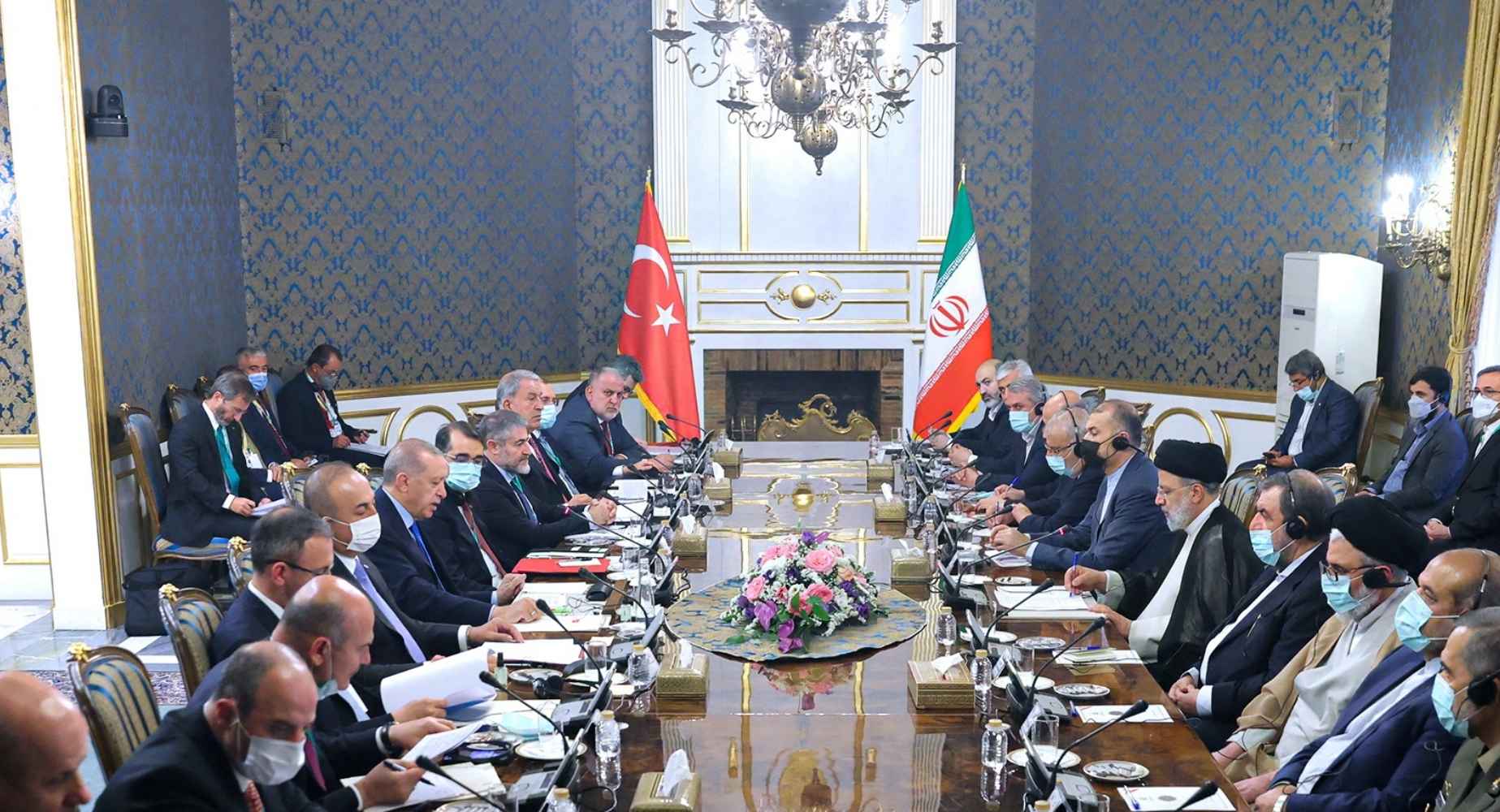
When missiles fall near Turkish territory, the expectation is usually clear: Ankara will answer with forceful rhetoric, calibrated signaling, and an emphatic defense of sovereignty. Yet when the source of that threat is Iran, Turkey’s response reveals a deeper strategic paradox. Even as Tehran tests Turkish red lines, Ankara remains reluctant to embrace any scenario that could bring about the fall of the Islamic Republic. This is not because Turkey trusts Iran, nor because it is indifferent to Iranian pressure. It is because, in Ankara’s view, the collapse of the current order in Tehran could produce a regional realignment far more difficult to manage than the uneasy status quo now in place.
On March 20, air raid sirens blared for the fourth time near İncirlik Air Base in Adana, southeastern Turkey. While the Turkish Ministry of Defense dismissed the event officially as a false alarm, social media reports of an explosion suggest authorities may be concealing a kinetic event to avoid the political pressure of responding to a sovereignty violation.
In the immediate aftermath of the incident, a written statement attributed to Iran’s new Supreme Leader, Mojtaba Khamenei, dismissed the missile attack against Turkey as a “false flag” operation and pointed the finger at Israel, even as Ankara denied the attack had taken place at all. Khamenei’s framing, however, sat uneasily alongside earlier statements by Turkish Foreign Minister Hakan Fidan, which made clear that Ankara understood Iran was the true source of the ballistic missile fire.
This follows a similar incident on March 13, occurring just one day after Ankara reaffirmed that İncirlik remains under absolute Turkish authority despite the American presence. Tehran’s recent provocations, however, increasingly challenge that narrative. The strike on Adana followed earlier reported missile incidents involving Hatay on March 4 and Gaziantep on March 10, both of which were intercepted by NATO air defense systems. After the first episode, Turkish officials appeared to favor strategic ambiguity, with reports suggesting that the missiles may have been intended for Cyprus rather than Turkey itself. But Iran’s subsequent actions, including drone attack on Azerbaijan, made that posture increasingly difficult to sustain.
Through active telephone diplomacy, Turkish President Recep Tayyip Erdoğan appears to have encouraged Azerbaijani President Ilham Aliyev to exercise restraint, while Baku reserved its right to respond at a later stage. Even so, the broader message of recent days is unmistakable: Iran has demonstrated a willingness to test the patience not only of Israel, but also of neighboring states that have thus far sought to remain outside the core of the confrontation.
This places Turkey in an increasingly uncomfortable position. On March 11, Erdoğan warned that “those who reach out a hand against Turkey will have their hands burned, and those who speak against Turkey will have their tongues burned.” Such language may serve domestic political purposes, but it also narrows Ankara’s diplomatic room for maneuver. Once public red lines are drawn, a government must respond in a manner that preserves deterrence without inviting a wider escalation.
Yet Turkey’s likely course of action remains uncertain. That uncertainty is not merely the product of the present crisis. It is rooted in a much longer historical pattern. Turkey and Iran — and before them, the Ottoman and Safavid empires — have not fought a direct conventional war since the Treaty of Zuhab in 1639. Their rivalry has endured for centuries, but it has generally been managed indirectly, through competition in Iraq, Syria, and the Caucasus rather than through open warfare across their shared frontier.
This historical legacy helps explain why Ankara remains wary of any scenario that could bring about the sudden collapse of the Iranian regime. Even when confronted with Iranian actions that challenge Turkish sovereignty, Ankara appears reluctant to endorse a broader project of regime change in Tehran. This position should not be mistaken for sympathy toward the Islamic Republic. Rather, it reflects a sober if controversial calculation: the alternatives may be even more destabilizing than the current order.
At the heart of this calculation lies a broader trend where Turkish foreign policy often prioritizes Neo-Ottomanist and Pan-Islamist ideologies over strictly national interests. This approach operates within a self-constructed illusion of an “Israeli threat.” By opposing the collapse of the Iranian regime, Ankara pursues a strategy that is rooted in a flawed premise yet has evolved into a form of pseudo-realpolitik. As can be recalled since the Hamas attacks of October 7, 2023, and the war that followed, relations between Ankara and Jerusalem have deteriorated sharply. Over the course of 2025, Turkish rhetoric increasingly portrayed Israel not merely as a rival state, but as a central strategic challenge. Within that framework, many in Ankara appear to believe that a post-Islamic Republic Iran would be more open to cooperation with Israel and the West, thereby reshaping the regional order in ways unfavorable to Turkey.
From Ankara’s perspective, such an outcome could contribute to a new geopolitical alignment linking the new Iran more closely with Israel, Greece, Cyprus, the United Arab Emirates, and India. Turkish officials and analysts have long warned against what they see as a pattern of strategic encirclement. In that sense, the current Iranian regime — despite its ideological distance from Turkey and its increasingly assertive behavior — may still be viewed as a familiar and, in some respects, containable actor within an imperfect regional equilibrium. Moreover, given Turkey’s deepening ties with Russia and China in recent years – especially regarding BRICS and the Shanghai Cooperation Organization – Ankara is left questioning how long the West will continue to tolerate its divergent policies once a regime change occurs in Iran.
There is also a broader question of Turkey’s place in Western strategy. Since 1979, Ankara has often benefited from being seen as a uniquely important Muslim-majority NATO member: at times difficult, but nonetheless indispensable. A future Iranian government seeking normalization with the West could dilute that perception. For Turkey, the emergence of another large, historically consequential, Muslim-majority state eager to rebuild ties with Washington and Europe would inevitably affect its own relative leverage in transatlantic policymaking.
Such a shift would have implications beyond diplomacy. If Iran were no longer the principal focus of Western concern regarding authoritarian governance and regional destabilization, greater scrutiny could fall on Turkey’s own democratic trajectory, institutional balance, and treatment of political opposition. At a time when the Turkish domestic political climate is already under close observation, such a reorientation of Western attention would not be insignificant.
Turkey’s concerns, however, are not confined to matters of alignment and influence. They are also shaped by the experience of the Syrian civil war. Between 2011 and 2024, Turkey hosted more than four million Syrian refugees. Although the Erdoğan government initially framed this policy in humanitarian and religious terms, the domestic social and economic consequences were profound. Housing pressures intensified, low-skilled labor markets came under strain, and anti-refugee sentiment deepened across much of Turkish society.
That experience weighs heavily on Ankara’s thinking today. Turkish officials are likely concerned that a sudden collapse in Iran could trigger a new refugee flow toward the Turkish border, especially if regime loyalists, vulnerable minorities, or civilians caught in transition sought to leave the country. In such a scenario, Ankara might consider some form of border security or humanitarian containment mechanism in order to prevent large-scale displacement from spilling directly into Turkish territory.
A further – and perhaps even more sensitive – concern is the Kurdish question. Turkish policymakers are acutely aware that major political change in Iran could create new opportunities for Kurdish political mobilization in Iranian Kurdistan, or Rojhilat. Given the symbolic place of that region in Kurdish political history – including its association with the short-lived Mahabad Republic of 1946 – developments there would be followed very closely in Ankara.
From the Turkish perspective, the issue is not confined to Iran alone. A reconfiguration of state-Kurdish relations in Iran could affect Kurdish political expectations across the wider region, including in Iraq, Syria, and Turkey itself. It is in this broader context that Ankara’s own Kurdish policy initiatives in recent years should be understood: not only as matters of domestic security, but also as part of a wider effort to manage the possible regional consequences of upheaval beyond Turkey’s borders.
For all these reasons, Turkey’s policy toward Iran is often read too narrowly. Ankara’s caution does not necessarily reflect trust in Tehran, nor does it imply comfort with Iranian assertiveness. Rather, it reflects a strategic judgment that the collapse of the current order in Iran could unleash a chain of consequences — geopolitical, demographic, and political — that Turkey would find difficult to contain.
This does not mean Turkey can absorb Iranian pressure indefinitely. Missile strikes on or near Turkish territory, whatever their intended target, place real stress on Ankara’s long-standing preference for calibrated ambiguity. The more direct the threat becomes, the harder it will be for Turkey to preserve the distinction between strategic caution and strategic passivity.
That is the essence of Ankara’s dilemma. Turkey seeks to deter Iranian encroachment without encouraging a broader unraveling of the regional order. It wants to defend its sovereignty without opening the door to a post-regime scenario in Tehran that could weaken its strategic position, intensify refugee pressures, and reshape the Kurdish question across the region.
In the unfolding 2026 war – marked by operations such as “Roaring Lion” and “Epic Fury” – Turkey is therefore confronting two imperatives that do not sit easily together. The first is the need to respond credibly to direct threats. The second is the desire to preserve a regional balance that, for all its dangers and contradictions, may still appear in Ankara less perilous than the uncertainties that could follow the fall of the Islamic Republic.
For Turkey, then, the issue is not whether Iran poses a threat. It plainly does. The real question is whether the collapse of the Iranian regime would produce a more stable neighborhood — or a far less predictable one. For now, Ankara appears to have reached its conclusion: a contentious but familiar Tehran may still seem preferable to a transformed Iran whose consequences no one can fully foresee.