The economic fallout of the Ukraine war, compounded by the EU’s energy decoupling from Russia and massive EU support for Kyiv, is driving a sharp cost-of-living crisis that has ignited mass protests across Europe in recent weeks, with the potential to reshape the continent’s political order.
The unrest began in France in late September, when lycée students blockaded schools over teacher shortages, dilapidated facilities, and underfunding. These actions quickly broadened into nationwide demonstrations against soaring living costs, housing, and the decline of public-services. On October 17, French authorities estimated more than 550,000 participants took part in nationwide demonstrations. Protests on October 24 drew roughly 410,000, according to the Interior Ministry, although the trade unions claimed nearly 800,000 took part. The protests turned violent in Paris, Marseille, Lyon, and elsewhere, with looting, arson (including the city hall in Limoges), and clashes that produced over a thousand arrests and injured hundreds of police officers. La France Insoumise (LFI) and its leader Jean-Luc Mélenchon aligned with the protesters, while trade unions and elements of the Yellow Vest movement joined.
The protest movement has spread very rapidly. Belgian students protested education cuts and fees in Brussels and Liège, facing off against tear gas and water cannon. Italian students and others marched in Milan, Turin, Bologna, and Rome over wages and prices, with some violence; unions planned further strikes. In Spain, housing protests, triggered by the eviction of an elderly Madrid resident after a 230% rent hike, drew large crowds and solidarity with French protest actions, prompting a general strike call. Greek students and teachers demonstrated in Athens and dozens of cities for funding and housing. Emerging protests in Portugal, Albania, Germany, and Austria reflected similar themes: frustration over prices, education, and budget priorities. A common thread running through the protests was the conviction that European governments are failing to provide everyday economic security and basic public services.
These pressures stem directly from the energy shock that followed Russia’s 2022 full-scale invasion of Ukraine. Before the war, Russian pipeline gas supplied a large share of EU needs at relatively low cost. EU and member-state decisions to phase out that supply, accelerated by subsequent sanctions, forced the EU to pivot to more expensive liquefied natural gas (LNG), primarily from the United States, with additional volumes from the Persian Gulf and elsewhere. European imports of LNG from the U.S. rose sharply. Europe more than tripled its import volumes of American LNG from 2021 to 2025. The US now accounts for a dominant share of the EU’s LNG and roughly 30% of total gas imports. Pipeline gas from Russia has largely disappeared from the market, replaced by higher-cost LNG whose price includes liquefaction, shipping, and regasification expenses.
Since Russia’s full-scale invasion of Ukraine in 2022, European wholesale natural gas prices — tracked primarily through the Dutch TTF (Title Transfer Facility) benchmark, a virtual trading hub in the Netherlands that serves as the main reference price for gas across the continent — have undergone a lasting shift. Before the war, TTF prices were typically much lower, often in the €15–30 per megawatt-hour range during calmer periods. The 2022–23 energy crisis, triggered by the cutoff of cheap Russian pipeline gas supplies, drove prices to extreme peaks above €300/MWh. These record highs later eased, but prices did not return to pre-war levels; instead, they remained structurally elevated because Europe chose to replace Russian pipeline gas with more expensive liquefied natural gas (LNG) from the United States and other suppliers. By 2026, this higher “new normal” was still in place, with prices often around €80–90/MWh, some three to six times higher than pre-war norms. In short, while the acute price spike for natural gas has faded, everyday European gas prices have settled into a permanently higher range that is ravaging both consumers and industry.
The Iran war brought additional energy supply disruptions, including Strait of Hormuz constraints affecting Qatari and other Gulf LNG. Meanwhile EU energy storage has lagged seasonal averages. The result of these trends has been broad inflation. In France, where the current protests began, energy prices rose 21.3% year-on-year in September 2026. Petroleum products were up by 36 percent, while diesel rose diesel 44 percent. Of course, the effects of massive inflation in energy prices have hurt the entire European economy, including industry, food supplies, transportation, and household expenses.
Indeed, the total additional cost of energy for the EU has amounted to approximately €900 billion since 2022, even while overall demand has fallen. The impact of this massive inflation has not been evenly spread. Energy-intensive economies such as Germany have been hit especially hard, while a few countries with different supply mixes or more domestic production have felt less pain. Non-EU countries in Europe, such as the United Kingdom, Norway, and Switzerland, have also faced higher energy prices.
Simultaneously, the EU and its member states have committed enormous resources to Ukraine. Their cumulative support since 2022 stands at approximately €231.5 billion, including roughly €117.3 billion from or guaranteed by the EU budget (i.e., the Ukraine Facility, macro-financial assistance, and other instruments. It includes as well €77.9 billion in military assistance, support for refugees, bilateral national aid, and proceeds from frozen Russian assets. A further €90 billion in the form of the Ukraine Support Loan for 2026–27 continues to flow, with recent disbursements for drones, missiles, air defense, and ammunition. While this aid has sustained Ukraine’s budget and military, it represents a significant fiscal claim on Europe amid high debt levels and competing domestic needs.
The political consequences of these policies are already visible in the EU’s two largest economies. In France, ahead of the 2027 presidential election, Marine Le Pen of the National Rally consistently leads first-round polls at 33–36 percent, with second-round matchups often favoring her over centrist or leftist rivals in recent surveys. In Germany, the AfD has become the most popular party in multiple polls, registering 26–30 percent, ahead of the CDU/CSU, in a development reflecting discontent over energy costs, migration, and economic performance under the post-2025 government. Along with powerful economic discontent, anti-immigration sentiment is a potent political force across the region.
Moreover the EU’s massive support for Ukraine has failed to produce a fundamental change in the war’s trajectory. On the battlefield Russian forces continue their slow advance in the Donbas, as they press toward the remaining Ukrainian-held portions of Donetsk Oblast and key fortress cities such as Kramatorsk and Sloviansk. Meanwhile the war’s continuation sustains the energy and fiscal burdens borne by Western Europe.
If the current unrest in Europe continues to grow and spread, it will produce an overturning of the European political order on a scale not seen since 1917. The combination of structurally higher energy costs from Europe’s energy decoupling from Russia, consequent inflation, massive expenditures for Ukraine, and grievances over immigration and public services has already shifted the electoral spectrum toward parties critical of the EU and the political status quo. The protests of autumn 2026 mark a clear inflection point in Europe’s political trajectory. The economic consequences of the Ukraine crisis are no longer an abstract issue. They are leading the continent toward a new era of political revolution.
Ukraine and the Coming Revolution in Europe
by
October 2026
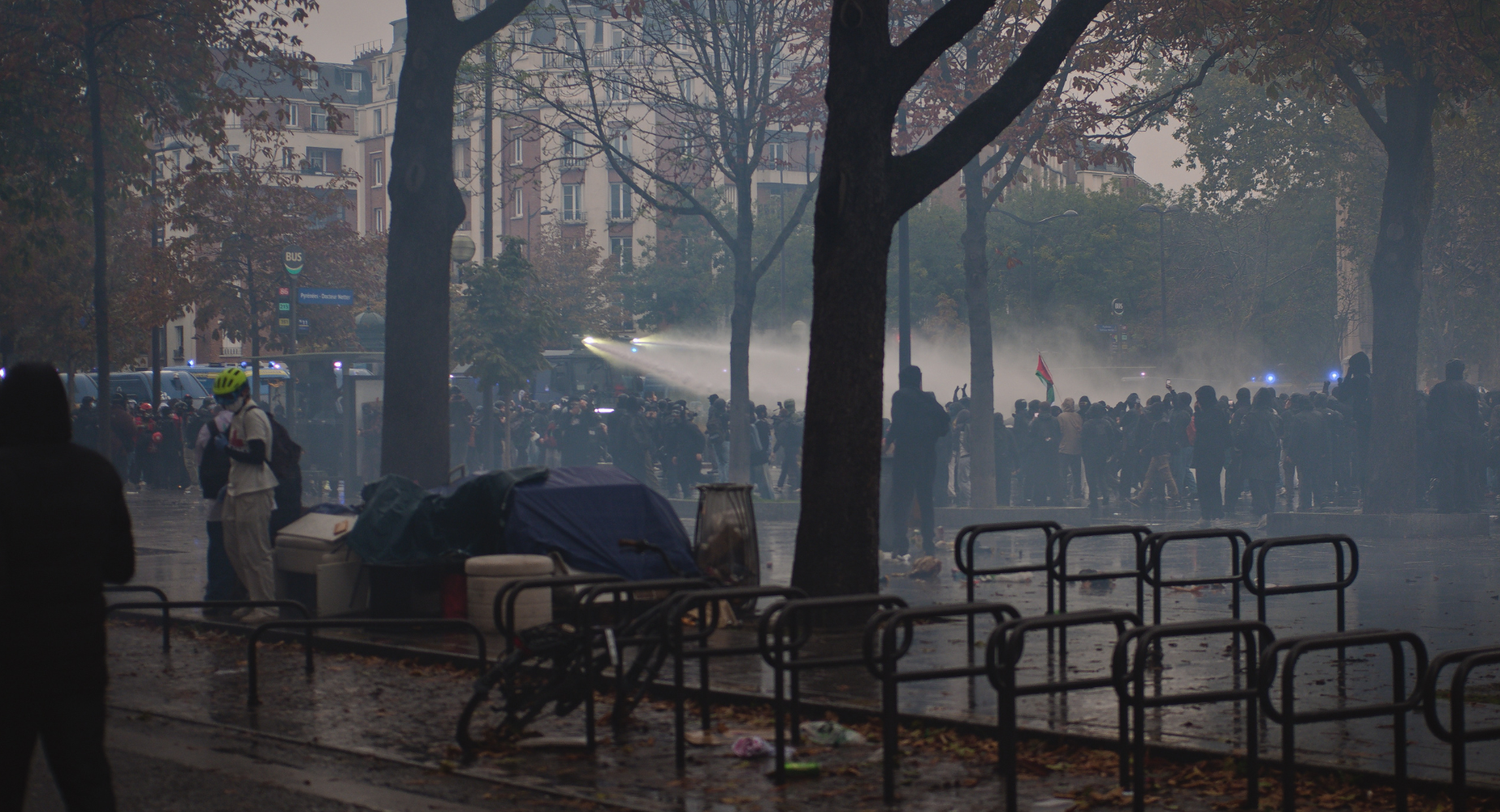
Law enforcement uses water cannons against protesters in Paris on October 24, 2026. Credit: Djoudi Hamani / Hans Lucas via Reuters Connect
Recent Articles
Ukraine and the Coming Revolution in Europe
The economic fallout of the Ukraine war, compounded by the EU’s energy decoupling from Russia and massive EU support for Kyiv, is driving a sharp cost-of-living crisis that has ignited mass protests across Europe in recent weeks, with the potential to reshape the continent’s political order.The unrest began in France in late September, when lycée […]
Alliances Without Obligation: The Middle East After October 7
The Middle East has rarely had so many partnerships, strategic agreements, and security arrangements, and rarely has it been so unclear who would fight for whom. The wars that followed Hamas’s October 7, 2023, attack exposed a basic weakness in Middle Eastern politics. The region is full of partnerships, strategic agreements, summits, and security arrangements, […]
Washington Must Learn From Its Own Successes
America’s greatest achievements have never belonged to one political party. They belong to the nation—and often to the world. American leadership has required people capable of recognizing possibilities that established opinion considered unrealistic. Yet Washington too often allows political rivalries to overshadow genuine accomplishments. A diplomatic breakthrough should be judged by what it changes in […]