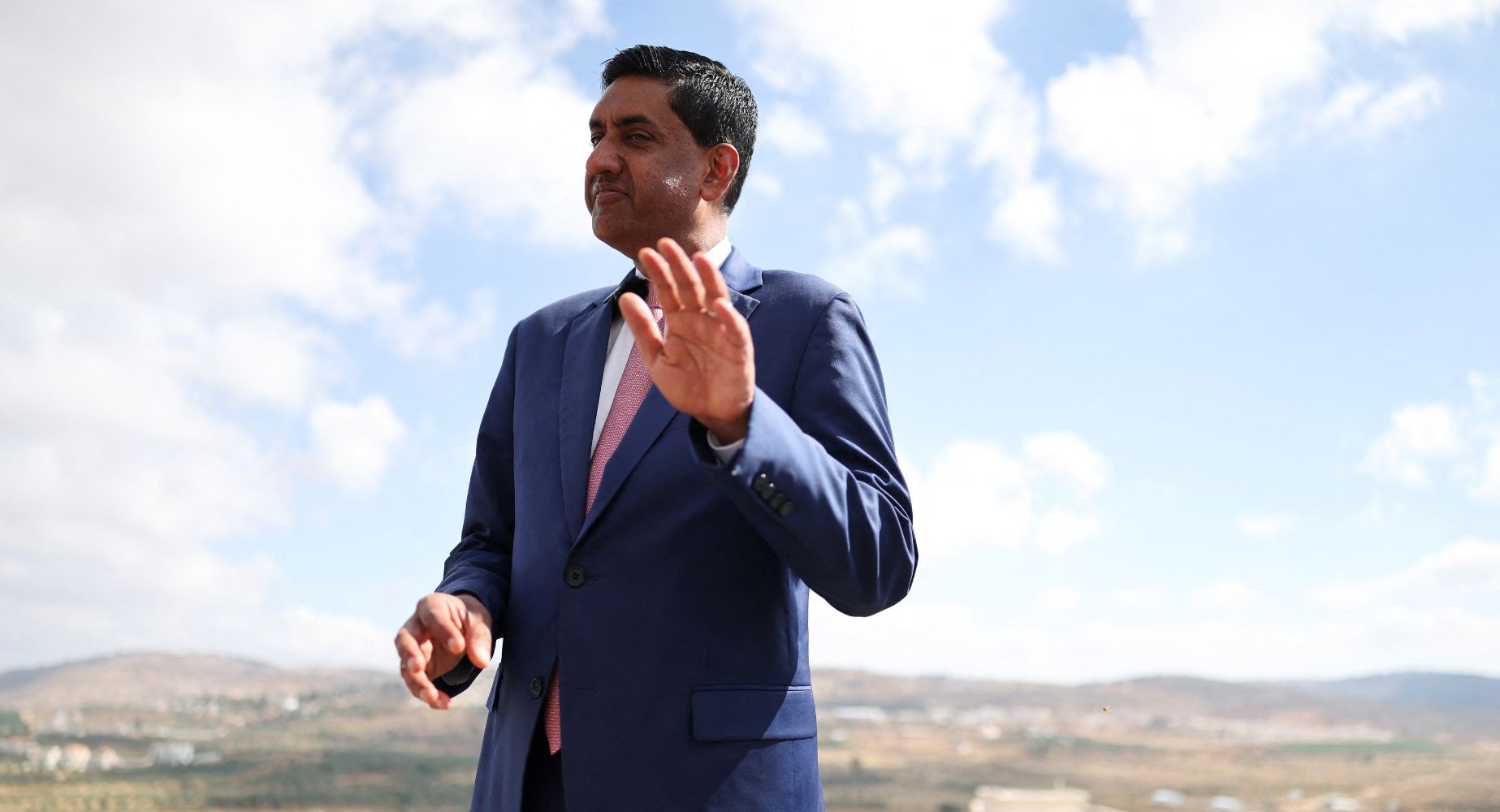
Representative Ro Khanna of California’s 17th district is a fervent champion of the Palestinian cause. He views the issue of Palestine as a “rallying cry” for realizing a “moral American foreign policy.” On September 19, 2025, the Congressman demonstrated his fervor by authoring a letter to President Trump (signed by 47 progressive members of Congress) requesting U.S. recognition of a Palestinian state. In July of this year, he took his passion and American activists to the West Bank to witness “firsthand” the Palestinian situation and continue his advocacy for a state.
Representative Khanna’s actions and argument in support of Palestinian statehood are representative of the questionable foreign policy declarations and thinking prevalent among members of the Congressional Progressive Caucus. Their over indulgence in activism, empathy, emotion and self-righteousness blinds them to broader contexts and repercussions. The beliefs, feelings and ideology regarding Palestine conceptualize a policy that is either unachievable, unsustainable or essentially subjective and hierarchical (ideas progressives claim to confront).
For example, the Congressman from California propounds a “moral U.S. foreign policy” rooted in the principles of “dignity” and “humanity” to make his case for Palestinian statehood. He claims that providing self-determination to the 5-6 million Palestinian residents of the West Bank and Gaza is “long overdue.” But Representative Khanna is unclear about whether his idea of a “moral U.S. foreign policy” and the principles defining it extend to other nations seeking statehood.
Congressman, what about the 30 million Kurdish people occupied, oppressed, separated, dislocated and denied statehood by the Turkish, Syrian, Iraqi and Iranian authorities? After a century of suffering, are they not deserving of dignity, humanity and self-determination too? The Kurds and their land have been subjected to war crimes, cultural genocide, ethnic cleansing, colonization, massacres, marital law, political disenfranchisement, deportation and economic impoverishment. Their attempts to create a state have been suppressed and opposed.
In Turkey, Syria, Iraq, and Iran, the Kurdish identity has been denied and criminalized. For years, Turkish authorities claimed there was no Kurdish ethnicity only a people identified as “mountain Turks.” Syrian Kurds experienced the disenfranchisement of their rights. Saddam Hussein, the Baathists in Syria and Turkish governments encouraged their Arab and Turkish populations to settle in predominantly Kurdish lands. It is not a coincidence that Masha Amini, the woman whose death in police custody for defying modesty laws that sparked protests in Iran, was a Kurd.
Decades of brutality accompanied the ethnic cleansing and colonization. The effects and trauma of violence endure to this day. The more notable deadly and destructive examples include the gassing of thousands of Kurds and the Anfal campaign that claimed over a hundred thousand Kurdish lives in Iraq, declaring a jihad against the community in Iran, razing and depopulating over a thousand villages in southeastern Turkey and the Turkish invasions and occupations of Syrian and Iraqi territory.
An underreported story of the U.S.-Iran conflict is the bombardment and drone strikes in northern Iraq by Iran. They even occurred during the U.S-Iranian “ceasefire.” The relentless and ruthless campaign is just the latest violation of Iraqi sovereignty by Iran in its efforts to degrade its Kurdish community by eliminating leadership (even in exile).
Kurdish areas are economically marginalized and underdeveloped. In Turkey, the average per capita income of Kurdish areas is one-third the average of the rest of the country. The Iraqi government refuses to release all of the funding designated to the Kurdish area of northern Iraq. Iranian Kurds suffer from some of the highest unemployment rates in the country.
If these examples are insufficient, like his recent travails in the West Bank, the Congressman can witness firsthand the inhumane treatment and occupation of Kurdish territory. Surely there are Kurdish-American activists willing to take him to areas of southeastern Turkey, parts of northeast Syria and the most northern parts of Iraq where crimes and oppression regularly occur.
An unsupervised trip (like the one in the West Bank) will trigger pushback, interference and possible detention by NATO ally (and recipient of U.S. arms sales) Turkey, Turkish-backed militias in Syria, the U.S.-friendly Iraqi government and the Syrian government. Obviously, they will not appreciate the Congressman observing and commenting on the inequities and injustice faced by the community. But speaking truth to power is fundamental to advancing a “moral U.S. foreign policy.”
When Representative Khanna enters northern Iraq and northeastern Syria, he should be prepared to answer difficult questions because he has been inconsistent about what he believes. Why did he remain silent about the 2017 referendum for Kurdish self-determination in northern Iraq? He also failed to oppose the dissolution of Rojava—a 10-year-old predominantly Kurdish autonomous zone with unprecedented huma rights—and the reintegration of the area into the Syrian-Arab state and society.
Khanna’s unwillingness to publicly support a Kurdish state, particularly in Iraq, is puzzling because of the benefits to U.S. national security. A Kurdish state is geo-strategically advantageous due to its close proximity to the Islamic Republic of Iran. The Kurds have also proven to be reliable allies in the territorial defeat of ISIS. The one thing the U.S. can never have enough of in the ever-volatile Middle East is allies.
It is difficult to imagine a similar relationship with a Palestinian state even in the wake of U.S. support for its creation. The Palestinian Authority resists U.S. requests for reform to effectively govern a future Palestinian state. The lack of cooperation is compounded by significant portions of the population still maintaining an affinity for Hamas and Palestinian Islamic Jihad (or at least their maximalist ideology). It is also hard to forget the Palestinians handing out sweets to celebrate the 9/11 attacks.
What does Representative Khanna exactly seek with his “moral U.S. foreign policy” defined by the precepts of humanity, dignity and self-determination?
A foreign policy that is empathetic and supportive of the aspirations of various nations around the world? If so, the Congressman is proposing a foreign policy that is essentially boundless, disruptive and intrusive (even with U.S. allies) for an America with finite resources, limited time, security priorities and a need for allies. While it may bring brief happiness to millions across the world, it will not advance U.S. security, only complicate and hinder it.
Or does the Representative from California, seek a U.S. foreign policy that engages in statehood sweepstakes? If so, Khanna and his progressive peers in Congress are advocating a policy that creates a hierarchy of victims. The 5-6 million Palestinians are somehow more deserving of statehood than the 30 million Kurds, the millions of Amazigh and other nations? Why do the Palestinians have a monopoly on victimhood? It does not bode well for a credible moral foreign policy or as self-proclaimed champion of equity and inclusivity.
Congressman Khanna and members of the Congressional Progressive Caucus cannot have their cake and eat it too.