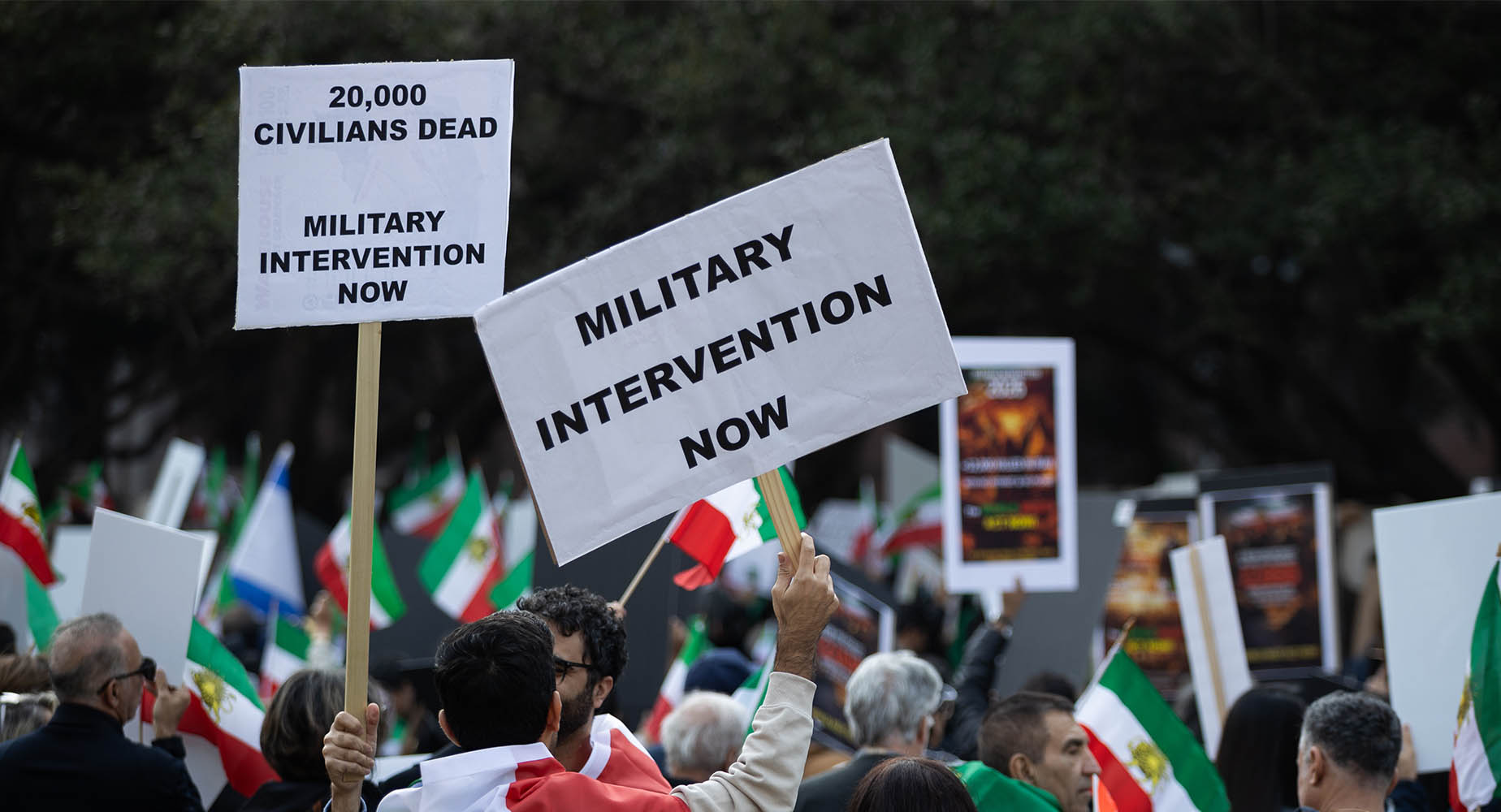
As with many contemporary challenges, the case for foreign intervention in Iran has a clear precedent: NATO’s intervention in the former Yugoslavia against the murderous regime of Serbian president Slobodan Milošević.
That regime did not pose a direct military threat to NATO. Instead, the intervention that took place was moral and humanitarian, initiated in response to the mass violence and ethnic cleansing that ensued upon the breakup of Yugoslavia. Milošević’s ambition was to create a “Greater Serbia.” By fomenting hatred against Bosnian Muslims, Milosevic helped create an ethnic powderkeg in the heart of Europe, one that required American military power to defuse it and that became a signal foreign policy triumph for the Clinton administration.
Indeed, Clinton’s decision to protect Bosnians marked a turning point in international politics. It legitimized the principle that protecting civilian populations can supersede absolute national sovereignty, and eroded the traditional distinction between internal repression and international conflict when fundamental human rights were at stake.
It’s worth recalling how Clinton’s decision came about. After hesitating for several years, Clinton approved NATO’s Operation Deliberate Force, a sustained air campaign against Bosnian Serb military targets. Four years later, in 1999, Clinton flexed the West’s military might once more–NATO conducted Operation Allied Force, striking Serbian military infrastructure and regime assets in Kosovo to protect ethnic Albanian civilians who were facing the prospect of mass slaughter.
These actions forced Serbia to negotiate the Dayton Accords, ended the Bosnian war, and compelled Serbian forces to withdraw from Kosovo. The Milošević regime ultimately collapsed and the Serbian leader ended up on trial for war crimes in The Hague, along with several of his confederates, including Radovan Karadzic. While the region continues to face political, ethnic, and institutional challenges, it has not experienced large-scale interstate or civil war since.
Notably, this model of intervention has been applied in Libya in 2011 (with the support of a United Nations Security Council Resolution) but has not been replicated in other humanitarian catastrophes—such as those in Sudan or Nigeria—where the international response has been limited largely to economic sanctions rather than military action.
Iran as the Next Test Case
Current negotiations with Iran are futile. Even if they should succeed, they would only ensure the survival of the Iranian regime. Given the regime’s ideological fanaticism, its continued endurance will remain a persistent challenge for neighboring states. Iran is unlikely to abandon its support for terrorist proxies, even if it formally commits to doing so on paper. Likewise, the regime will continue to pursue nuclear weapons as it rebuilds its defense systems and applies the lessons learned from the June 2025 “12-Days War.”
Any such agreement would be comparable to the Molotov–Ribbentrop non-aggression pact, which Germany and the Soviet Union signed to buy time and divide Poland while rebuilding their military capabilities—an approach that ultimately led to a catastrophic war. In this analogy, Iran mirrors both regimes: states led by ruthless leaders who exploited diplomacy not for peace, but for strategic advantage.
This is why Iran presents a compelling case for revisiting the Balkan precedent. Current tensions between the United States and Europe may complicate transatlantic coordination. Ideally, the U.S. administration would succeed in persuading European allies to participate in a targeted air campaign against regime military bases and Iranian Revolutionary Guards. It is reasonable to assume that once the regime is weakened, it will be easier for mass protests to topple the regime.
True, the challenge will not be over, because one big question remains–who will oversee Iran? The son of the late Shah, Prince Reza Pahlavi, could serve as a transitional figure until political parties organized and decided on a timetable for elections. This approach would help avoid a descent into anarchy and allow civil society to organize politically for future governance.
Like the Milošević regime, the Iranian theocracy has carried out mass killings of its own citizens, slaughtering tens of thousands in a matter of days. Some observers have compared these atrocities to the death toll inflicted by Argentina’s military junta during its seven-year rule. From a human rights perspective, the moral case requires little elaboration.
Unlike the Milošević regime, however, Iran poses a direct and ongoing threat beyond its borders. The Islamic Republic destabilizes the Middle East, threatens Israel, and endangers Western interests—including those of the United States, Europe, and Latin America. In Europe, Iran’s criminal and terrorist activities are well documented. In Latin America, Iran and Hezbollah maintain an entrenched presence.
If NATO proves unwilling to act, the United States and Israel should not rule out acting independently. Iran’s proxy forces—pro-Iranian militias in Iraq and Syria and the Houthis in Yemen—have repeatedly attacked U.S. forces and American allies, including Saudi Arabia, and threaten U.S. partners throughout the Persian Gulf.
Should the United States choose not to intervene, Israel may have little choice but to act alone. From Israel’s perspective, a political settlement in Gaza and the disarmament of Hamas will remain impossible so long as the Iranian regime continues to arm, fund, and direct its proxies. Moreover, Israel should not be expected to continue, as it has for the past two decades, to endure the threat posed by Iran’s advancing nuclear program and its sponsorship of terrorism on its borders.
It also goes without saying that a nuclear-armed Iran would constitute a grave global threat, triggering regional proliferation and dramatically increasing the risk of large-scale war. Multiple pathways exist for action—by NATO, by the United States and Israel, or by Israel alone. The end of the Iranian regime is not a question mark. It is a certainty.