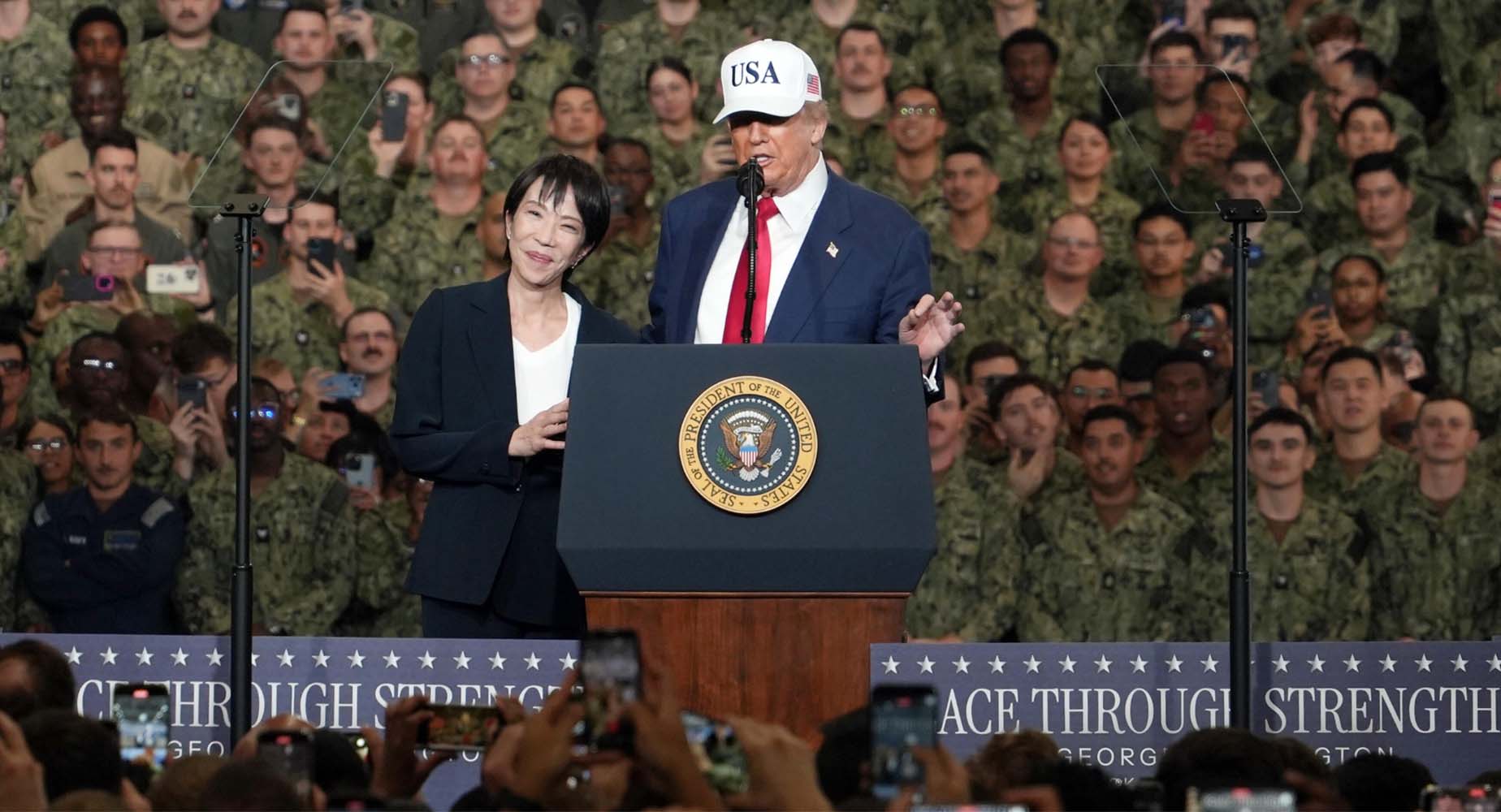
Your Sunday probably wasn’t as good as Sanae Takaichi’s. The Japanese prime minister romped to victory in her country’s general election, which handed the Liberal Democratic Party its biggest majority ever in the House of Representatives.
President Donald Trump, who had endorsed Takaichi, sent his congratulations and called her “highly respected and very popular” in a social media post. The results in Japan demonstrate that a Trump endorsement doesn’t always doom a leader’s campaign. Rather than bestow a “kiss of death,” his forays into elections can advance American interests overseas.
Takaichi was unafraid to embrace Trump. Just one week after becoming prime minister in October, she spoke alongside him from the aircraft carrier USS George Washington. She seemed to enjoy the pomp and circumstance, beaming and pumping her arm as the crowd of service personnel cheered. Following his endorsement a few days ago, Takaichi wrote that she was “sincerely grateful to President Donald J. Trump for his warm words.” At the very least, Takaichi’s relationship with Trump did not damage her at the polls. What’s more, Trump’s encomium testifies to his enthusiasm for her.
Takaichi’s win is a win for the United States. “We will confirm the unshakable unity between Japan and the U.S., while advancing broad Japan-U.S. cooperation in diplomacy, economics, and security,” the pro-American prime minister said Monday. She has refused to kowtow to Beijing and is expected to pursue a much more assertive defense policy than her predecessors who refused to recognize that China’s regional ambitions pose a direct threat to Japan. A Japan that can better deter China is a boon to American security and prosperity.
Trump’s election interventions haven’t always paid off. On the contrary, they were counterproductive in Canada. After winning a second term in November 2024, Trump ridiculed the Canadian prime minister as “governor” Trudeau and said repeatedly that he wanted Canada to become the 51st state.
Inhabitants of the Great White North took exception to Trump’s brickbats. Rather than beget Canadian statehood, they harmed the Conservative Party and its leader Pierre Poilievre, who had previously enjoyed a considerable polling lead over the Liberal Party. In March 2025, Trump implied that he’d welcome a Liberal Party election victory, saying “I’d rather deal with a liberal than a conservative.” He also criticized Poilievre and called him “no friend of mine.” Trump got his wish the next month, when Mark Carney, who had succeeded Trudeau as prime minister, led the Liberals to a remarkable comeback victory. Trump’s behavior hurt Poilievre and helped Carney.
The president was his own worst enemy. Canadians are acutely aware that they’re overshadowed by Americans. They also resent American arrogance, real or imagined, and treasure their independence. If his intention was to assist the politician more favorable to the United States, Trump’s ventures into Canadian politics backfired mightily.
This was tragic for North America’s two most developed countries. Canada squandered the chance to elect Poilievre, who had the right answers for its ills: tax cuts, deregulation, and sane social policies. Instead Canadians are getting more of the same under Carney. Their country suffers from a widening GDP per capita gap with the United States and little to no economic growth, not to mention “progressive” policies on euthanasia and drugs.
Carney’s victory has also harmed the United States. Most egregiously, he has courted China as an economic partner. During his trip to Beijing in January, Canada and China struck a deal cutting Canada’s 100 percent tariff on Chinese electric vehicles to 6.1 percent. Washington took it poorly. “Canada is systematically destroying itself,” Trump stated in his typically understated way. “The China deal is a disaster for them. Will go down as one of the worst deals, of any kind, in history.” Secretary of Transportation Sean Duffy said that Canada would “surely regret” the agreement, while U.S. Trade Representative Jamieson Greer also criticized it.
If Canada keeps tilting toward China, it will augur poorly for Washington. A major strength of American foreign policy has been forging partnerships and alliances with Asian countries that can check China’s regional ambitions. Beijing is trying to give the United States a taste of its own medicine in the Western Hemisphere. The more influence China has in Canada, the worse for America.
If only Poilievre were in charge. In 2024, he slammed China for its predatory industrial policies. “They have stolen technology from western countries, limited access to global supply chains and have massively subsidized steel, aluminum and EV industries,” Poilievre said of the Chinese. “They’re doing this with the goal of crushing our steel, our aluminum and our automotive production and taking our jobs.” More recently, he has rebuked Carney for his agreement with Beijing, arguing that is “jeopardizing our security and auto jobs.” Trump could have had a friendlier prime minister with a clear-eyed view of China on America’s northern border.
It need not be like this. Before his presidency ends, there will be more opportunities for Trump to weigh in on foreign elections. If Trump embarks upon a charm offensive, as he did in Japan, he can have a salutary impact on them. His critics would do well to take note.