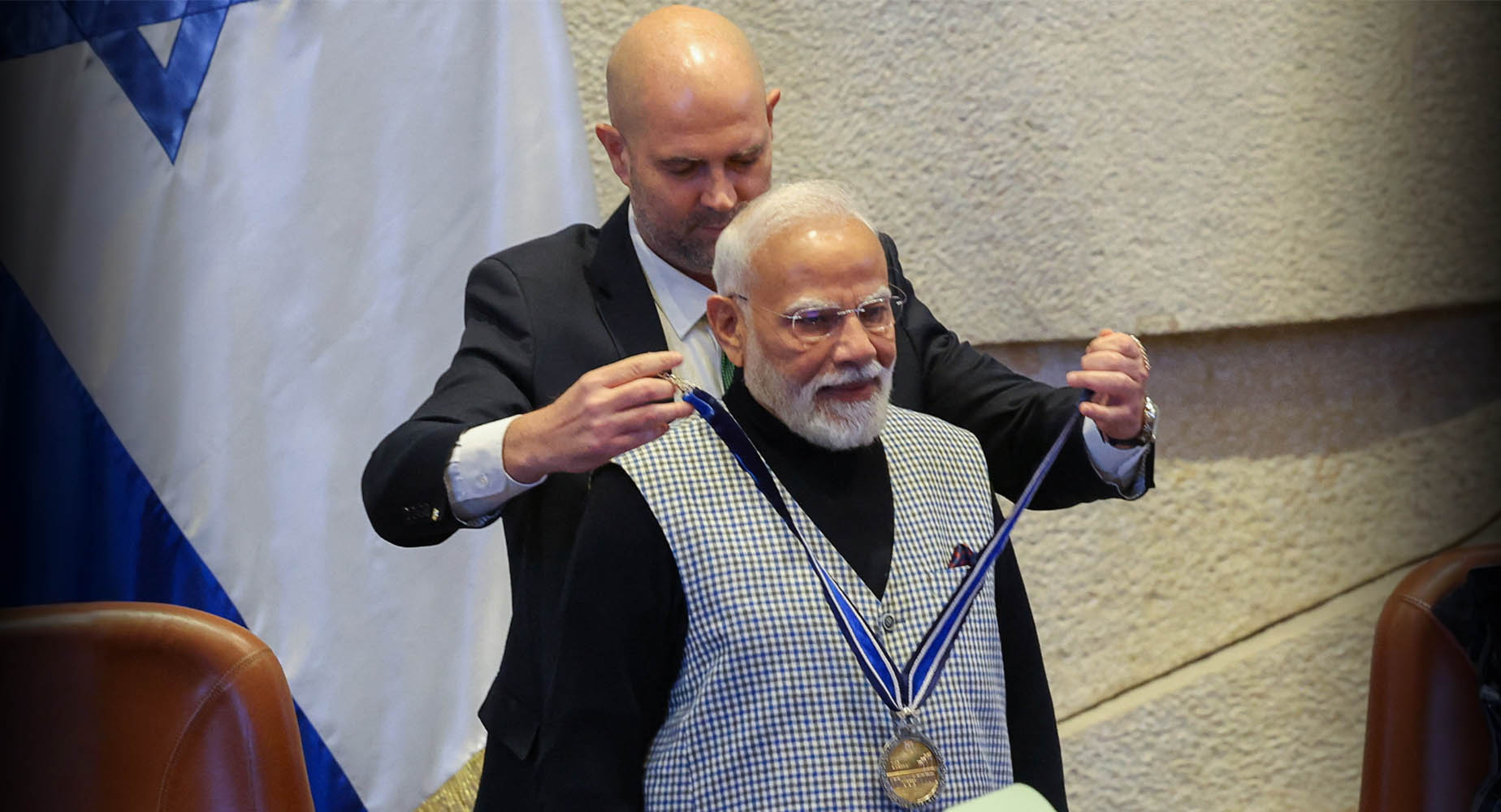
Prime Minister Narendra Modi’s address to the Knesset represents a strategic inflection point in the evolution of India–Israel relations. Beyond symbolism, the visit signals the maturation of a partnership that increasingly bridges the Indo-Pacific and the Middle East — anchoring cooperation in defense, innovation, and shared democratic resilience at a moment when regional balances are shifting and global alignments are under stress.
Nearly a decade after his groundbreaking 2017 visit, Modi returned to Jerusalem not merely as a bilateral partner, but as the leader of the world’s largest democracy. The historic nature of the address — the first ever by an Indian prime minister before Israel’s parliament — underscores how far the relationship has evolved from cautious engagement to structured strategic convergence.
Institutional Leadership and Strategic Recognition
The session opened under the stewardship of Knesset Speaker Amir Ohana, whose leadership framed the occasion with institutional dignity and geopolitical clarity. In welcoming Modi, Ohana emphasized the significance of hosting the leader of a rising global power and underscored the depth of India’s friendship toward Israel — particularly in moments of crisis.
By presiding over the ceremony with composure and strategic awareness, Ohana elevated the event beyond protocol. The conferment of the Knesset’s newly established parliamentary medal upon Modi symbolized Israel’s recognition of India not only as a partner, but as a country of growing weight in shaping the international order. At a time when Israel faces diplomatic pressures and regional uncertainty, honoring India in such a manner conveyed confidence rather than isolation.
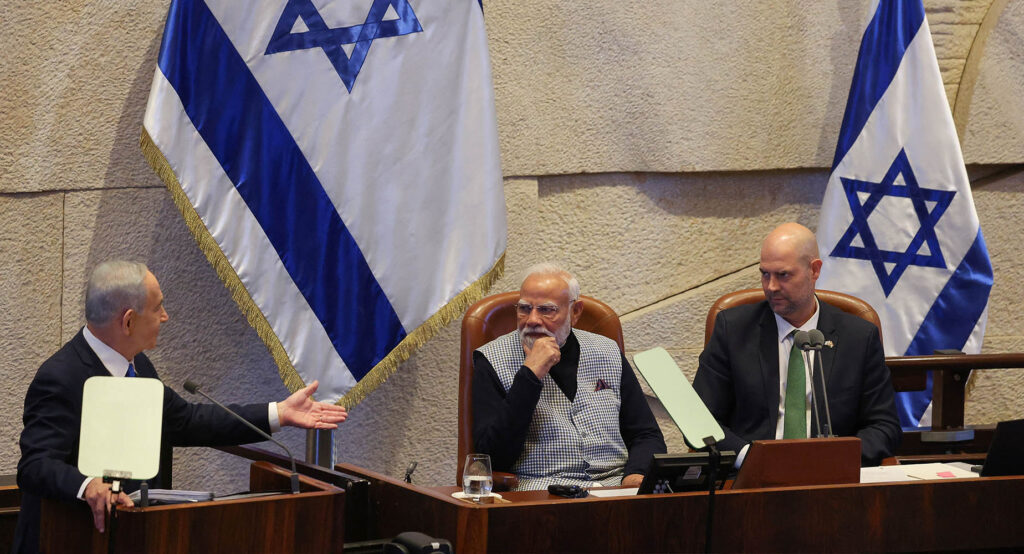
Netanyahu’s Strategic Framing: Multiplying Strength
Prime Minister Benjamin Netanyahu reinforced this message by framing India as a “gigantic power” whose partnership with Israel acts as a multiplier of capabilities. His remarks moved beyond personal warmth — though the personal bond between the two leaders remains a visible feature of the relationship — to articulate a broader strategic logic.
Netanyahu emphasized that cooperation between Jerusalem and New Delhi amplifies innovation, defense readiness, and geopolitical reach. He publicly thanked Modi for standing firmly with Israel in the aftermath of the October 7 attacks, noting that solidarity in moments of crisis defines the authenticity of partnerships. In doing so, Netanyahu positioned India not as a distant observer of Middle Eastern affairs, but as a democratic actor willing to engage meaningfully with regional realities.
Modi’s Message: Zero Tolerance for Terrorism, Commitment to Stability
In his address, Prime Minister Modi delivered a speech that balanced unequivocal solidarity with strategic nuance. He condemned terrorism in the strongest terms, reaffirming that India stands firmly with Israel and rejects double standards in confronting extremist violence. Drawing parallels with India’s own experience of terror — including the 26/11 Mumbai attacks — Modi framed the fight against terrorism as a shared civilizational imperative.
At the same time, he reiterated India’s support for dialogue, stability, and long-term peace in the Middle East. This calibrated posture reflects India’s broader foreign policy tradition: principled opposition to terrorism combined with strategic autonomy. Modi’s reference to the Abraham Accords signaled recognition of diplomatic breakthroughs in the region while acknowledging the complexities that persist.
The message was clear: solidarity does not preclude diplomacy, and strategic clarity does not exclude the pursuit of stability.
Security, Technology, and the Architecture of Partnership
The substance of the visit extends well beyond rhetoric. India and Israel have steadily deepened cooperation in defense technology, intelligence sharing, cybersecurity, and advanced innovation.
Today, that partnership spans missile defense systems, unmanned platforms, artificial intelligence applications, agricultural technology, and water management solutions. India’s expanding industrial base and “Make in India” initiative align naturally with Israel’s innovation ecosystem. The strategic logic is mutually reinforcing: scale meets specialization; demographic weight meets technological agility.
Negotiations on expanded trade frameworks and infrastructure connectivity initiatives further indicate that the relationship is broadening from security-driven cooperation to comprehensive economic integration.
The Indo-Pacific–Mediterranean Arc
Modi’s visit must also be understood within a wider geostrategic context. India increasingly views the Middle East as an extension of its Indo-Pacific strategy, linking maritime security, supply chains, and infrastructure corridors across regions. Initiatives such as the India–Middle East–Europe Corridor (IMEC) and cooperative platforms like I2U2 reflect an emerging architecture connecting South Asia, the Gulf, Israel, and Western markets.
In this framework, Israel represents more than a bilateral partner; it is a technological node and strategic gateway to the Mediterranean. Conversely, India offers Israel demographic scale, market access, and global diplomatic reach.
As geopolitical competition intensifies — from revisionist powers in Eurasia to regional ambitions in the Middle East — the India–Israel partnership embodies a model of democratic coordination without formal alliance structures. It is pragmatic, interest-based, and resilient.
The timing of the visit is significant. The Middle East remains volatile, with shifting balances involving Iran, Turkey’s regional posture, and persistent non-state militant threats. India maintains a calibrated approach to these dynamics, balancing relationships across the region. Yet its visible solidarity with Israel during crisis periods reflects a maturing assessment of shared threats.
Despite occasional trade tensions between New Delhi and Washington, India remains anchored in a broader democratic ecosystem. Israel, closely aligned with the United States, occupies a complementary position. The convergence among these actors suggests the gradual consolidation of a flexible democratic network spanning the Indo-Pacific and the Mediterranean.
Modi also invoked the historical bonds between the Indian and Jewish peoples — centuries of coexistence and protection afforded to Jewish communities in India. These references were not merely ceremonial. They reinforced a narrative of civilizational respect that underpins modern statecraft.
People-to-people exchanges, tourism, academic collaboration, and entrepreneurial partnerships further solidify this foundation. Strategic partnerships endure when societal familiarity accompanies political alignment.
Prime Minister Narendra Modi’s 2026 visit to Israel marks the consolidation of a relationship that has moved decisively beyond cautious diplomacy. From Speaker Amir Ohana’s institutional leadership to Netanyahu’s framing of strategic multiplication, and Modi’s articulation of zero tolerance for terrorism alongside support for stability, the visit reflects a partnership grounded in shared interests and democratic confidence.
What was once an unlikely relationship has become a strategic bridge linking two dynamic regions. Its long-term trajectory will matter not only for Jerusalem and New Delhi, but for the broader geopolitical landscape connecting the Indo-Pacific to the Mediterranean.