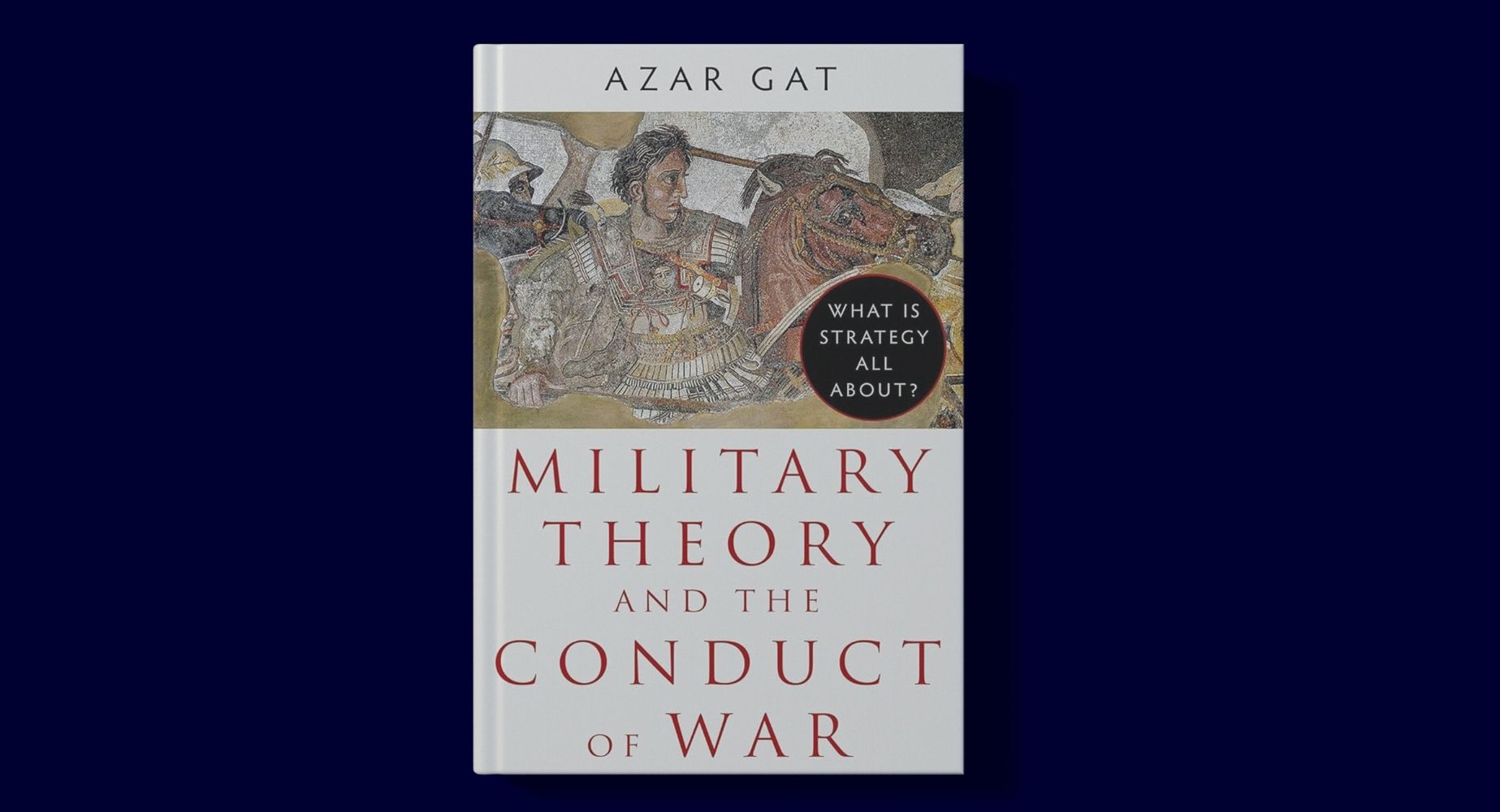
Azar Gat, Military Theory and the Conduct of War, Oxford University Press, 2025
As the ongoing conflict in Iran has made clear, war remains a stubbornly persistent part of human life, as it has been since before the beginning of recorded history. Not surprisingly, this ancient practice has inspired a large and growing body of writing, which divides into two parts. The first, the literature of peace, concerns how to prevent it. The second and older literature, that of strategy, has to do with how to conduct it. Since the eighteenth century, contributors to this second category have sought general principles that govern organized armed conflict. Have they succeeded? Have such principles been discovered? Military Theory and the Conduct of War addresses that question.
As the author of a number of well-regarded books about war, notably War in Human Civilization (2008) and The Causes of War and the Spread of Peace (2017), Azar Gat, the Ezer Weizman Chair in National Security at Tel Aviv University and recently appointed the Chair of the Strategy, Diplomacy, and Security Program at Shalem College in Jerusalem, is well qualified to address it. He returns a mixed verdict. On the one hand, wars have displayed such variety in the eras, the locales, and the political and technological contexts in which they have taken place that the study of military history has not revealed, and cannot reveal, immutable rules for waging them. On the other hand, observations about armed conflict that apply widely if not universally are possible; and Gat’s three compact, readable, and informative chapters usefully provide readers with a series of them.
A section of the first chapter, for example, puts into perspective the most frequently cited (although less frequently read) general treatise on the subject, On War, by Carl von Clausewitz (1780-1831). Having drafted it to reflect his experience as a Prussian army officer in the Napoleonic Wars, Clausewitz concluded that he had wrongly interpreted as universal some features of that war that had arisen from the particular circumstances in which it was waged. He began to change what he had written but died before he could complete the task, leaving an only partly revised manuscript, which was published posthumously. As a result, Gat writes, On War has confused and misled readers since then, distorting the ongoing search for eternal principles of warfare.
Gat’s second chapter includes, among other things, a concise account of the ongoing evolution of war-related technology that the Industrial Revolution set in motion and that has repeatedly transformed warfare several times over. The search for law-like principles of war began in the preindustrial era, when social institutions and practices changed only very slowly. Military innovations based first on steam power and iron, then on the internal combustion engine, and now on computers and digital advances have made war, by contrast, like everything else the Industrial Revolution has affected, unprecedentedly dynamic. That, in turn, has made the quest for eternally valid precepts of armed conflict an all but hopeless one.
The third chapter affirms, as some students of war have contended, that large-scale armed conflict has become less frequent since the beginning of the nineteenth century. Gat attributes this happy development in human history not, as many do, simply to the increasingly destructive character of war in the modern age, but rather to the sustained economic growth that the Industrial Revolution made possible for the first time in that long history. It is this development, he says, that, by radically altering the incentives for war, has made the world more peaceful: “Rather than war becoming more costly, as is widely believed,” he writes, “it is in fact peace that has been growing more profitable.”
Finally, while war cannot be turned into a branch of science, yielding to those who study it the timeless regularities that scientists have discovered in the natural world, the kinds of general observations that do emerge from such a study can illuminate specific conflicts, as Military Theory and the Conduct of War demonstrates. The author’s discussion of guerrilla warfare, for example, can be employed to shed light on Israel’s recent war in Gaza.
Gat argues persuasively that guerrilla movements have succeeded in the modern era only when fighting liberal democracies, for the simple reason that liberal democracies are not willing to employ the brutal tactics – in effect making the entire society in which guerrillas operate the target of a crushing military campaign – that are required to defeat such insurgencies. Undemocratic regimes have no such scruples: the mass killings of anti-government protesters by the Islamic Republic of Iran earlier this year offers a vivid illustration of this point.
The murderous assault by Hamas on southern Israel on October 7 2023 resembled less a guerrilla operation than classic cross-border aggression by one state against another, since Hamas had formed the effective government of Gaza and had assembled an army far more powerful than a typical guerrilla force. October 7 qualifies as well as an act of terrorism, since the assault specifically targeted civilians. The leaders of Hamas counted, however, on using the circumstances Gat identifies as favorable to guerrillas to protect themselves. By hiding their military equipment in homes, hospitals, and mosques in Gaza, and by denying to Gazan civilians access to the vast network of underground tunnels that they had built, they assured that an Israeli military response would entail the kind of damage to Gaza’s civilian infrastructure and population that liberal democracies such as Israel are, by virtue of their governing principles, loath to inflict.
Israel managed, however, to have it both ways — to destroy Hamas’s major military capabilities while waging war in a manner consistent with its democratic principles. The Israeli government took care to make it possible for the civilian population in Gaza to move away from the sites of the fiercest fighting. As a result, the ratio of civilian fatalities to the deaths of actual combatants turned out to be, compared with other such military operations elsewhere, historically low. Israel nullified, that is, what might be called the barbarian’s advantage even as it was carrying out the universally valid mission of self-defense.
Hamas did achieve one kind of success in the Gaza war. Sectors of the publics in Western Europe and the United States, motivated by misinformation or ignorance about the causes and the conduct of the war – as well as, it must be said, in at least some cases, by preexisting bigotry against Israel and the people whose state it is – noisily condemned, sometimes spilling over into violence, what the Israel Defense Forces were doing. This represented a victory of sorts for the strategy of the people who had planned and supervised the attacks of October 7; but those people could take no satisfaction in that achievement because, thanks to the carefully calibrated military campaign of the Israel Defense Forces, they were no longer alive to witness it.