The Iran war stands at a pivotal and perilous juncture. What originated as Israel’s preemptive strikes during the Twelve-Day War in June 2025 has evolved into a sustained joint U.S.-Israeli campaign that began anew on February 28, 2026. This conflict has decisively altered the balance of power across the Middle East. The Islamic Republic of Iran, once a menacing regional superpower armed with an ambitious nuclear program and a web of clients and proxies, now confronts total conventional military defeat. The United States and Israel have dismantled the regime’s most potent military assets while incurring astonishingly low costs. Israel’s civilian and military infrastructure remains intact, the U.S. has absorbed only minimal casualties, and America’s Arab partners in the Gulf have weathered intense Iranian retaliation with remarkable resilience. By every objective military standard, Iran has lost the war to date. Yet the conflict is not over. Tehran’s surviving leadership — hardened ideologues who have ruled through terror for decades — refuse to capitulate. The regime could still inflict catastrophic regional damage through asymmetric tactics. The Trump Administration’s current approach of a naval blockade paired with intermittent negotiations is effective but dangerously incomplete. It grants Iran time to prepare potentially devastating countermeasures. Washington must now escalate pressure through renewed military strikes while insisting on nothing less than the unconditional surrender of the Islamic Republic.
The scale of Iran’s military collapse is staggering. In the opening phase of the conflict and the operations that followed, Iranian forces were systematically neutralized. The regime’s navy, long a threat to Gulf shipping lanes, has been reduced to a handful of small, fast combat craft capable only of hit-and-run operations in coastal waters. Nearly every major surface vessel and submarine has been sunk or rendered inoperable by U.S. and Israeli strikes. Iran’s once-formidable air defense network — comprising Russian-supplied S-300 and S-400 systems alongside indigenous platforms — has been almost entirely obliterated. Radar sites, command centers, and missile batteries that once blanketed the country now lie in ruins, leaving Iranian airspace wide open to U.S. and Israeli aircraft. Ballistic and cruise missile inventories have been halved, with launchers, storage facilities, and production lines targeted in relentless waves of attacks. These losses have stripped Iran of its primary means of long-range retaliation and deterrence.
Most devastating of all has been the destruction of the nuclear program. Facilities at Fordow, Natanz, Arak, and Isfahan — critical hubs for uranium and plutonium enrichment and weapons research — were subjected to repeated, high-yield precision strikes that penetrated even the deepest underground bunkers. Centrifuge cascades were pulverized, research laboratories reduced to rubble, and stockpiles of enriched uranium either destroyed or rendered inaccessible. The setback is generational. Iran’s dream of a nuclear weapon, pursued in defiance of international norms for over two decades, has been shattered. What remains is a hollowed-out infrastructure that would require years, if not a decade, to rebuild under the most favorable conditions. None of this came at a high price for the victors. Israeli cities and bases absorbed only scattered, largely intercepted strikes. Advanced multi-layered missile defenses — augmented by U.S. naval assets in the eastern Mediterranean and Persian Gulf — performed flawlessly. American forces, operating from carriers, bases in the region, and long-range bombers, suffered negligible losses. Even the Gulf monarchies, despite absorbing the brunt of Iranian missile and drone barrages aimed at oil infrastructure and population centers, emerged largely unscathed. Desalination plants continued functioning, energy exports flowed with minimal disruption, and civilian casualties remained low thanks to rapid evacuations and robust allied air cover. This asymmetry reveals a fundamental truth: Iran’s conventional military has been routed. Its much-vaunted “axis of resistance” — proxies in Lebanon, Yemen, Iraq, and Syria — has been degraded, intimidated, and isolated. The regional imperium Tehran spent 47 years constructing from Herat to the Mediterranean now lies in ruins.
Faced with this reality, the Trump Administration could have chosen a path of total economic devastation. Precision strikes on electric power plants, bridges, rail lines, and oil and gas infrastructure would have brought Iran’s economy to its knees within weeks, triggering widespread blackouts, supply chain collapse, and humanitarian crisis. Such measures, while militarily feasible, carried unnecessary risks of long-term regional instability and civilian suffering that could complicate postwar reconstruction. Instead, the Administration adopted a wiser, more surgical strategy: sparing Iran’s domestic economic infrastructure while imposing a comprehensive naval blockade that has severed the regime’s oil and gas export lifeline. U.S. Navy and allied vessels now patrol the approaches to the Strait of Hormuz and Iranian ports with overwhelming force. Every tanker seeking to load crude or refined products is intercepted, diverted, or boarded. The strategic effect has been speedy and devastating. Storage tanks on Kharg Island — the heart of Iran’s export infrastructure — and at lesser terminals will soon be filled to capacity. Crude continues to flow from the wells, but with no outlet for export, production must soon be curtailed, or catastrophic overflows, pipeline ruptures, and uncontrolled fires could occur. As of this writing, Iran stands days or at most weeks from the point at which it will be forced to shut down large segments of its oil output. Revenues that once funded the IRGC, subsidized food imports, and paid for proxy wars have evaporated. The regime’s ability to maintain patronage networks and military readiness is crumbling under the weight of this silent, relentless pressure.
At the same time, the Administration has wisely kept diplomatic channels open. Indirect talks, conducted through intermediaries in Oman, Qatar, and elsewhere, signal that a negotiated exit from the war remains possible for what is left of the Iranian leadership. Yet the two sides remain far apart. Washington’s central, non-negotiable demand is a complete, verifiable, and irreversible end to Iran’s nuclear program — including the physical dismantling of remaining enrichment sites, the removal of all fissile material, and the imposition of intrusive, permanent international inspections. Tehran, even in its weakened state, refuses to yield on this central issue. Hardliners within the Supreme National Security Council and the IRGC view any concession as tantamount to regime suicide. They calculate, perhaps correctly in the short term, that economic pain alone may not fracture their political control.
This intransigence flows directly from the character of those who still rule Iran. The men directing policy today are not diplomats or reformers; they are veterans of a revolutionary system built on violence. Their specialty is the ruthless application of force to maintain and expand power. They have shown no hesitation in turning shotguns on peaceful protesters, deliberately aiming to blind and disfigure young demonstrators in the streets of Tehran, Isfahan, and Shiraz. As recently as January 2026, the regime is credibly reported to have massacred more than 40,000 of its own citizens who took to the streets demanding political change, an end to corruption, and relief from economic misery. These killings were not aberrations; they were longstanding policy. The IRGC and Basij paramilitary forces — hundreds of thousands strong — execute such orders with chilling efficiency. These men and their supporters understand that surrender would mean more than the loss of power. It would expose them to the legitimate vengeance of the families and friends of their victims in any future democratic Iran. A new order would hold them accountable for decades of oppression, terrorism sponsorship, and domestic slaughter. Consequently, they are prepared to do anything—literally anything—to cling to survival.
This survivalist mindset explains why Iran could once again turn to its historic doctrine of asymmetric warfare. For 47 years, the Islamic Republic has compensated for conventional weakness by cultivating a vast network of client states and terrorist proxies stretching from Herat in Afghanistan to the Mediterranean shores of Lebanon and Syria. Hezbollah, the Houthis, the Iraqi Popular Mobilization Forces, and Syrian militias served as forward-deployed instruments of Tehran’s will. That network is now fractured, but the underlying strategy endures. Two desperate measures immediately present themselves. First, Iran retains enough surviving missiles and drones to target the massive desalination plants that supply the vast majority of drinking water to Saudi Arabia, the UAE, Bahrain, and other Gulf states. These facilities are fragile, expensive, and difficult to defend. A concentrated barrage could contaminate or destroy critical infrastructure, triggering rapid state collapse, mass refugee flows, and a humanitarian disaster that would dwarf anything seen in the region to date. Second, while the destruction of Fordow, Natanz, and Isfahan has almost certainly eliminated Iran’s capacity to design and fabricate functional nuclear warheads in the near term, the regime likely still possesses significant quantities of uranium enriched to 60 percent — well beyond the level needed for radiological dispersion devices, or “dirty bombs.” These weapons, which spread radioactive contamination through conventional explosives rather than fission, could be mated to remaining delivery systems or smuggled via proxies. The resulting panic, environmental damage, and long-term health crisis would serve Tehran’s purpose: to impose costs so severe that the U.S. and its allies hesitate to press for the regime’s total defeat.
The principal danger of the Administration’s current policy of calibrated negotiations alongside the blockade is precisely that it provides the regime with the one commodity it needs most: time. Every additional week allows surviving IRGC commanders to disperse missile stocks into hardened caves and civilian areas, reposition leadership into deep bunkers, and coordinate final asymmetric strikes with whatever proxy cells remain operational. While the blockade’s economic pressure is immense and could eventually fracture the regime’s cohesion, this outcome is far from inevitable. The ruthless leaders who dominate decision-making today have survived sanctions and isolation before. They are ideologically conditioned to view compromise as betrayal and chaos as an opportunity.
The United States would therefore be well advised to alter its current strategy before Iran can execute these desperate measures. The naval blockade should continue at full strength — it remains the most elegant and effective tool for economic coercion without unnecessary collateral damage. But it must be paired immediately with a resumption of the intensive, large-scale bombing of military and political targets inside Iran. Strikes should focus first on the remnants of Iran’s missile and drone forces, command-and-control nodes, and production facilities. Simultaneously, the campaign must target the physical elimination of the regime’s surviving senior leadership wherever reliable intelligence locates them. IRGC and Basij formations — responsible for both external aggression and the brutal suppression of internal dissent — must be systematically eliminated. Particular attention should be paid to the Popular Mobilization militias that Tehran has imported from Iraq to reinforce its domestic control; these foreign fighters represent a direct threat to any future stable order inside Iran. Such operations would not constitute reckless escalation. They would represent the logical continuation of a war that Iran initiated and has already lost on the conventional battlefield.
In any future negotiations, the U.S. position must be simplified and hardened to demand the unconditional surrender of the Islamic Republic. This means not only the verified end of the nuclear program but the cessation of all support for terrorist organizations, the release of all political prisoners, and the acceptance of international oversight sufficient to guarantee that neither the nuclear program nor the apparatus of domestic terror can ever be reconstituted. Anything less would be far too risky for American interests and the security of the region. Any partial deal that leaves the current leadership in place would merely postpone the next crisis, allowing Iran to regroup, rebuild covertly, and strike again when the moment seems favorable.
The current stage of the Iran war illustrates both the extraordinary effectiveness of American and Israeli military power and the enduring dangers posed by a cornered revolutionary regime. Iran’s conventional defeat is complete and irreversible. Its economic isolation tightens hourly under the weight of the blockade. Yet the ideological DNA of the Islamic Republic — forged in violence, sustained by terror, and animated by a refusal to accept defeat — means that half-measures will not suffice. The Trump Administration possesses both the capability and the strategic clarity to finish what it has started. By combining relentless pressure on the battlefield with an uncompromising diplomatic posture, Washington can translate tactical victories into a lasting strategic success: the permanent neutralization of the Islamic Republic’s nuclear threat, the dismantling of its terrorist network, and the opening of a path toward a more stable and prosperous Middle East. The alternative — prolonged negotiations that grant the regime breathing room to prepare asymmetric horrors — is an invitation to far greater tragedy. History will record whether the United States seizes this decisive moment or allows it to slip away. The stakes could not be higher.
Achieving a Complete Victory in Iran
by
May 2026
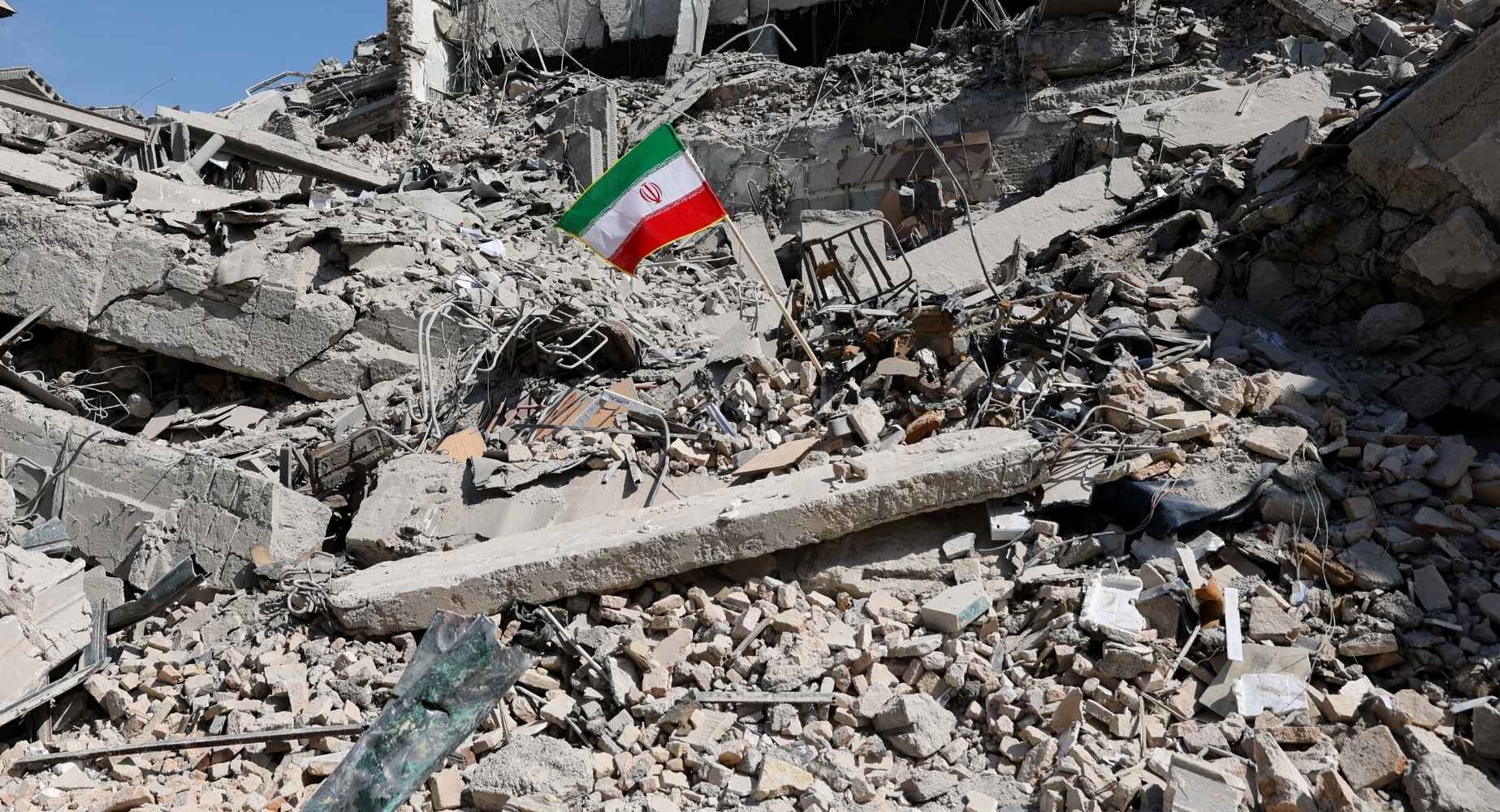
Credit: REUTERS
Recent Articles
Sewage Without Borders
Gaza’s sewage has reached Israel’s taps. We had thirty years of warnings and chances to prevent it. The squills are up on the hills, white and upright as surveyors’ stakes — which is more or less what they were since antiquity. Farmers here planted them in rows to mark where one field ended and the […]
Should Vance or Rubio be the Republican nominee in 2028?
The Failure of American Isolationism in Iran and the Republican Choice for 2028 The case against JD Vance is not about a memorandum. It is about a policy, and about the kind of failure that falls on the leader who argued it into being. A policy is different from a deal. A deal has terms […]
Middle East-Jeremy Ben-Ami: “I don't call it a two-state solution. I call it a 23-state solution”
In his conversation with Jacob Heilbrunn, the president of J Street, Jeremy Ben-Ami, advocates a “23-state solution” to the Israeli-Palestinian conflict. He calls for full Israel’s integration into the Middle East, and a comprehensive regional peace agreement based on mutual security, normalization, and diplomacy rather than military force.