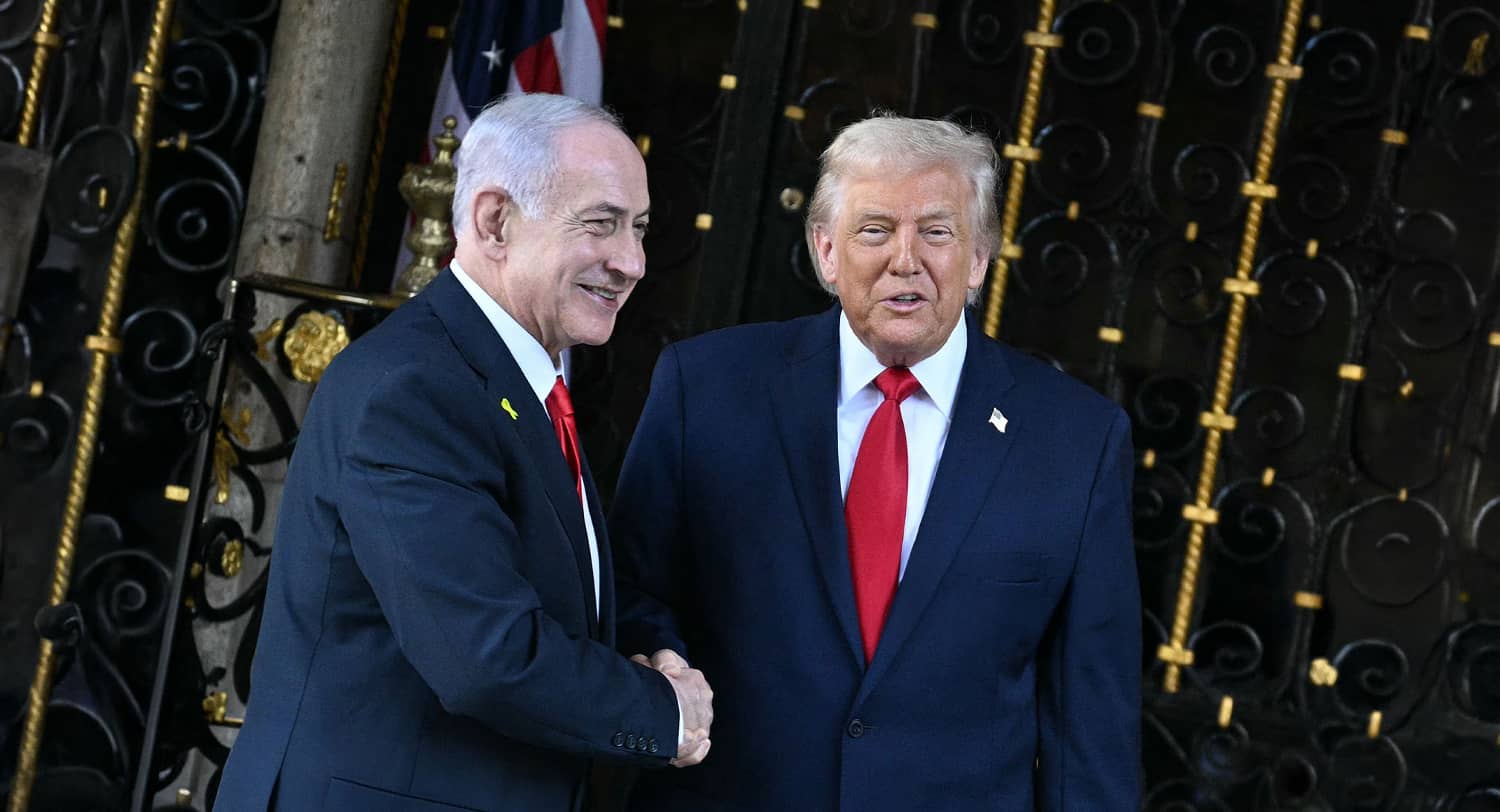
Some media commentators were quick to dismiss Prime Minister Benjamin Netanyahu’s meeting this week with President Donald J. Trump, depicting it as driven by domestic politics, legal pressures, or media optics. But that is a mistake. This meeting comes at a time of profound regional fragility and converging pressures.
On one front lies Iran’s aggressive proxy network, stretching from Gaza to Lebanon, from Yemen across the Red Sea. On the other lies a quieter but no less corrosive danger: the strategic incoherence of actors who present themselves as partners of the United States while sustaining, through action or omission, the ecosystems in which extremism regenerates. This dual pressure—external aggression and internal contradiction—defines the strategic reality confronting Washington and its allies.
In the December 29 Trump-Netanyahu meeting, key topics included Gaza, next-phase regional arrangements, deterrence generally and specifically in the question of future action against Iran’s capabilities. The significance of the meeting does not lie in whether or not every detail was finalized or publicly disclosed. It lies in a shared recognition that the old Middle East—defined by proxies, ideological capture, and the manipulation of legitimacy—is attempting to reassert itself, even as the foundations of a new regional order struggle to emerge.
The Abraham Accords represent a deliberate shift away from ideological conflict toward pragmatic cooperation, from permanent grievance and proxy warfare toward regional integration and sovereign responsibility. The Accords are the product of sustained strategic effort, intellectual clarity, and unusual political courage.
In this regard, the statecraft of Jared Kushner, and his willingness to challenge failed orthodoxies, deserves recognition. The Abraham Accords have endured over the past five years, through wars, regional shocks, and political transitions, in no small part owing to the well-designed architecture of shared interests and their serious implementation efforts.
Today, the United States, Israel, and the signatories to the Abraham Accords face a two-front challenge.
The first is overt and familiar: Hamas, Hizbullah, the Houthis, and a wider constellation of armed actors trained, financed, and politically shielded by Iran.
The second is more insidious. It comes from states that speak the language of counterterrorism while enabling movements tied to the Muslim Brotherhood. They denounce extremism while empowering ideologues inside “legitimate” institutions; they praise stability while tolerating and even sponsoring destabilizing networks under the protection of state recognition.
In Yemen, these states back an official governing authority penetrated by Brotherhood-aligned actors. That does not defeat political Islam but rather institutionalizes it. Violent ideology is laundered through bureaucracy. International legitimacy becomes a shield for a long-term project that lacks genuine popular consent. The outcome is predictable: Islamist networks embed themselves in ministries, security services, and patronage systems, while presenting themselves internationally as the only alternative to chaos. Meanwhile, the external threat of the Houthis persists and Tehran retains leverage not because it is strong, but because its adversaries are divided.
The Netanyahu–Trump meeting should be understood as pointing to the central strategic question of the present-day Middle East: How to prevent Tehran from regenerating its proxy capacity and exporting crisis as a governing strategy.
Iran itself is also showing signs of internal exhaustion. A regime forced to rely increasingly on coercion at home has diminishing capacity to sustain complex external architectures indefinitely. Hizbullah, Hamas, and the Houthis are not autonomous actors; they are extensions of an Iran that supplies financing, coordination, weapons pipelines, and media support. As Tehran’s domestic legitimacy erodes, so too does the ideological credibility on which its proxies depend.
This is why the present moment constitutes a strategic window, which will not remain open indefinitely. Coordinated Western and regional action can exploit Iran’s internal strain to fragment its proxy network and raise the cost of its asymmetric strategy beyond sustainability. Coordination, however, must be operational, not rhetorical: sanctions enforcement that disrupts procurement, intelligence integration that chokes weapons routes, hardened maritime and air defenses, and diplomatic clarity that denies legitimacy to ideological capture.
For those states supporting violent Islamists, including the Muslim Brotherhood, ambiguity must end. Strategic clarity is not moral theater; it is survival logic. One cannot oppose the Muslim Brotherhood while enabling its advance. One cannot fight terrorism while empowering regressive Islamist movements that capture governing institutions. One cannot defend the Abraham Accords rhetorically while eroding their foundations in practice.
The Abraham Accords can still shape the Middle East’s future, but only if those who benefited from their promise accept the cost of clarity. History will not record intentions. It will record strategic choices.