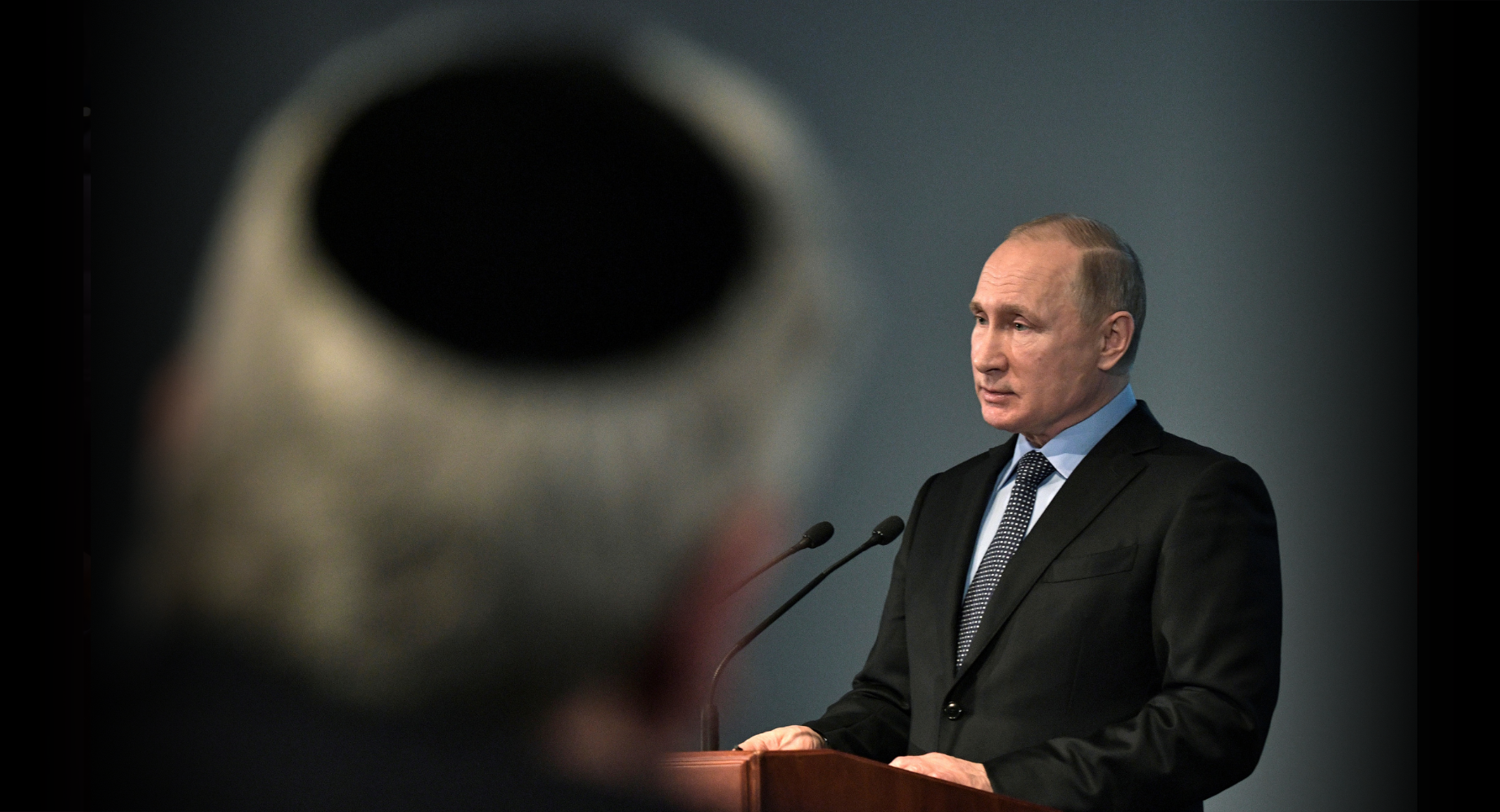
In the Soviet Union, antisemitism was not incidental. It was a tool of statecraft. That tool has been picked up again by Russia.
In the late nineteenth century, the tsarist police fabricated The Protocols of the Elders of Zion, a document that purported to reveal the inner workings of a Jewish plot for global domination. It has remained a potent source of antisemitic conspiracy thinking.
The collapse of the Romanov dynasty in 1917 did little to attenuate the virulence of antisemitism in Russia. After World War II, Joseph Stalin denounced “rootless cosmopolitans” and hatched the “Doctors’ Plot,” claiming that Jewish doctors in Moscow were conspiring to eliminate the Soviet leadership. A new purge trial loomed that was only stymied by Stalin’s sudden death in March 1953.
Stalin’s successors were not shy about dipping into the anti-Semitic well. In the 1970s, for example, Yuri Andropov, then head of the KGB, described Zionism as a hostile force working against the Soviet state, formalizing a Stalin-era doctrine that treated Jews as inherently suspect and politically expendable. At the same time, the Soviet authorities denied Jews exit visas to Israel, creating the phenomenon known as “refuseniks.”
While the Soviet overt use of antisemitism faded with the USSR’s dissolution at the end of the Cold War, the logic behind it never disappeared. Today, those tactics have re-emerged — modernized, digitized, and amplified through global networks.
Following the heinous October 7 Hamas attacks on Israel, a brief spasm of support for Israel was replaced by a surge of antisemitism worldwide. Once Israel began to defend itself against Hamas, it was widely depicted as the international bad guy.
In short order Jewish schools, synagogues, sporting events, and concerts faced threats and attacks from Islamist extremists, often amid institutional paralysis. In the United Kingdom, the Community Security Trust reported a record spike in antisemitic incidents in the weeks after October 7. Meanwhile, French authorities deployed police to protect Jewish sites amid escalating threats reported by Le Monde.
These arenas — campuses, social media, street protests, and political movements — are not isolated. Antisemitic narratives circulate easily between them, adapting in form while preserving their animating hostility. That permeability makes antisemitism especially potent and difficult to contain.
In particular, Moscow moved quickly to exploit the moment, not by openly promoting Hamas but by amplifying antisemitism as a destabilizing force within Western societies. This was not passive opportunism. During periods of crisis, Russia routinely and adeptly deploys state media, proxy outlets, and covert online networks to inflame social division for strategic gain.
Within days of the Hamas attacks, Russian state media mobilized. In October 2023, RT Arabic and Sputnik broadcast unverified and inflated Gaza casualty figures as evidence of Israeli “genocide,” well before any independent assessments existed. These patterns were documented by the Institute for Strategic Dialogue. By November, the Russian-linked “Doppelgänger” network escalated further, publishing cloned versions of major European newspapers falsely claiming that Western officials had privately acknowledged Israeli genocide, according to EU DisinfoLab.
At the same time, Russian bot networks pushed fabricated atrocity claims at scale — doctored casualty charts, manipulated images, and false reports of hospital bombings. By the time corrections emerged, many of these claims had already migrated into street protests. The protestors saw what they wanted to see.
The consequences were visible. In Berlin and Paris in late 2023, demonstrations featured open Nazi comparisons targeting Jews and Israel, alongside explicit antisemitic chants. Jewish schools and synagogues heightened security amid rising threats and vandalism. French authorities and independent reporting also documented cases in which Russian-linked operatives were paid to spray antisemitic symbols across Paris. The result is not abstract for Jewish families, where fear has again become a daily calculation.
The Kremlin has been candid about its methods. Margarita Simonyan, editor-in-chief of RT, has in interviews with the BBC openly described information warfare as cheaper and more effective than conventional military confrontation in interviews.
The Kremlin has fused its long-running “Nazi Ukraine” narrative with antisemitic inversion, portraying President Volodymyr Zelenskyy, who is Jewish, through conspiratorial and mutually contradictory lenses. Putin revels in the notion that Zelensky represents a new Third Reich that Mother Russia must once more battle and crush.
Russia exploits volatility deliberately. It injects antisemitism simultaneously into Muslim communities, the hard left, and the hard right — intensifying mistrust, inflaming grievance, and turning citizens against one another to weaken Europe from within.
Antisemitism never confines itself to Jews. It corrodes institutions, legitimizes violence, and leaves societies easier to fracture and harder to govern. Solidarity with Jewish communities therefore cannot be separated from confronting a Kremlin that has repeatedly weaponized antisemitism — against Jews, against Israel, and against the West.