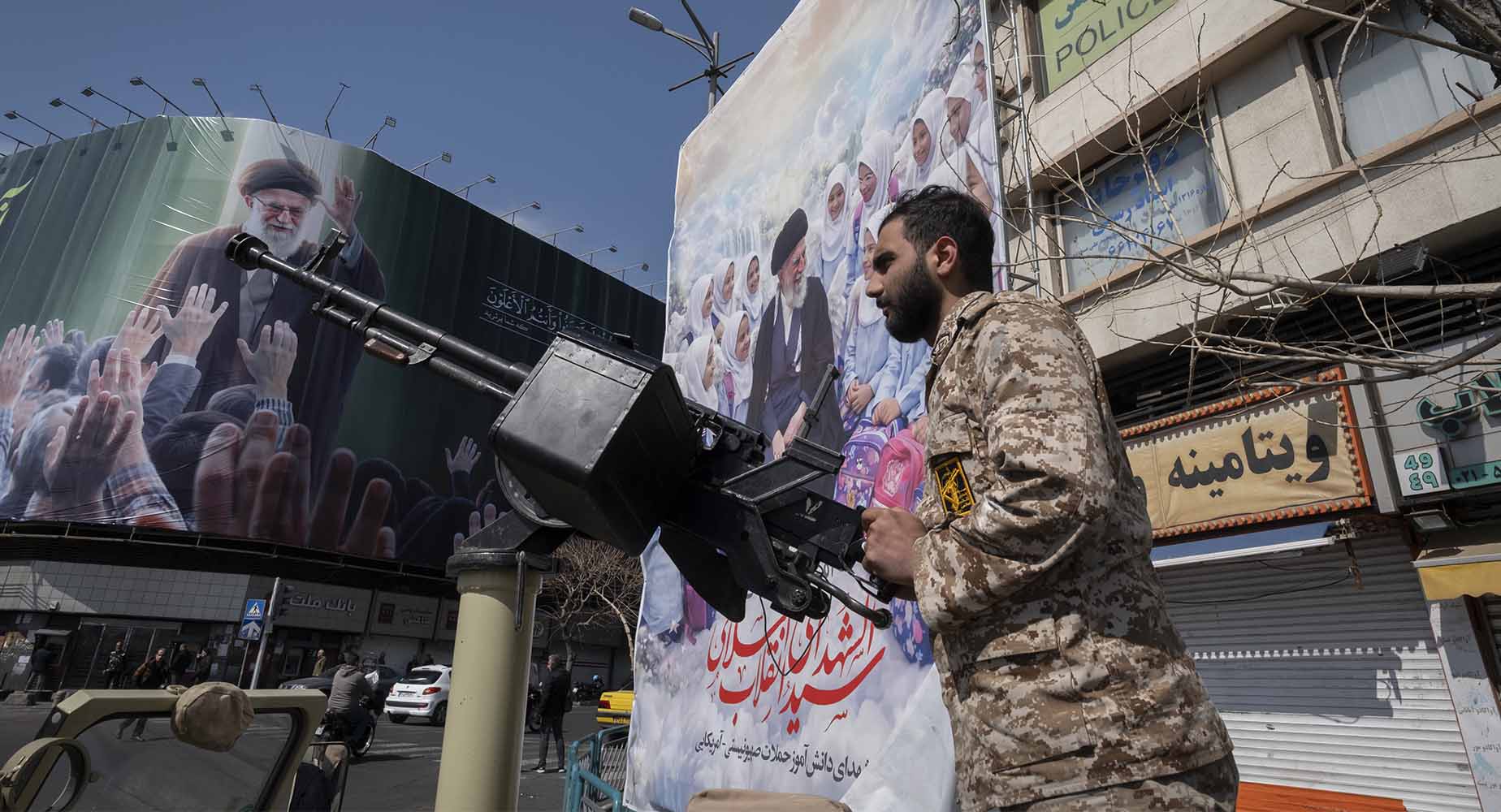
Iran’s Revolutionary Guard Corps (IRGC) is fighting for its life. It has long been the most powerful force in Iran, controlling its own army and navy, as well as a major portion of the country’s economy. It also controls the Basij organization and supports both Iran’s proxies—Hamas, Hezbollah, the Yemeni Houthis and the Iraqi militias. American and Israeli attacks are decimating its leadership on a daily basis, as are its powerful missile and drone forces and its command and control capabilities.
The IRGC was closely associated with Ali Khamenei, the country’s long-time Supreme Leader, who was killed in an Israeli air strike that opened the latest iteration of America and Israel’s war with Iran. It has close links with Mujtaba Khamenei, his father’s putative successor, though whether he will survive the ongoing war, or even if he dies, whether he will actually assume control of the government, is highly uncertain. Similarly, is it far from clear that the IRGC might survive in its current form.
It is the IRGC that is conducting the war in the name of Iran. With its back to the wall, the IRGC not only has retailtated against Israel, but it has also struck American bases throughout the Gulf and beyond, often killing civilians in the process. In doing so it has committed a major strategic mistake, no doubt out of panic and its loss of a coherent chain of command.
As a result of its attack Iran has alienated, with very few exceptions, the Gulf Arabs, Turkey, and many European states, all of which had preferred to remain neutral in the current contest. Within days of the initial Israeli strike that killed Ali Khamenei and several of his leading associates, the IRGC fired missiles and drones at American bases or facilities in all six of the Gulf Cooperation Council states—the United Arab Emirates, Saudi Arabia, Bahrain, Qatar and Kuwait. Not only had none of these states wanted to get dragged into the conflict, they had quietly been improving their relations with Tehran in the past few years.
The Iranian attacks put paid to those relations. Within a few days of the war’s onset, the Emiratis had intercepted 154 Iranian missiles—13 others fell into the sea—and 506 drones. Thirty-five drones did crash inside UAE territory causing what the govenrment termed “material damage.” Drone debris hit Etihad Towers in Abu Dhabi on the second full day of the war. The building housed not only the Israeli Embassy; but other offices as well. The strike lightly wounded a woman and her child. On the same day Emirati Air defenses intercepted Iranian drones over Dubai, but fragments from the drones fell on two homes and wounded two people. Fragments from another drone that the Emiratis intercepted over Dubai caused a fire on the faced of the world-famous Burj Al Arab hotel, while there was also an attack on Dubai international airport that wounded four people. So far the attacks have resulted in the death of three people.
It is true that the UAE has long been at odds with Iran ever since the late Shah seized the Emirati islands of Abu Musa and the Greater and Lesser Tunbs in November 1971. Even so, the UAE had not committed itself to support the American-Israeli attack. Moreover, Dubai’s trade with Iran has been an open secret for many years. For the Iranians to hit Dubai in particular simply has made no sense.
Like the UAE, Sunni-led Bahrain has resented Iran for years; the Manama government claims that Tehran foments revolution within the country’s Sh’i’a majority. Indeed, since at least the 1950s, Iran has claimed that Bahrain is its 14th province. Iran has launched attacks on Fifth Fleet headquarters in Bahrain. It has hit the Crowne Plaza hotel in Manama and caused damage at the country’s international airport. Of all the unprovoked attacks that Tehran has launched against the Gulf states, those on Bahrain at least are consistent with long standing tensions between the island and its large neighbor.
The Iranians have also attacked the Riyadh region of Saudi Arabia, as well as the petroleum-rich Eastern Province. The outraged Saudis have pointed out that Iran launched these attacks “despite the Iranian authorities knowing that Saudi Arabia confirmed that it would not allow its airspace or territory to be used to harm Iran.”
The Iranian attacks on the other Gulf States have made even less sense. It is true that Qatar hosts America’s largest Middle Eastern base at al-Udeid. But Doha has always maintained proper relations with Tehran. Nevertheless, it too has intercepted missiles and drones that Iran launched against its territory.
Similarly, though Kuwait houses Army Central Command Headquarters forces at Camp Arifjan, as well as air units at Ali Al Salem AIr Base, and a logistical support unit at Shuaiba port, it has generally maintained a low international political profile ever since the first Gulf War. Yet it too has been the scene of drone attacks, one of which resulted in the death of eleven American servicemen.
Of all Iran’s attacks on its Gulf neighbors, those on Oman make the least sense of all. It is true that Oman, like the other Gulf Oman hosts American units at several locations. Nevertheless, the country has always maintained friendly relations with its much larger neighbor across the gulf that carries its name. The Omani leadership certianly recalls that Iran came to the aid of Sultan Haitham bin Ali al Said’s late cousin and predecessor, Sultan Qaboos, in the 1970s that enabled him to quash the Dhofar rebellion. Moreover, Oman has always acted as a go-between, serving as a venue for negotiations between the United States and Iran, including one of the latest rounds that preceded the outbreak of war.
The Iranians have not only targeted American facilities. They have also aimed drones and missiles at British and French facilities in the Gulf. And Iraqi militias, no doubt on instructions from the IRGC, have fired missiles toward Irbil, the capital of the Kurdish Regional Government in Iraq.
The Iranians have not limited their attacks to their Gulf neighbors. According to the Jordanian military the IRGC launched 49 drones and ballistic missiles at the country. Like Saudi Arabia, Jordan houses some American units, but again like the Saudis, Jordan had not allowed American or Israeli aircradft to transit its airspace in order to hit Iran.
In addition, the Iranians have fired at the British sovereign base at Akrotiri, Cyprus, and perhaps most surprisingly at a target in Turkey, which has maintained correct relations with the Mullahs since they first came to power in 1979. Iran also launched a drone attack at Azerbaijan’s airport at Nakhchivan thus expanding the war even further beyond the Gulf. And an American submarine torpedo sank the Iranian frigate Iris Dena some 25 miles from the Sri Lanka coast, further enlarging the theater of war.
There can be little doubt that the IRGC has been boxed into a corner, and having had its command and control capability devastated by American and Israeli attacks, no longer is firing its dwindling drone and missile assets in a coherent fashion. Instead, it seems to be impervious to the fact that in alienating more and more states, it is only digging itself deeper in a hole from which it might never emerge. Indeed, its unprovoked attacks have found them at odds with both sides of both long-standing rivalries such as Greece, which is supporting Cyprus, and Turkey, and more recent ones, notably Saudi Arabia and the UAE.
The IRGC still retains considerable power inside Iran, and may remain at the country’s helm, whether by controlling whoever replaces the late Supreme Leader, or by having one of its own take charge. It does face a potential challenge not only from the hundreds of thousands, if not millions, of Iranians who seek at least some degree of regime change, but also from its rival, the regular army, which thus far has kept its powder dry.
Given these factors, and the hostility its faces from states that it need not have provoked, at war’s end the IRGC like Iran will certainly be far weaker than at any time since its emergence in1979. And that can only increase the prospect for a more stable and peaceful Middle East in the immediate and, hopefully, longer term.