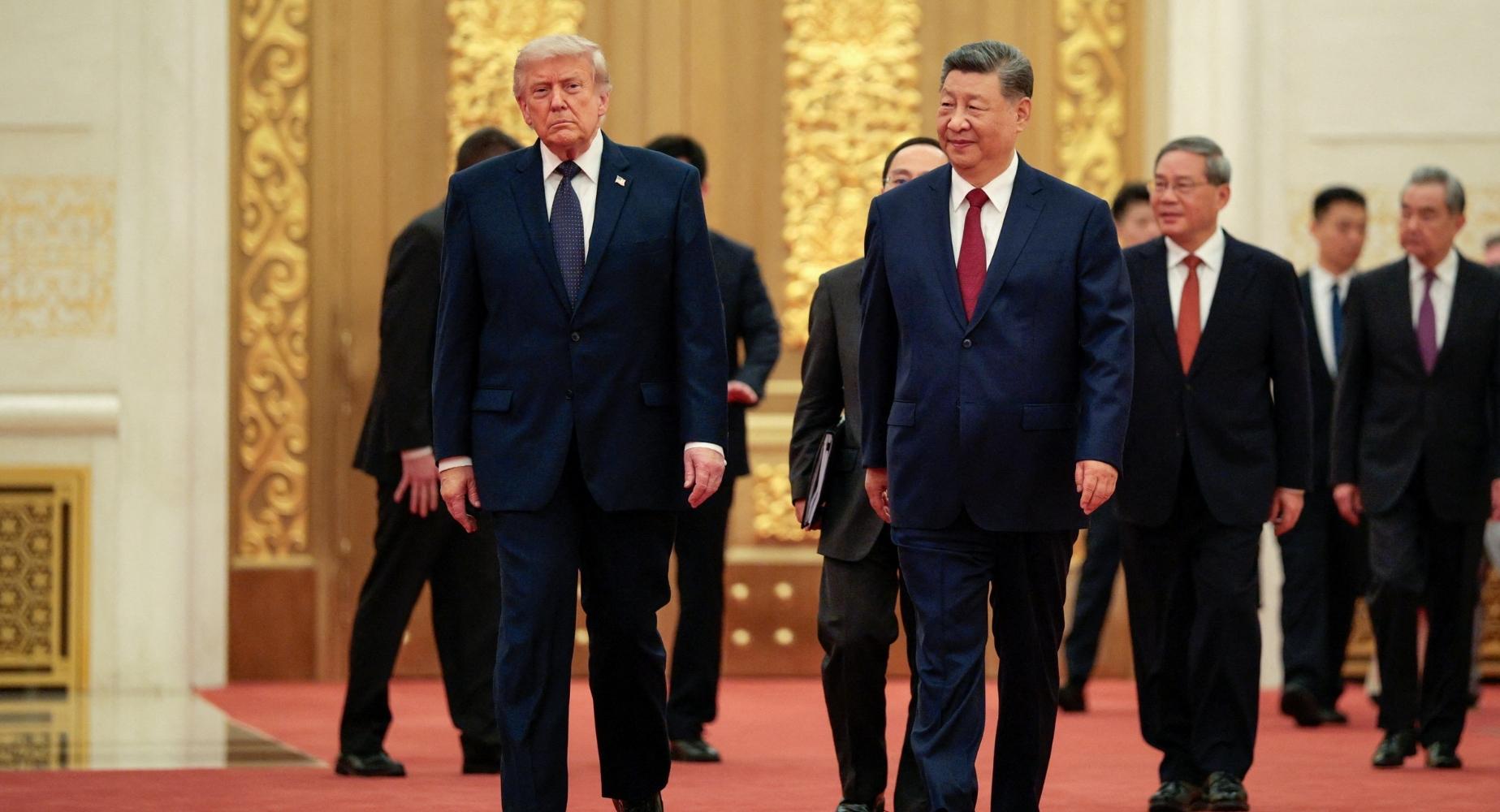
The meeting between Donald Trump and Xi Jinping can signal a broader geopolitical shift linking Taiwan and Iran within a shared framework of strategic bargaining. Rather than a formal deal, both powers could test indirect forms of restraint, leverage, and de-escalation across interconnected regional theaters.
President Donald Trump’s high-stakes meeting with Chinese President Xi Jinping focused on trade, tariffs, and the familiar theater of great-power competition. However, the more consequential story may lie elsewhere. Beneath the surface of the summit, Washington and Beijing are quietly testing a broader strategic accommodation, one that implicitly links Taiwan and Iran, two of the world’s most volatile geopolitical flashpoints.
That does not necessarily imply a formal quid pro quo. Neither side is likely to frame concessions on Taiwan as the price for Chinese pressure on Iran. However, major-power diplomacy rarely operates through explicit exchanges alone. More often, it develops through tacit understandings, calibrated signals, and reciprocal restraint. The central question, therefore, is not whether Trump and Xi will conclude a grand bargain, but whether they can establish a framework in which moderation in one arena creates room for de-escalation in another.
For President Trump, the appeal of such an arrangement is straightforward. His approach to diplomacy has consistently favored transactional outcomes over institutional process. Tangible achievements matter more than procedural continuity, and foreign-policy success is often measured through visible demonstrations of leverage. If Beijing were persuaded to constrain Tehran, whether through stricter sanctions enforcement, reduced economic support, or greater political distance from Iran’s regional activities, Trump could present this domestically as a significant strategic victory.
At the same time, Washington could reduce pressure elsewhere. Taiwan remains the most sensitive issue in U.S.-China relations, and even limited American signaling there carries the risk of escalation. A modest adjustment in rhetoric, a reduction in military symbolism, or a temporary easing of diplomatic friction could be interpreted in Beijing as evidence of greater American caution regarding Chinese core interests. In that sense, Taiwan and Iran become linked not because they are intrinsically connected, but because each functions as a source of leverage within a broader effort to manage strategic competition.
The logic is attractive for both sides. The United States seeks to contain Iran without becoming trapped in another prolonged Middle Eastern crisis, while simultaneously managing China’s rise without confrontation. China, meanwhile, wants stability around Taiwan and continued influence in the Middle East without being drawn into open conflict with Washington. Each power, therefore, possesses assets it seeks to protect and instruments it can employ to shape the other’s behavior.
Nevertheless, the apparent symmetry quickly breaks down. For Beijing, Taiwan is not merely another foreign-policy issue. It is tied directly to sovereignty, regime legitimacy, and President Xi’s historical legacy. Chinese leaders can negotiate over tariffs, technology restrictions, or maritime tensions; they cannot easily appear flexible on Taiwan without incurring substantial domestic and strategic costs.
Iran occupies a different position in Chinese strategic thinking. Beijing values Tehran as part of a broader anti-hegemonic posture and as an important partner in energy, connectivity, and regional balancing. However, Iran is not foundational to Chinese national identity in the way Taiwan is. Consequently, China may be prepared to recalibrate aspects of its relationship with Tehran at the margins, though not in ways that resemble abandoning a strategic partner for short-term accommodation with Washington.
This asymmetry is important because it suggests that any emerging understanding would likely remain indirect, incremental, and carefully managed rather than dramatic or explicit. Washington is unlikely to “trade away” Taiwan, just as Beijing is unlikely to “abandon” Iran. More plausibly, both sides could engage in calibrated de-escalation: softer American signaling on Taiwan, accompanied by greater Chinese cooperation in sanctions enforcement, or more restrained diplomatic positioning toward Tehran. Such adjustments would fall short of a grand bargain, yet they could still reshape the broader strategic environment.
The possibility also aligns with President Trump’s broader diplomatic style. He has consistently favored personalized, leader-driven negotiations that can be framed as demonstrations of strength. That approach can generate tactical flexibility, but it also carries risks of inconsistency and overreach. In dealing with China, those risks become especially pronounced because Beijing approaches diplomacy through long-term strategic calculation, disciplined signaling, and careful management of escalation.
President Xi, by contrast, is unlikely to view the meeting through the lens of immediate spectacle. From Beijing’s perspective, predictability, leverage, and strategic patience matter more than dramatic breakthroughs. If China can avoid a worsening trade confrontation, preserve maneuvering space around Taiwan, and maintain flexibility in the Middle East, that may already constitute a satisfactory outcome. Beijing does not require a historic rapprochement; it requires sufficient stability to prevent strategic encirclement or coercive pressure.
This is why the meeting matters beyond the usual symbolism of summit diplomacy. If Washington and Beijing begin to connect Taiwan and Iran within the same strategic calculus, they may be signaling a return to a more classical form of great-power politics, one in which regional crises are increasingly folded into wider systems of bargaining and competitive restraint. The Middle East and the Indo-Pacific would no longer function as separate theaters but as interconnected arenas within a broader contest over influence, escalation management, and geopolitical leverage.
Such a shift would carry significant implications for Israel and the wider Middle East. If China assumes a more active role in shaping Iranian behavior, even indirectly, that could influence Tehran’s calculations regarding sanctions evasion, nuclear positioning, and proxy activity. At the same time, it could indicate a growing American tendency to interpret Middle Eastern stability through the prism of strategic competition with China. In that scenario, the region would become not merely a localized security arena but also an embedded component of the larger U.S.-China rivalry.
Caution, however, remains essential. There is no public evidence that Trump and Xi have agreed to a formal exchange linking Taiwan and Iran. Still, the strategic logic underpinning such linkage is increasingly difficult to dismiss. The summit may matter less for any explicit agreement than for the implicit message it conveys: that the world’s two most powerful states are once again exploring whether pressure in one region can be balanced through restraint in another.
If that is indeed the emerging trajectory, then the significance of the meeting extends well beyond a single diplomatic encounter. It points toward a geopolitical environment in which Taipei, Beijing, Washington, and Tehran become interconnected components of a wider conversation about power, leverage, and strategic limits. In an era defined by renewed great-power rivalry, that may be the summit’s most consequential implication.