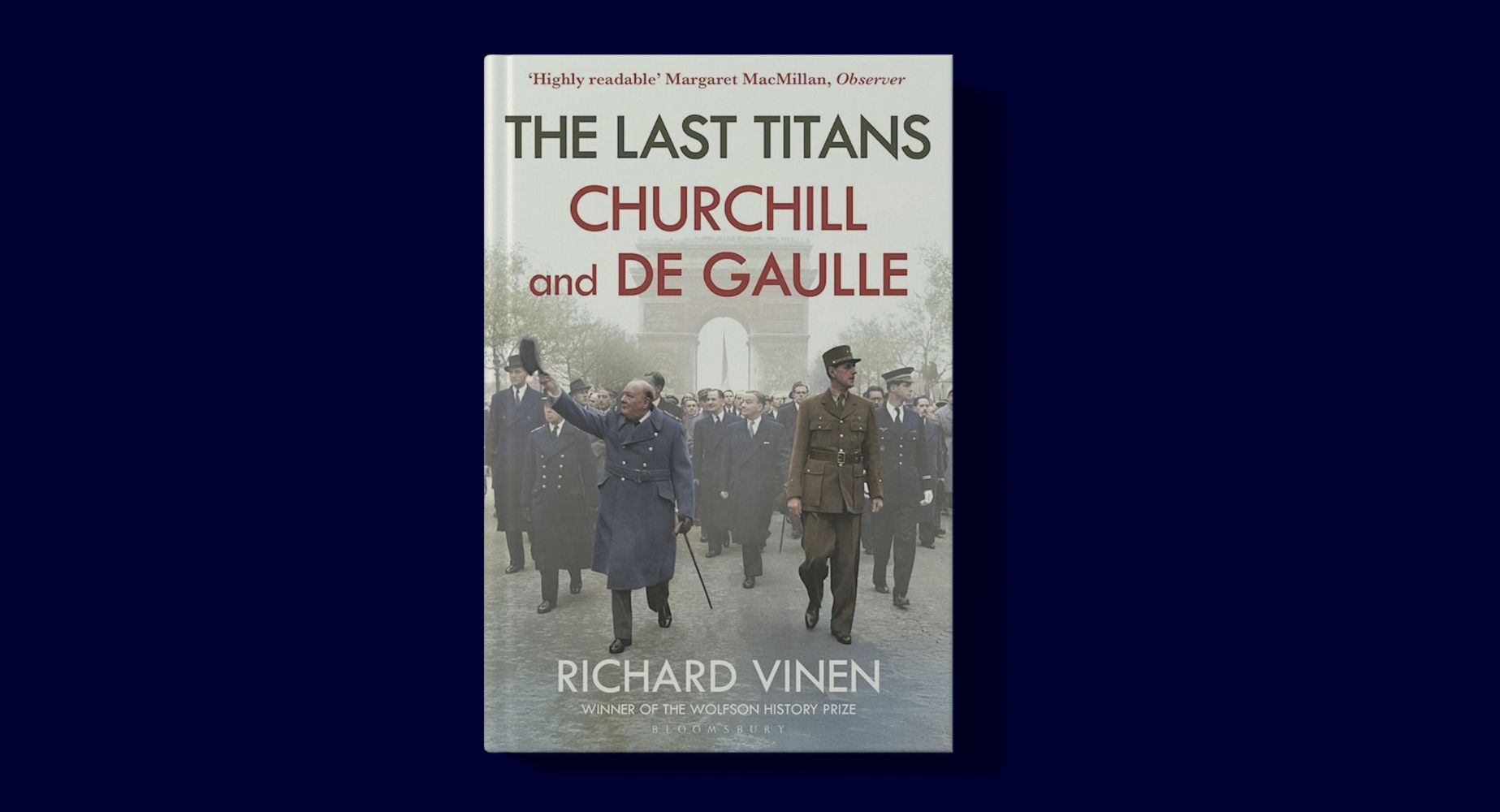
Review of Richard Vinen
The Last Titans: How Churchill and de Gaulle Saved their Nations and Transformed the World
Simon and Schuster, 2026, 388 pp. $30.00
Donald Trump has frequently likened himself to Winston Churchill. In filing class-action lawsuits against major social media companies in 2021, he drew on Churchill to declare, “We’ll fight in the courts, we’ll fight in the legislatures, and we’ll fight at the ballot boxes.” More recently, Trump alluded to Churchill’s British Prime Minister Keir Starmer for his manifest reluctance to participate in the Iran war by contrasting him with Churchill. “This is not Winston Churchill we’re dealing with,” Trump said.
It would be difficult to imagine an American president similarly invoking the name of the former French leader Charles de Gaulle. But in his sterling new dual biography The Last Titans, Richard Vinen suggests that like Churchill, de Gaulle played a pivotal role in creating the modern world. Both men were soldiers, orators, writers and thinkers about military strategy and history who helped rescue their nations during World War II. Vinen is a professor of history at King’s College London. His book is filled with shrewd assessments and elegantly written.
De Gaulle referred to Churchill as “the great artist of a great history,” while Churchill lauded his French counterpart as l’homme du destin. For all their mutual admiration and fascination with the past, they formed something of an odd couple. Unlike the meditative and enigmatic de Gaulle, Churchill was a showman.
As the son of Lord Randolph Churchill–a member of the Tory party whose career had capsized when he impulsively resigned his position as Chancellor of the Exchequer–Winston Spencer Churchill was intent on vindicating the family name. But the impetuous nature that Churchill inherited from his father meant that he did not climb the greasy pole until relatively late in life. Indeed, Churchill was regarded with misgivings by many of his coevals–as an overly flamboyant and mercurial figure who had led Great Britain straight into the disaster of Gallipoli during World War 1. As Chancellor of the Exchequer, moreover, he returned Britain to the gold standard in 1925, plunging it into a prolonged economic slump. The great British historian A.J.P. Taylor observed, “If he had died in 1939 at the age of 65, he would now be regarded as an eccentric character, sometimes a radical, sometimes a Tory, and running over with brilliant ideas that were more often wrong than right.”
Churchill, who was born in 1874 at the zenith of the Victorian era, attended Sandhurst. In 1895, he was commissioned into the Queen’s Own 4th Hussars, a cavalry regiment that served in India. He attracted attention for his journalistic writings from Cuba and South Africa, where he wrote a dramatic account of his escape from a Boer prisoner-of-war camp. This eminent Victorian took it for granted that Great Britain would preside over an empire that served as a force for stability abroad. Churchill saw himself as its foremost exponent. “He knew himself to be exceptional,” Vinen writes, “and took it for granted that he would be the center of attention.”
By contrast, de Gaulle, who was born in 1890 into a family of provincial nobility, circulated in a different milieu—Catholic royalists who viewed the republic with frigid reserve but were dedicated to the French nation itself. De Gaulle’s parents regarded the French Revolution of 1789 with horror, living in what Vinen terms a form of internal exile. They venerated the idea of France, not its current incarnation.
Another difference with Churchill is that de Gaulle, Vinen writes, “made no great claims about himself as an individual.” Instead, his aim was to serve the national ambitions of France. According to Vinen, he was “one of the greatest speakers of the twentieth century, but his most impressive quality was one that almost all twentieth-century politicians (Churchill especially) lacked: the capacity to remain silent.”
During the 1930s, Churchill sounded the tocsin about Nazi Germany’s malign intentions. As early as 1934, he warned that “Germany is rearming. That is the great new fact which rivets the attention of every country in Europe.” In 1936 he implored the British government to assist France in averting Germany’s occupation of the Rhineland, an early step in Hitler’s drive to restore German prestige and power. For Churchill an unshakable British alliance with France to counter Germany was imperative. “Faith in the French army was the cornerstone of his thinking,” Vinen writes, “and the reason why he believed that Britain could get by with a relatively small army.”
Illustrative of Churchill’s proclivity for imaginative geopolitical thinking is that he also began contemplating in 1935 an alliance with Russia to stymie Germany. Churchill had long been a fervent foe of Bolshevism, but he recognized that Nazism was the more immediate peril. The Russian ambassador Ivan Maisky–who makes an appearance in Anthony Powell’s roman-fleuve A Dance to the Music of Time in the form of a monkey, and whose diaries were released in 2016 by Yale University Press–soon became a valued interlocutor of Churchill’s. Maisky persuaded Foreign Secretary Anthony Eden to visit Moscow in March 1935, but the meeting with Stalin proved inconclusive. In September 1938, Maisky visited Churchill who told him, ‘In my cellar I have a bottle of wine from 1793! Not bad, eh? I’m keeping it for a very special, truly exceptional occasion.’
‘Which exactly, may I ask you?’ Churchill grinned cunningly, paused, then suddenly declared: ‘We’ll drink the bottle together when Great Britain and Russia beat Hitler’s Germany!’ I was almost dumbstruck. Churchill’s hatred of Berlin really has gone beyond all limits!” 1793 was, of course, the year that Louis XVI was guillotined. On July 16, 1945 Churchill visited the Führerbunker in Berlin, where Hitler and his consort, Eva Braun, had committed suicide as Russian troops approached. Churchill sat amidst the ruins and contentedly puffed away on his favorite cigar.
De Gaulle, Vinen observes, was never in doubt that France would end up in a military conflict with Germany. He saw the Nazi regime as a natural outgrowth of the Hohenzollern monarchy and the Prussian military caste with its emphasis on Kadavergehorsamkeit, or corpse-like obedience. During the 1930s, de Gaulle pushed for the establishment of a professional as opposed to a conscript army. When it came to strategy, he focused on technological innovation and land warfare, particularly tank engagements. His chief patron was Paul Reynaud, a staunch opponent of Nazi Germany during the interwar years and a member of the Alliance Democratique.
After the German invasion of Poland in September 1939, Britain declared war on Germany. The so-called “phony war” prevailed as Hitler directed his attention to the Eastern front. After the German invasion of Belgium and France in 1940, Churchill and de Gaulle met for the first time. French forces quickly capitulated in what the historian Marc Bloch termed “a strange defeat.” Churchill was stunned. De Gaulle was not. He saw the collapse of the French state as an almost predestined shipwreck.
On May 10, 1940, Churchill became prime minister, replacing the hapless Neville Chamberlain. Appeasement was out. Martial vigor was in. In early June, Churchill proposed a Franco-British Union to try and bolster the spirits of the French. But Marshal Philippe Petain had already become prime minister and set about seeking an armistice with Germany. The result was the rise of Vichy France. Headquartered in the Free Zone in southern France, it existed until 1944 and never signed a formal peace treaty with Germany.
De Gaulle himself fled to Great Britain. On June 18, he delivered a celebrated speech on the BBC, calling upon the Free French to continue battling Nazi Germany: “the flame of French resistance must not and will not go out.” He urged French soldiers and armaments workers to continue the battle from Britain. By July 6,000 French people had joined Gaullist forces in Britain.
De Gaulle never matched Churchill’s importance during World War II. He nourished the thought that the United States might serve as a counterweight to Britain. But Franklin Roosevelt never took him that seriously. Vinen notes that when Churchill visited Washington in May 1943, Roosevelt and Cordell voiced their displeasure with de Gaulle and showed him “documents that seemed to reflect de Gaulle’s hostility or lack of grace towards his English and American allies.” In the end, de Gaulle won a spot for France as one of the four powers that ruled a defeated Germany after 1945.
What are we to make of these two leaders? Churchill’s high-water mark was his fervent defense of the British realm before American entry INTO WORLD WAR II after the Japanese attack on Pearl Harbor. De Gaulle never played as pivotal a role as Churchill during World War II.
But as the scholar Michael Mandelbaum has noted in the New Criterion, de Gaulle eclipsed Churchill during the postwar era. Churchill returned to power in 1951. In ailing health, he was, as the British statesman and writer Roy Jenkins put it, “gloriously unfit for office.” Churchill resigned in 1955, perishing a decade later, Knight of the Garter. The 1956 Suez Crisis, bungled by Churchill’s longtime protege, Anthony Eden, was the final act of the British empire that Churchill had sought to preserve.
In 1958, de Gaulle became the first president of the Fifth Republic. Four years later, he ended the Algerian War of Independence. Both he and Churchill were saviors of their countries.