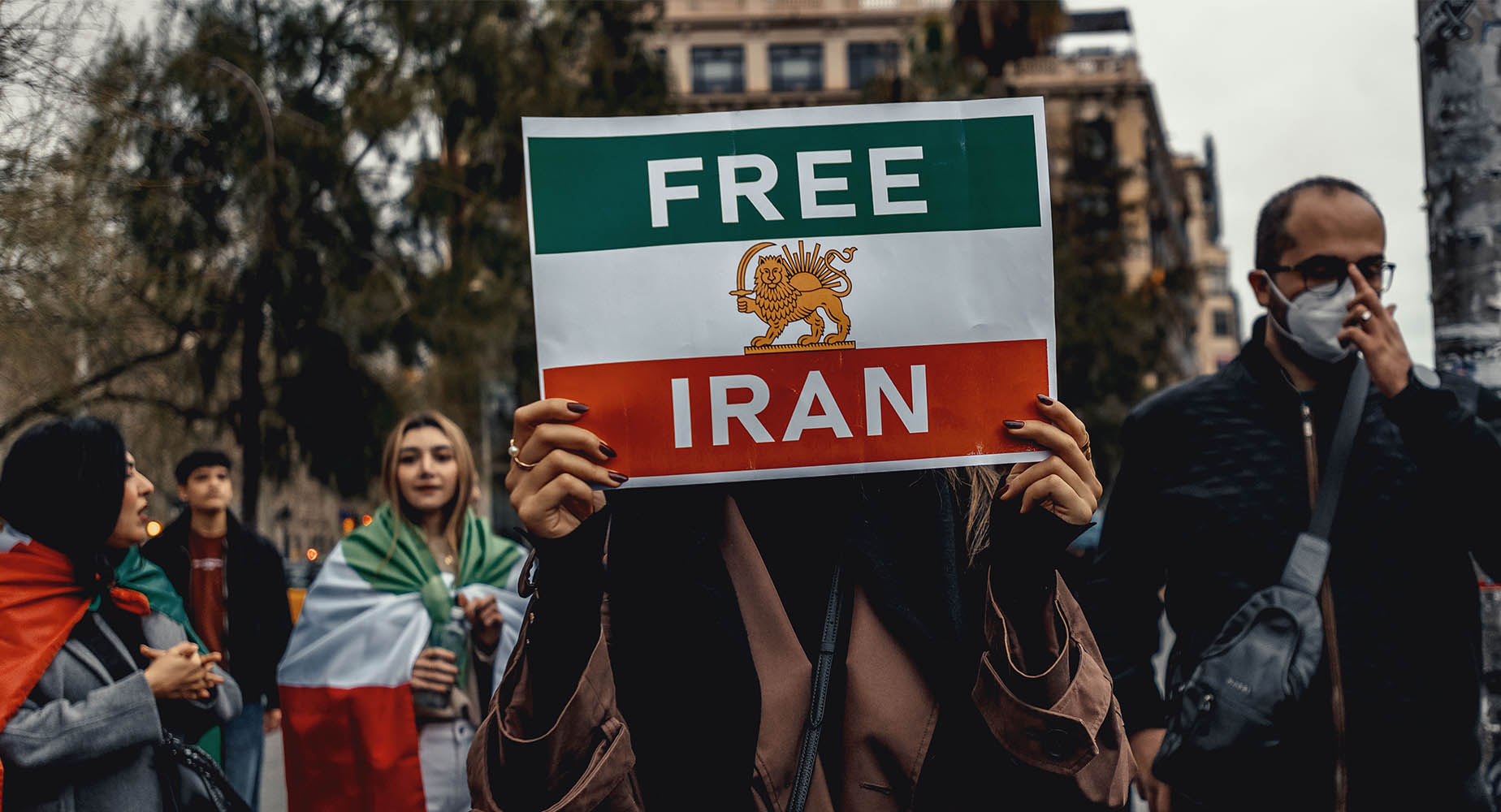
In a recent essay in this journal, “Regime Change in Iran Is a Strategic Imperative,” Gen. Yosi Kuperwasser argued for eliminating and replacing the current government in Iran. He wrote,
The phrase “regime change” is often treated as reckless. It should be understood instead as strategic realism. A Middle East is which Iran is governed by a leadership that prioritizes economic development, normal state relations, and domestic welfare would look fundamentally different from a Middle East shaped by revolutionary guardianship and proxy warfare.
Fair enough. Whatever the Islamic Republic is, Iranians deserve something better: a government that treats them decently and does not jail, beat, or kill those who raise inconvenient questions. Other countries prefer an Iran that doesn’t call for the destruction of other states and seems, at times, to be at war with the world.
President Trump has ordered bombing and called for Iranians to overthrow the brutal Islamic Republic. He seems to be telling unarmed civilians to go out and be slaughtered by a regime that will stop at nothing to stay in power. And yet, for forty-seven years Iran’s anachronistic theocracy– despite its incompetence and the predictions of experts – has survived essentially unchanged. Despite hostility from abroad and profound dissatisfaction at home, it has not altered its fundamental domestic or foreign policies. The same elite men’s club has run the country since 1979 and has survived time, assassinations, isolation, and war. Those club members and their acolytes have stymied all efforts at reform, often from their own relatives and former followers.
Who can make the change which so many will welcome? So far there are few obvious candidates. President Trump found a winning political slogan in “no forever wars” and seemed to have learned the lessons from disasters in Iraq and Afghanistan. Air strikes alone can blow things up but will not destroy a system that has proved so resilient. Most other states in the region will do their best to live with a difficult neighbor rather than provoke an expensive and destructive conflict.
For the US, imposing regime change in foreign countries has rarely ended well. After the 1953 coup that overthrew the Nationalist Mohammad Mosaddegh, the Shah and US could never disengage. The Shah failed to shake the “Made-in-USA” label, and whatever he did – for better or worse – was construed as pliant obedience to foreign masters who had saved his throne. The U.S., having rescued the Shah, was now stuck with him, his autocracy, and his corrupt relatives and sycophants. Twenty-five years later, the bill came due. Subsequent events cost Jimmy Carter his presidency and sent Iran and the U.S. into a destructive and futile cycle of endless hostility that – like the Islamic Republic – has defied all attempts at change.
In 1978-79, the Pahlavi monarchy, despite its foreign support and its apparent stability, turned out to be a hollow shell. It collapsed after a year of fighting a powerful coalition of religious and secular opponents who agreed on one thing: the Shah must go. The Islamic Republic, by contrast, has survived 47 years of its own ineptitude, unpopularity, and international isolation.
The new system Khomeini and his allies established in the 1980s was, for better or worse, Iranian. It was not, like the previous dynasty, established and maintained by foreigners. Although direct clerical rule was new in Iran, absolutism and brutality was not. Nor were Iranians unfamiliar with fanatical rulers who attempted to impose puritanical ways on people who enjoyed dance, music and wine. Despots had ruled Iran for over two millennia, and traditions of tolerance, pluralism, democracy, constitutionalism were weak or non-existent in the prevailing political culture.
In this atmosphere, the Islamic Republic today – although deeply unpopular – has enough supporters – perhaps 15 or 20 percent of the population — to continue killing and beating opponents. The Islamic Republic has given its millions of supporters, marginalized during the Pahlavi years, power, position, and respect. It has allowed them to lord it over those compatriots who for decades ridiculed and despised them as omol (backward). These followers, who staff the Basij and the morals police, know what their fate will be when the system collapses. Those at the top may be able to take their gold bars and run; but millions of others would face reprisals from those they have bullied for decades.
In an Iranian regime change, reconciliation is rarely on the agenda. New dynasties sought to obliterate the monuments and memories of their predecessors. In 1979, in the months after the fall of the monarchy, there were waves of revenge killings, and radio announcements began with “be-naam-e-khodaa-ye-montaqem” (In the name of God the avenger). In 1978-79, few Iranians felt a strong attachment to the monarchy and most switched sides quickly when the winds shifted. Today, however, those millions who have been riding high for almost four decades know that change means a grim fate. They will fight to keep what they have.
Those in power have shown they are willing to slaughter their countrymen to keep power. Those in opposition appear to lack the necessary leadership and unity to lead a successful uprising. Unlike in 1979, today there is no obvious revolutionary leader like Khomeini under whose banner all factions could unite. Reza Pahlavi, son of the last monarch, says positive things about inclusiveness and pluralism. In office, however, he would suffer from the same handicap his father did: he could not avoid the label of being foreign sponsored. In the end, Reza’s father was seen as “unauthentic”, out of touch with ordinary Iranians, and as someone who cared more about pleasing foreign powers than his subjects. The son, well-intended as he might be, would suffer from the same handicap.
Other opposition groups, particularly those in exile, have not shown an ability to form coalitions or to make compromises. They repeat slogans about democracy, but their actions tell a different story. The diaspora opposition spends more time denouncing each other than in serious organizing. As one Iranian friend said, “We believe in democracy up and dictatorship down. When I’m at the bottom, those on top must listen to me. When I’m on top, those below must obey me.” One opposition group, the Mojahedin-e-Khalq Organization (MKO) has more supporters in the U.S. Congress (thanks to generous donations) than in Iran, where people know the groups very suspicious history and know that it offers them a combination of the Khmer Rouge and Jonestown.
Iranians’ most recent experience with regime change – in 1979 – went as planned for a few and very badly for most. The Nobel laureate lawyer Shirin Ebadi, when asked, “What did you lack when you revolted against the Shah in 1979?” answered simply, “Sanity.” Many educated Iranians, who had not read Khomeini’s works, convinced themselves that he was an Iranian Gandhi who would get rid of corrupt rulers, leave running the state to technocrats, and allow them to continue their private lives as before. Such an outcome seemed within reach in the first months after the change, but extremists on the left and right united to prevent such an outcome.
In my view, if Iran’s badly needed regime change is going to bring something better, four things are key:
- Foreign powers must recognize the limits of what they can impose and learn from history of similar operations gone wrong. A “made-in-USA” leader in Iran will command no respect.
- Iranian diaspora groups must stop attacking each other for failing some political virginity test.
- Iranian opposition figures must create a democratic climate in which rivals are listened to and negotiated with, not denounced as “traitors” and “enemies”.
- Those seeking change should have clear goals: an Iran that treats its citizens decently, that acts in the country’s national interest and does not call for revolution or destruction of other countries.