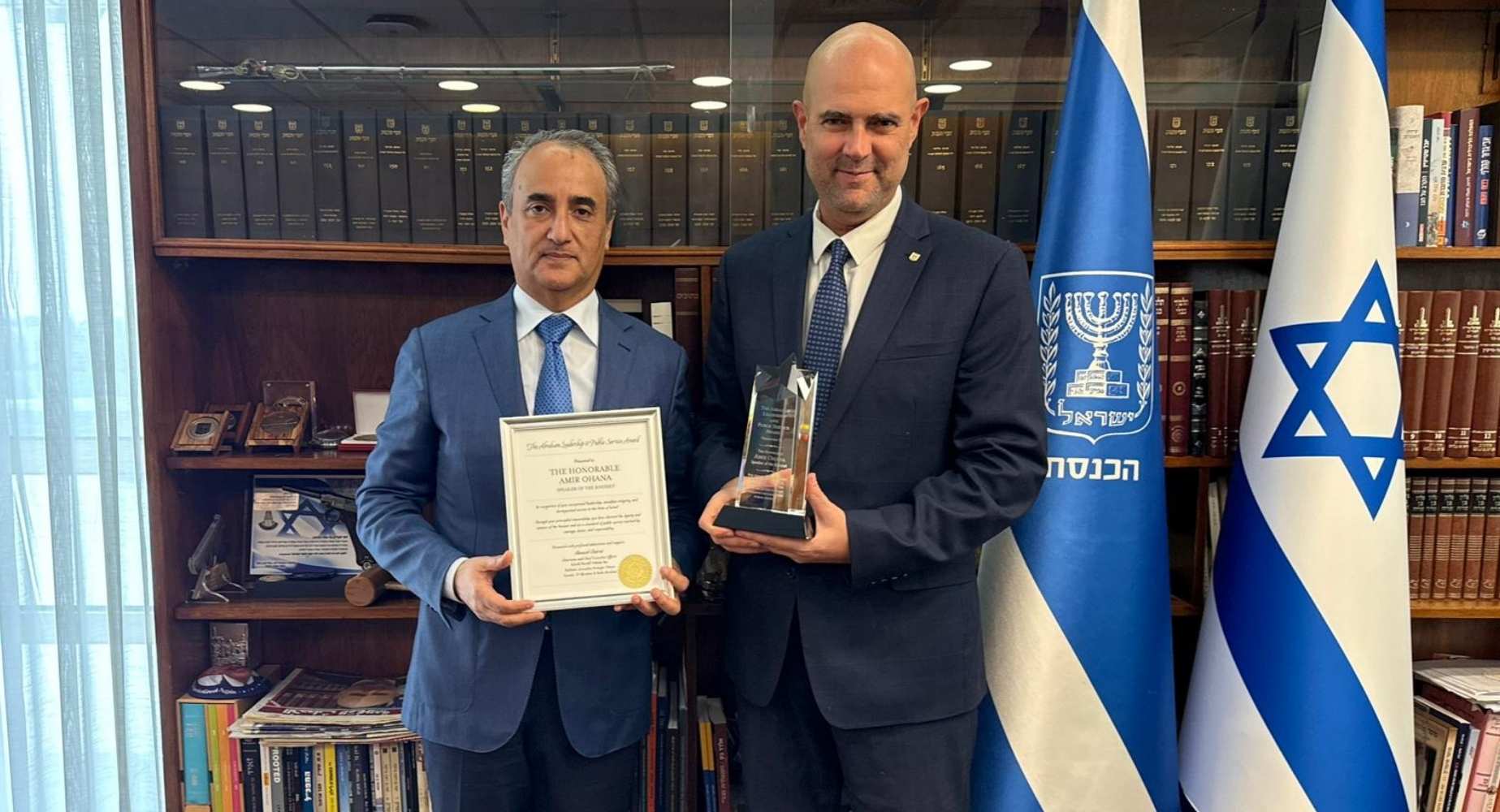
The Abraham Leadership and Public Service Award honors institutional responsibility, personal courage, and the values of dialogue in a difficult moment for the Middle East.
At a time when the Middle East is facing one of its most difficult and uncertain periods, public service carries a special responsibility. Leadership is not only measured by power or political position. It is also measured by dignity, restraint, seriousness, and the ability to serve institutions with honor in moments of national pressure.
It is in this spirit that Knesset Speaker Amir Ohana was honored with the Abraham Leadership and Public Service Award, presented by Ahmed Charai, Chairman and Chief Executive Officer of the U.S.-based World Herald Tribune Inc., and publisher of The Jerusalem Strategic Tribune, TV Abraham, and Radio Abraham.
The award recognizes Speaker Ohana’s contribution to public life, his service as Speaker of the Knesset, and the dignity and integrity he has brought to one of Israel’s most important democratic institutions.
For The Jerusalem Strategic Tribune, this recognition is not a partisan gesture. It is not intended to place Speaker Ohana in a political context or to assign to him a role beyond his constitutional and public responsibilities. Rather, it is an acknowledgment of the importance of institutional leadership at a time when public life across the region is under extraordinary strain.
As Speaker of the Knesset, Amir Ohana occupies a position that requires balance, discipline, and respect for the democratic process. The Knesset is not merely a political chamber. It is one of the central institutions through which Israel’s public life is expressed, debated, and preserved. To serve in such a role during a period of war, trauma, and regional instability requires seriousness and a deep sense of responsibility.
Speaker Ohana’s personal story also gives this recognition a broader meaning. As an Israeli public figure with Moroccan heritage, he represents a living connection between Israel and the wider history of Jewish life in the region. His journey reflects a deeper truth often overlooked in public debate: the Middle East is not only a region of conflict, but also a region of memory, identity, and shared civilizational ties.
That symbolism is especially meaningful in the context of the Abraham vision. The Abraham Accords opened a new chapter in regional thinking — one based on recognition, cooperation, dialogue, and the possibility that different peoples of the region can build practical and respectful relations despite history’s burdens.
Today, that vision is being tested. Extremism, war, and polarization continue to threaten the possibility of coexistence. In such a moment, it is important to recognize public figures who, through their service and example, help preserve dignity, responsibility, and faith in institutions.
The Abraham Leadership and Public Service Award was created to honor individuals whose work reflects courage, public responsibility, and a commitment to a more constructive future. In recognizing Speaker Amir Ohana, the award honors not only a public official, but also the values that strong institutions require: integrity, discipline, and respect for the responsibilities of office.
For Ahmed Charai and the Abraham media platforms, this recognition is part of a broader mission: to support dialogue, moderation, and strategic understanding at a time when the region urgently needs voices of clarity and responsibility.
The future of the Middle East will not be shaped by one institution alone, nor by one moment alone. It will be shaped by the ability of societies to preserve dignity, strengthen responsible leadership, and keep open the possibility of a future beyond hatred and permanent conflict.
By honoring Amir Ohana, the Abraham Leadership and Public Service Award affirms a simple but important message: public service matters, institutions matter, and the spirit of dialogue remains essential to the future of the region.